Insects, a healthy alternative: report
 |
|
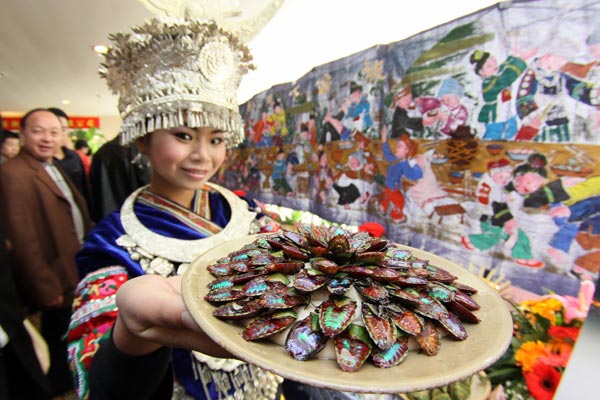
A Miao woman dressed in traditional ethnic costumes, presents ethnic food made of insects at the 10th Chinese Food Festival in Tianjin in 2009. Li Xiang / Xinhua News Agency |
 |
The earliest citing of entomophagy, or the consumption of insects as food, can be found in biblical literature but eating insects was, and still is, taboo in many Western societies, the report states.
The unconventional nature of entomophagy has meant that farming insects for food and feed has largely been absent from the great agricultural innovations in livestock farming that emerged in past centuries - with a few exceptions, such as bees, silkworms and scale insects.
Insects have also gone unnoticed by agricultural research and development agencies worldwide, including the UNFAO. But insect consumption is not a new concept in many parts of the world, the report says.
From ants to beetle larvae - eaten by native tribes in Africa and Australia as part of their diets - to the popular, crispy-fried locusts and beetles enjoyed in Thailand, it is estimated that eating insects is practiced regularly by at least 2 billion people worldwide.
More than 1,900 insect species have been documented in literature as edible, most of them in tropical countries.
The most commonly eaten insect groups are beetles, caterpillars, bees, wasps, ants, grasshoppers, locusts, crickets, cicadas, leaf- and planthoppers, scale insects, termites, dragonflies and flies.
Insects are healthy, nutritious alternatives to mainstream staples such as chicken, pork, beef and even fish, the report said. Insects promoted as food emit considerably fewer greenhouse gases than most livestock. Methane, for instance, is produced by only a few insect groups, such as termites and cockroaches.
Insect rearing is not necessarily a land-based activity and does not require the clearing of land to expand production. Ammonia emissions associated with raising insects are also far lower than those linked to conventional livestock.
Because they are cold-blooded, insects are very efficient at converting feed into protein. They can also be fed on organic waste streams.
Insect harvesting and rearing is a low-tech, low-capital investment option that offers entry even to the poorest sections of society, such as women and those without land.
Since 2003, the FAO has been working on promoting the eating of insects in many countries worldwide.
Gao Xiwu, an entomologist at Chinese Agricultural University who specializes in the economic value of insects, said China, one of the largest insect-consuming countries, is not ready for the mass consumption of insects.
"A clear and comprehensive food safety standard is needed to pave the way for promoting insects as food," he said.
Attempts to include insects in food management began in 1996 when the China Food and Drug Administration and the National Health and Family Planning Commission approved more than 30 health products containing ants. Since then, no progress has been made.
Yang Yao in Beijing contributed to this story.