| The Torch Festival falls on the 24th day of the sixth lunar month. On that day, Yi people from Shilin County gather at the Stone Forest and participate in various activities, such as shopping in the open market fair, bull fighting, dancing and a fireworks display. It is also a good opportunity for young men and women to meet their prospective spouses.
Yunnan Province is home to 25 ethnic minorities, each with its own culture and conventions, and, consequently, there is a plethora of folk festivals throughout the year. These exotic celebrations, together with the rich natural heritage the province's flora and fauna, display a colorful Yunnan to the world. The Torch Festival, celebrated by the fire-worshipping Yi people, is one such joyful occasion.
For centuries Yi people have lived in what is now the Shilin Yi Autonomous County, located 82 kilometers east of Kunming, the capital city of Yunnan Province. Their tribes include 27 kindred branches, including the Sani, Axi, Heiyi, Baiyi, Yiqing and Ayizi. The Sani is the largest, and the Sani folk epic, "Ashima," which is well known throughout China, has been translated into over 20 languages, including English, Russian and Japanese. After the founding of the People's Republic of China in 1949, this epic was adapted into a film that won the top dance prize at the Spanish International Film Festival. Ashima, which means "girl as beautiful as gold," is the heroine of the epic. She epitomizes the finest qualities of the Yi people: diligence, kindness, honesty and a love of life. "Ashima" has become synonymous with the beautiful, gentle Yi girls. The strong, warm-hearted, kind, clever, honest and brave Ahei is the hero of the epic. Young Yi women often refer to their sweethearts as "Brother Ahei."
On the day of the Torch Festival, men and women in pairs form rows facing one another on a patch of grass. The men play three-stringed instruments as the women kick and clap to the tempo. Snack vendors take full advantage of the occasion, pitching booths under shady trees where people can rest and take refreshments before carrying on with the day's activities.
This assembly is a good chance for young men and women to find their "Ashima" or "Brother Ahei," paying particular attention to their costumes. Young women wear a stiff, triangular piece of fabric on either side of their headdress to attract the attention of young men, but no young man should ever touch this ornament, or he will be forced to labor for three years at the girl's home. On their wedding day, young women remove the two triangles and lay them flat on top of their heads to symbolize marital peace and happiness.
When a young man chooses a certain young woman, he snatches away her embroidered belt when she is not looking. This practice can be traced back to the ancient Yi marriage custom, where the bridegroom pretends to kidnap his bride. If the young woman returns his love she will allow him to court her. If not, she will put on another belt allowing the man to keep the one he had "stolen."
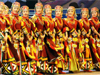
In the afternoon a costume contest begins. A team from each of the 27 Yi kindred tribes displays their beautiful costumes on stage. There is a huge diversity of men's and women's clothes among them -- the headdresses alone encompass many varieties, such as circular, cylindrical or cone-shaped curves adorned with flowers or with hanging embroidered balls, colorful ribbons, and fringes. Seated on the surrounding slopes are the audience, watching and cheering on their teams.
As night falls, the crowd gets bigger, and the climax of the Torch Festival draws near. When it is completely dark, the activities on the open ground subside and a five-meter-tall platform venerating the shrine of the God of Fire is erected to the north.
Suddenly, the ground becomes illuminated by light from its four corners, and the fire-worship ritual begins. Hundreds of women clad in blue shirts and trousers and black aprons enter the grounds in a square formation. They hold a fan-shaped black-and-white wooden drum in their left hands and a drumstick in their right. They then move towards the center of the ground, beating their drums and leaping, squatting and shouting to represent the hard life and daily struggles their ancestors had to endure before they learned to use fire.
The drum beat then stops and the women kneel to face the east from where an army of men clad in black turbans and cloaks emerges. In the front are four men carrying a thick bamboo pole on which stands a necromancer wearing a black gown, swaying and shaking his long, loose hair. On either side are three men, each holding a large red mask with a yellow beard and exposed teeth -- images of the God of Fire.
The necromancer advances to the front of the shrine and makes obeisance and prays for the Yi to be blessed with a bountiful harvest in the coming year. He then raises his arm and a ball of fire bursts from the top of the shrine, turning it into a torch. As the crowd cheers, the young men shed their cloaks, and, bare-chested, converge on the site where they cavort wildly, accompanied by women who sing and beat their drums.
Gradually, the women disappear, and, having discarded their drums, reappear holding torches, which are simultaneously lit to illuminate the dark ground. As the crowd bursts into thunderous cheers, fireworks shoot into the sky from all around, and the torches and their bearers form lines that move rapidly across the ground like flying dragons.
As the performance draws to a close, bonfires all around the ground are lit and spectators on the surrounding slopes form circles and dance around the bonfires. At this point, all those present on the sacred site -- young or old, man or woman, local or visitor -- become completely immersed in the happiness and joy of the festive atmosphere. |