| The Blangs mostly reside in Xishuangbanna in the west of Yunnan Province. They have their own language, but have no letters. Some of them excel in Chinese, Dai language and Va language. They are mainly engaged in agriculture, and famous for cultivating early season rice. They are also skilled in tea planting.
Close-Door and Open-Door Festivals
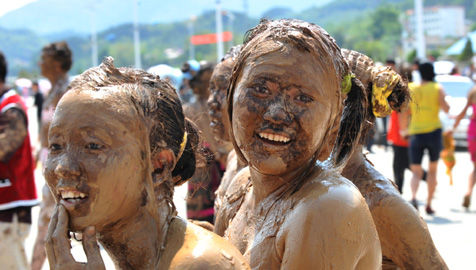
The Blangs celebrate the Hao-Wahsa (Close-Door Festival) and Weng-Wasa (Open-Door Festival) every year, as Dais do. The Hao-Wahsa falls on September 15 of Dai calendar (the mid-July of the Gregorian calendar); the Weng-Wasa is celebrated on December 15 (the mid-October of the Gregorian calendar). The activities on the whole are just as similar as those of the Dais. What is different is that all members of the family should pay a visit to Shaikh and worship on bended knees and confess in the Shaikh's home. One of the clan members has to send a flower and a pair of wax bar to fete the ancestor. Besides, he should bend on the knees to preside over the activity of washing hands and feet for the Shaikh. The Shaikh, seated on the bamboo stool, blesses all members of the clan: May I pray the Gods to bring luck to you all and bless you all. You will certainly have many children and longevity. You will have a bumper harvest, ample food and clothing this year and live in happiness.
New Year
The New Year of the Blangs is the most important festival for the Blangs, and falls between June and July of the Dai calendar.
On this day, every family eats cakes made on sticky rice and brown sugar, which have to be packed into two portions with a pair of wax bars and two flowers plugged in each. They pack one in the ancestor spirit tablet, and send another to the Shaikh. The housemaster of each family has to take off his headcloth and kowtows to the Shaikh, who represents the patriarch of clan. They use water to perform the ablution rite for the Shaikh from head to feet, blessing him with longevity, luck and safety.
In return, the Shaikh blesses everybody, Children from whole family, we come together to pray for good fortune.This is the ancient rite passed down from our ancestors, which we should not forget. Years passed by one after another, and all the children come to say goodbye to the past year and expect the coming one, then you will be lucky.May I wish all of you to have a bumper harvest, and the prosperity for both human and livestock! After blessing, the Shaikh prays for the God of the clan. Facing the direction of sunset, households will hold the Water Dropping Ritual.
The holiday usually lasts three days. On the first day, people have to clean the house and the village, just like the eve of the Spring Festival of Hans; on the second day, they will slaughter pigs and cattle, and prepare sticky rice food for the festival; on the third day comes the very festival, whenpeople will hold activities to celebrate the comingyear.
Singing with Lanterns
It is also referred as to Playing Lanterns. As one of the folk festivals, it prevails in the area of Blangs, in Shidian County of Yunnan Province. From lunar January 2 to 15, the amateur teams of singing with lanterns will be invited to perform.
Prior to the festival, the team members will be grouped. A memorial ceremony will first be held in front of a local god's altar to pray for a successful performance as well as a good fortune. Afterwards, people start to make lanterns: two in square shape, two in round, and one Girl Lantern (Flower Lantern). Besides, a Flower Sedan Chair should be made, which is similar to land boat. The Player could drive it to perform. Once the preparation completed, a messenger will be dispatched to the housemaster who is qualified for the issuance of an invitation. If the master accepts the invitation, it means he welcomes it and the timetable can be set for the reception. The Singing with Lanterns Team has to have rehearsal in advance to avoid mistakes due to defect cooperation. The oil lamp in front of the altar will be kept burning during the performance.
When all things are ready, the performance team is lined up with four square lanterns ahead, and following them are the Girl Lantern, round Lanterns, Flower Sedan and Marshal Art Team. The team is followed by a group of fans and onlookers. Once the team steps into the door of the housemaster, five lanterns will be held high in front of the hall. The person who is responsible for the Lantern team will start singing the New Year's greetings, blessing him with a happy life, good fortune, safety and luck. After that the performance commences. A group of dancers sing and dance to pray for luck and prosperity around the Flower Sedan, then the Marshal Art and sideshows in succession.
Marshal art shows the passion of the Blangs. They are open and bold. The dance and the marshal art are integrated into a show, which represents the combination of power and tenderness, and the agility in rhythm. The Sword Dance is performed with glint and flash and the Stick Dance in whistling. The spectators' cheering upsurges the ambiance. These all fill the household with warm atmosphere and pleasure. When the Singing Lantern performance is finished, the housemasterappliesrice, wine and money as thanks and rewards. The team pleases every family including the neighborhood until the lunar January 15.
Fresh Rice Festival
It takes place in the fall of each year, right on the eve of the harvest. At that time, people will choose a snake-symbolic day to taste fresh rice (The Blangs believe that a snake eats no millet and has a small appetite. Hence, the consumption will be lessened and foodstuff will last longer). While tasting rice, the Ah-Zhang (a religious practicer) leads all villagers to the paddy field. Facing eastward, they will cut down a small bundle of paddy, which will be pounded into grain, then braised into rice.Addedwith a package of meat or vegetable, theytake themto the Buddhist temple as the offering for the Buddha that returns. Afterwards, they offer fresh rice to the village and family deities. After that comes the eldership of the family. Finally all family members enjoy together. When the Fresh Rice Festival is over, the whole village formally begins the harvest.
Many traditional festivals of Blangs have something to do with the religious activities, andamong them the most special arethe Year Festival, sacrificial ceremony for Village Deity and Cattle Hooves Cleaning, etc.
1.Year Festival
In around 10 days after theQingming(Tomb-Sweeping Day, the 5thof the 24 solar terms), every family is going to slaughter pig and the whole village butchers cattle. The women prepare Baba (stick rice). On the very day of the Year Festival, the juniors have to pay a New Year call and get ready two portions of Baba packed in banana leaves for the ancestor's offering. Each portion is set with a pair of wax bars and two flowers. One is offered to the ancestors, and the other to the Shaikh; some of the Blangs will go under the Linden in front of the temple; they pile up sand, plant flowers, andcontributeBuddha rice flower, glutinous rice cakes and bananas, etc.
2. Worship the Village Deity
The worship is held in every village respectively. During the sacrifice, first a chicken is to be killed. Then people go around the village and arrange the water dropping ritual. After the ceremony, they start enjoying the feast. Finally, all young people of the village go to grub bamboo rats. They use rat's flesh for godliness and praying for good harvest.
3. Shan Kang Festival
The young males and femalescontributefood to the gaffers to express thanks for their fosterage. Besides Baba and bananas, they offer foods including carefully extracted and processed spring tea. During the festival, every household has to prepare some delicious dishes. They get together for a family reunion dinner. It is a rich feastthatsometimes more than 30 various dainties andgamessuch as bean starch noodle, bean curt are served on the table.
4. Cattle Hooves Washing
In every May, the Blang ethnic minority in Shidian County will celebrate the Cattle Hooves Washing Festival. When it comes, the elders and the Shaikh will wear bamboo hats and coir raincoat,holdbesoms made of osiers and peach twigs,leadsheep and hang up narrow flags of red paper above every door to show their benediction. The blessed housemaster should splash water on them, meaning to clean up the cattle hooves traces. Finally they lead the sheep outside the village, slay them and cook for a dinner party together.
5. Broken Hooves
It is one of the folk customs of Blangs, and prevails in the villages of Blang minority in Shidian County of Yunnan Province.
Besides Buddhism, the primitive religions and natural worship also have strong influence on the Blangs. They consider the horse as the auspicious object and forbid neither slaughter nor eating of horses. Their carcases have to be buried even if the livestock is dead of an accident instead of a disease. As the horse hooves resemble shoe-shaped gold or silver ingots, which prefigure the enrichment; on the contrary, the cattle hooves have openings and they are considered as defect hooves predicting the financial loss. No matter the houses are in earth and wood structure or bamboo-framed structure with balustrades, the Blangs consider the hall door as the Gateway to Wealth. During the Spring Festival, when the Dragon Day or Tiger Day comes, a piece of red cloth has to be hung up outside the Gateway to Wealth. In addition, a cock will be slain to worship the God of Wealth. On the early morning, two kids are sent to open the door, referring as to Open the Door of Wealth. If the cattle hooves prints are found on the hall floor, it will be counted as an omen of fortune loss. People have to renew the ceremony of the worship, and lead the horse into the hall to replace Broken Hooves with good ones. It is only after this remedy that the door can be opened.
6.Dan-Shila Festival
It is one of the folk worship festivals, which is popular in the Blangs villages in Xishuangbanna Dai Autonomous Prefecture of Yunan Province. It is held in two days in July of each Chinese lunar year. The Dan is a phonic translation of the Dai language, which means oblation and donation. The word Shila, another transliteration of Blangs language, means a large bamboo basket and wicker basket.
People stop working during the festival tocomfortthe souls of decedents. Buddhists or monks are invited into houses on the day prior to the festival. According to the seniority in the family, they write down in the Dai language the names of dead relatives on banana leaves, which are used to pack four portions of cooked pork, then send respectively to tomb, upper part of the village, center of the village and the temple. On the morrow, each family sends clothing, money and food that are prepared in advance to the temple. These are intended to be sent to their dead relatives via Buddha. If the dispatchers stay in the temple that night, they will meet their relatives in their dreams.
Gang Yong Festival
During the days of the planting season in April and harvest in September, Blangs in the Xishuang Banna Autonomous Prefecture will celebrate the Gang Yong Festival to worship the bamboo rats. In the past, every time the festival took place, men and women, all villagers would put on new dress, carry bamboo baskets and take the rattraps. They all went to the bamboo forest to catch bamboo rats.
Once having caught the bamboo rats, people tie them on the stick and put the flower on them. Two people carry them to go around the village. A person who shakes the broken bamboo pole he takes, and recites the blessing and greeting words while closely following the rat lifters. Finally, they carry the rats to the house of the village head, and cut off the rat head for him. The left parts will be chopped up and allotted one portion to each family. Later on people will take their part to the pond bank for the dropping ritual. This means a gift for the maintos.
After the worship, they brush off the rat flesh, considering that by such a ritual the bamboo rat will bring paddy and table salt symbolizing ample food and clothing in coming year. If a female rat is captured, that will be the luckiest for there will be a bumper crop in the village.
Why do the Blangs regard bamboo rats as their totem?It isa touching myth in the folklore:in ancient times, there was no corn seed,but only a lady named Ya Kusuo had it. The corn seed was large and pumpkin-like. One day, Ya Kusuo feltsickand forgot covering the garner. The corn seed rolled from the corner into the garner.
Because of its large size, the corn seed crowded the garner, and the lid could not cover it quite well. Ya Kusuo got angry and hit it with a crabstick. The corn seed was crushed into grains and hid where no residents lived. People lost both corn and food. They had a hard time. Ya Kusuo was anxious. Fortunately, many bamboo rats got into the grotto and picked up the scattered corn seeds. They carried them to the fields where the seeds budded.
Hence, peoplebegan to knowhow to plant the corn. To show their thanks, the Blangs never beat bamboo rats even if they see them eating the corn, and nor do they eat them. Besides,the worship has been formed for them gradually.Whenever people celebrate the Gang Yong Festival, all villagers put on new dress and go to catch rats in bamboo forest.
According to the experience gained from rats capture and hunting,once it is proved that the bamboo rats hide in a grot, the Blangs would stretcha reed staff into the grot to trap them.Once they find rat hairs on the reed staff, or the hunters bark because of smelling the rat's odor, people will deepen the grot with hoe and hollow to drive out the rats.They set firewood on the spot, burn of rat hairs,chop the rat flesh into several pieces and bake them on the fire. After the flesh is well cooked, they share it with each other and enjoy the interesting Gang Yong Festival. The day after the festival, Blangs will start to plant and harvest delightedly. |