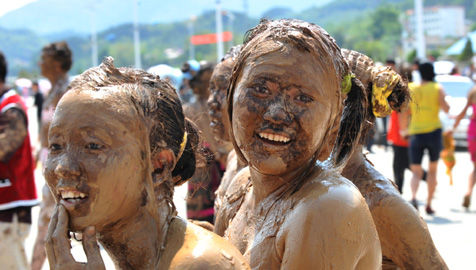
| The Jinos reside in the Xishuangbanna Dai Autonomous Prefecture and its neighboring areas in Yunnan Province. They have their own language, but do not have letters. They believe that everything in the world has a spirit; they worship the ancestors and honor the sage Zhuge Liang. They have a long history of tea planting, for which the most popular is Zener Tea.
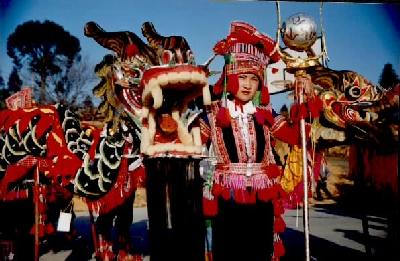
The Jinos used to believe in the primitive religion that deems that everything in the world has a spirit, but the worship to the ancestor still had the dominant status. The most important festival is the New Year. Though each village would determine the actual time of the celebration, it is mostly held in December of the lunar calendar year. On the occasion of the New Year or the worship, every family will slaughter livestock and prepare the festal feast. The most spectacular entertainment during the festival is the bull slaughter. On the occasion, some lads cut the bull legs with swords. Then, they cut down a part of the huckle of beef to worship the ancestor. The rest of beef will be distributed among the villagers. At the meantime, people will make a sort of cold dish made of muscle beef, skin, blood, gall bladder, garlic, pepper, sour bamboo shoot, areca, leaves and wine, which are offered as gifts combined with three chickens and flying squirrels to present to the village chief in the neighborhood with eulogy.
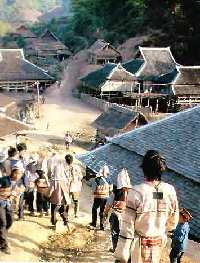
After the bull slaughter ceremony, the host of every family has to visit the head of the kin for the ancestor worship. The head will entertain the guests, who get seated according to the table prescription.
Temaoqie
Also called Forging Iron Festival, it is one of the Jino folk festivals. It falls in December or January of the lunar calendar. The word Temaoqie is from the Jino language, which means to celebrate the New Year, or to forge iron. The festival usually lasts three days. Legend has it that a woman had been pregnant for 9 years and 9 months; the baby was born by breaking his mother's ribs in the posture of holding the pincers and hammer and pretending to forge iron. Therefore, he was esteemed as the ancestor of the forgers and his birthday was taken as the Forging Iron Festival. Finally, it became the local custom.
Before the festival, every family will prepare wine, slay pigs and prepare food. Zhuoba (village father), the senior of the village and Zhuosheng (village mother) beat cow-skin drum, and call on all villagers to gather in the chief's family, and each of them will bring half a kilogram of good-quality rice. The elder will entertain the visitors. On the day, the great ceremony of the bull slaughter is to be held. The cow legs are the first part to be cut down. As the cow falls down and is not yet dead, people cut its huckle for the offering and the rest will be distributed to each family.
After the worship, every family will send a man to the mountain to catch a pair of squirrels with yellow mouths to offer to the senior of the village. A pair of bamboo squirrels is given to the forger of the village as a gift. On the next day, the host of every family gathers in the village chief's family to hold the ceremony of dead stock and toast the forger with bamboo squirrel soup. On the 3rdday, the village chief leads all villagers to restore the route signs and carry out the ceremony of the spring plowing. During the festival, there are also many entertainments: women play swing and feather ball: boys pelt javelin, play football and walk on stilts; young men and girls sing around the need fires, dance while playing the reed-pipe wind instrument, jump over the bamboo poles and play bamboo tube music, etc. The most ceremonious is the drum beating.
The big wooden drum is the divine object worshipped by the Jinos. It is kept in the Zhuoba's be home, and allowed to beaten only on the New Year. Legend has it that in the remote past there was only one pair of virtuous brother and sister who survived the flood. They were guided by the immortal and survived the disaster by hiding themselves in the drum. They finally became the ancestors of the Jinos. While beating the wooden drum, men hold the drum and women beat it. All villagers dance around the drum. This reflects the life profile of the primitive human being.
Haoxizao
It is the traditional festival of the Jinos. The word Haoxizao is from the Jino language, and means to have fresh rice or to taste fresh rice. The festival occurs on the Tiger Day when the crops are just ripe. Prior to the festival, the host of every family gathers in the family of the Zhuoba and Zhuosheng or in a public house to discuss the celebration of the New Year and the worship. At the beginning of the festival, the village chief will first worship the vale soul and taste fresh rice. On the next day, it is the turn for every family to start the celebration. The first step of the Vale Soul worship is termed to call on the Vale Soul. Someone will carry on his back a basket containing several chooks and walk in the field. He collects some flowers and inserts them onto the hencoop, then takes out a box made of thin bamboo strip covering silver bracelet and coin. He sings while shaking it and it is not allowed for him to turn his head. When he reaches a crossing, he will place down a bundle of paddy with fresh flowers. Afterward, he goes back home and slays hen and pig, hangs the heads over the garner door to fete the Vale Soul.
After the worship, two persons will be sent to get some ripe and plump paddy from their rice field to make fresh rice. The fresh rice will be cooked in the room of the host. All family members surround the stove to see which direction the steam will emit from. This is a primitive augury. If the steam goes to the east, it foresees many children; to the south, a harvest in the coming year; to the west, a successful hunting; and to the north, it indicates that the children are not in good health, unlucky for people and livestock, and family members should watch out in the future.
When the fresh rice is ready, a cooked chicken and a bowl of rice will be served to fete the Vale Soul, the soul of the deceased ancestors and forger ghost. The major worshipper chants the verse to pray for a bumper harvest, longevity of family members as well as prosperity of livestock. While tasting fresh food, people have to, by courtesy, invite the village elder. The relatives will also be invited for fresh tasting. The one that is not able to be present has to send a package of fresh rice and a piece of chicken on the next day. Now, the worship gradually turns to the celebration of the bumper harvest.
Dragon Worship Festival
It is the worship festival of the Jinos, which is divided into the Grand Dragon Worship and the Small Dragon Worship. The Grand Dragon is worshipped in the July of each lunar calendar year; and the Small Dragon Worship is held 13 days later following the former one. The rituals are presided over by the Zhuoba and Zhusheng, the village chiefs. In case of the Grand Dragon Worship, the cow slaughtering is necessary. In addition, the farming work ceases for three days. All villagers are not allowed to leave the village. The village chief will bring a chook, a bottle of wine, and some rice as he goes to Moyang Village to worship the precious sword. Legend has it that there was a sword, which can control the changes of weather. During the drought, to worship it will bring rain; by flood, it will bring a fine day.
While worshipping the sword, people will insert three pieces of grass on the chook's head, then bake it on the fire and check the vein on the chook's legs to verify the good or bad luck. In fact, it is a kind of the chook divination or bone divination. The worship to the Small Dragon lasts 6 days. People do not work in the field, but men have to go hunting in mountains. Women do housework at home. The aim of the Small Dragon Worship is to pray for good weather and a bumper harvest for the year. |