| The Huis are mostly distributed in the Ningxia Hui Autonomous Region. The earliest Huis came from the descendants of the Arabian and Persian merchants who came to China in the 7thcentury. The Huis take Chinese as their language while preserving some Arabian and Persian words.
Shengji Festival
The Shengji Festival is also called the Maolude Festival. It is considered as one of the three Islamic festivals. It is said that the birthday and death of Mahomet coincided on March 12 of the Islamic calendar. The Muslims found the Islam to memorize the Islamic saints (founders). They hold convocation on the date of his birthday and his death. Since then, it has evolved to an Islamic festival.
The programs of the festival are presided over by the emcee of the mosque. On the occasion, the Muslims will dress up and take a bath in the mosque. They change clothes, worship and listen to the imam chanting scripture and telling the history of Mahomet and his deed of establishing the Islam. Afterward, they take a rest and enjoy recreation for a whole day.
Kaizhai Festival
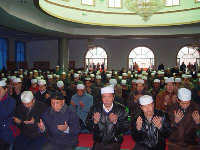
The Kaizhai Festival (the end of Ramadan) is one of the three large festivals of the Islam. It is also the great festival of the Huis. In China, some ethnic minorities also name it Rouzi Festival. In line of the Islamic rules, the Hui calendar is divided into 12 months, 30 days per odd month, 29 days per even month. There are the shortage of 11 days in comparison with the solar calendar and about one month less per three years. Hence, counted according to the solar calendar, no fixed time is set for the Islamic festivals. However, the Ramadan is preserved in each September. During the Ramadan, the Muslims are only allowed to take food at the sunrise and sunset except the elders, patients, handicapped and children. The women in menses may not observe the Ramadan ceremony.
During the Ramadan, the Muslims have to abstain from sex and food. The wine and dine are strictly prohibited in public. The beginning and the end of the Ramadan depend on the crescent. The Ramadan counts 29 days, sometimes 30 days. After one month of Ramadan, the mission prescribed by the Allah is considered to fulfill, which announces the resume of the Ramadan on the early October of the Islamic calendar, where the Kaizhai Festival comes from.
According to the record of the relevant sutra of the Islam, it is said that on the early stage of the Islam foundation and at the end of the Ramadan, Mahomet, the founder of the Islam, led his adherents to have picnic on the outskirts for worship. After taking bath, he got dressed in clean clothes and distributed Feituer (money). Since then, the Muslims consider this date as a festival and hold the great celebration.
Nowadays, the Muslims from all countries worldwide keep the divine service and other celebration activities. Chinese ethnic minorities that believe in the Islam also have to take bath and gather in the mosque on the Kaizhai Festival. Then, they arrange the festal entertainments.
People put on their folk costumes, pay visits to each other, and exchange gifts. Every family prepares almond, dried apricot, fried fruits, tea, melons and fruits. Some families offer milk tea, five aromatic teas (made of tea, gouzha, almond, dried apricot) to the guests and relatives. People, old and young, men and women, entertain themselves in groups. Many young men and girls gather together, singing and dancing.
Rouzi Festival
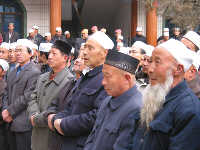
The Rouzi Festival is the great festival of the Huis who believe in the Islam. The word Rouzi means the Ramadan, which corresponds to the decrease of food. According to the legend in the past, people hid themselves in the mountain to evade the invasion of different races. They hid in remote mountains and did not set fire on the daytime. They only cooked when the moon rose. Generation after generation, it becomes a custom. Once on the day of the Rouzi Festival, they drink no water and take no food until late at night. They do so for one month, then resume the diet as usual.
In a month prior to the Ramadan, people have to tidy up the room and the courtyard. They have haircut and take bath. Not only do they have to make preparations for the festival, but also they should make the festal costumes. There are also many festival goods in the shops.
On the morning of the festival (May 23), there are many people on the streets. Men and women go to the mosque and sweep tombs for their deceased relatives. They chant the scripture, and then pay New Year call on each other. After the liberation, along with their improvement in consciousness and the development of the production, people considered that abstaining from food on the daytime goes against the production and labor as well as the health, so they gave up the custom of fasting.
Livestock Slaughtering Festival
On the 70thday after the Kaizhai Festival (resume of the diet), there is also a traditional festival of the Huis. It is also known as Guerbang Festival, Sacrifice Festival and Faith Festival.
The ancestors of the Huis embraced the Allah. Every year, they slain a certain number of livestock (cows and sheep) and distributed to the people around for the purpose of expressing their belief in Allah. However, the fact was that the poor had no livestock for the sacrifice, and the herd masters possessed many livestock. It is said that once there was a devoted adherent. He was very poor, and no sheep and cows were available for the sacrifice. He was very old but had no children. Once, the herd master sneered at him in public. On the very night, he took bath and made a vow to Allah: "My graceful Allah! I am your devotional adherent and missionary, but I am poor, and have no cows and sheep available for sacrifice. People look down upon me and laugh at me. If you bless me for having a child, I would kill him and share him with others, which would prove my sincerity." Soon after his vow, his wife got pregnant and later gave birth to a healthy sun. As he was the first baby the poor had, Bulaxin was very happy. A long time passed, he forgot his vow to the Allah. His son grew up, and was very handsome and clever. Ibulaxin regarded his sun as his treasure. One night, he dreamed that someone told him: "You made a vow to Allah that you would kill your son, but now your son is 12 years old, why not do it?" Ibulaxin woke up and could hardly fall asleep. When he finally slept again, he had the same dream and had it three times running. Now he could not sleep again and wondered what to do. Finally he determined to kill his son to show his sincerity for Allah.
On the morrow, which happened to be December 12, the adherent awoke his son, asked him to put on new clothes and went with him to Aifukani Mountain and enjoined his son to keep this from his mother. Both went into the mountain. He referred to his son the vow he made before Allah. Aware of the story, the son kowtowed to his father and said, "Dad, I will follow your wish. Now please tie my hands up and protect your clothes from getting tainted with blood. Otherwise, my mother would be upset when she sees my blood."
With tears on face, Ibulaxin tied his son's hands up and chopped towards his neck with a sword. But the blade was turned down when the sword touched his neck. Ibulaxin had no alternative but to throw the sword on a big stone, which was hacked apart.
At this moment, the son, in tears, said to his father: "Why not kill me? Are you upset or you worry that I won't obey? If that is the case, please wrap your eyes with towel and loosen my hands. I will stand in front of you to show my obedience". Ibulaxin, in tears, untied his son, wrapped his eyes and chopped towards his son, but the blade was turned down again the moment it touched the neck of his son. Once and again, he failed to kill his son. Then, here came two sheep and he heard someone saying, "Don't kill your son any more. We have understood your godliness. Just kill the two sheep." Upon hearing this, Ibulaxin devoutly kowtowed to the sky and then killed the two sheep. People of the later generations fix this date as the Livestock Slaughtering Festival.
Cereal Festival
It is also known as Ashula Festival, Mother Fair, or Fatumai Festival. The Huis will have Ashula rice on the 100th day after the Kaizhai Festival.
The Ashula rice is a kind of porridge made of glutinous millet, rice, wheat, barley and dozens of different beans, such as haricot, pea, soybean and mung bean as well as jujube and walnut. But why do the Huis have the Ashula porridge?
Legend has it that saint Ali and his soldiers had a war with the enemy. They fought three days until they ran out of food. When his soldiers got back to the barracks and found no food to eat, Fatu, Ali's wife bought a pot, but there was no rice. Ali was very anxious: "How could the soldiers fight if there is no food for them?" He called on his sons, Hasai and Hasang and enjoined them: "There is a carpenter in the city. His name is 'Duositi'. You both go to visit him and borrow some rice from him!" Bearing this in mind, the brothers departed. At this moment, the soldiers were very hungry and someone asked, "Is dinner ready? We just starve to death."
In order to appease the soldiers, Fatu replied, "It will be ready in a few minutes, please wait for a while." But the people waited and the brothers didn't show up. The Fatu could not wait any longer, so she went out and collected small pieces of stone in different shapes, washed them and put them in the pot.
Soon later, Hasai and Hasang came back. They both took a sack with them. Fatu was very happy and asked, "Have you borrowed any food?"
To prevent from being noticed by the soldiers, Hasa said in undertone: "Yes, I have it, look, Mom!" Fatu looked at it, but she found it was a sack of wood scraps and was disappointed. At this moment, people shouted louder and louder. Fatu had no alternative but to put the wood scraps into the pot.
While Ali was chatting with his soldiers and saw his sons were back, he hurried in and looked over. Hasang sighed and said, "Your friend, Duositi, did not rap to us at all". Ali uncovered the pot and saw there were only stones and wood scraps. They looked at each other and could not work out a solution. Fatu only kept adding firewood into the stove.
After a while, it smelt like rice and bean from the pot. Ali found it strange. Fatu hastily opened the lid: well! A pot of porridge! She ladled a spoon and checked it: the wood scraps and stones turned into the glutinous millet, millet and rice; the different stones became various beans. The aroma filled the room. She had a taste and found it delicious.
Ali got excited and hurried out to tell the soldiers: "You can eat as much as you can now!"
People surged into the room like tidewater. Fatu, Hasai and Hasang could not supply their orders. And what was strange was that the pot was not big enough, but it never ran out. Some took three bowls and some five. All people glutted themselves with porridge.
Ali told people: "Today, it is an exception, and Allah would not blame us."
Up to now, while having the Ashula dinner, people will eat as much as they like. They invite the guests, send food, and collect money for purchasing grains to make porridge. They just keep eating until they get excessively full. |