Comments
  Print
Print  Mail
Mail  Large Medium Small
 |
|
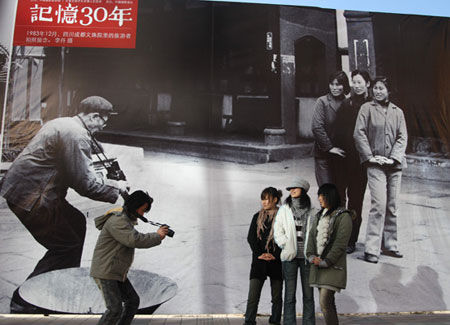
Young women and their photographer pose in front of a giant photo, which is on display in Wangfujing Street, Beijing, to mark the 30th anniversary of China's reform and opening-up. Wang Jing / China Daily |
 |
|
In the 1950s, a short bob, cut just below the ears, was a simple style widely favored by Chinese women. Xinhua |
 |
|
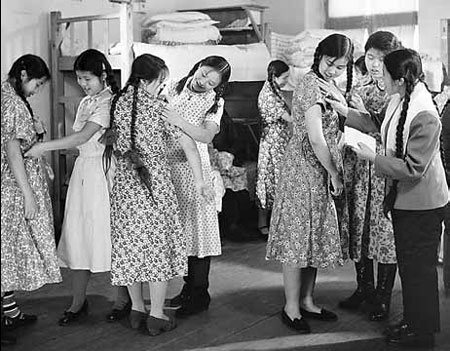
For a long time girls favored braids, one on each side of the head. Xinhua |
 |
|
In the 1980s, perms were common, along with short bobs. Wang Wenlan / China Daily |
From sinners to stylists, from a famed general to ordinary women, Chinese hairstyles have evolved from symbols of ethnicity, class status and political alignment to an expression of individuality and style. Han Bingbin investigates.
To describe the significance of China's changing hairstyles is no simple task. In China, possibly more than in any other culture, hair has long had strong political and social meaning. Until as recently as the 1970s, hairstyles were not an easily changeable outlet for personal expression, but a symbol of everything from status and ethnicity, to political ideals.
In ancient times especially, people cherished their hair as a symbol of self-respect. Hair was as highly valued as the body. In the Spring and Autumn Period (770-476 BC), a punishment called kun required sinners to shave their hair and beard. Compared with other physical punishments this was considered more devastating because it insulted the soul.
During the Warring States Period (475-221 BC), the famed General Cao Cao was spared the death sentence, but instead of losing his head he had his hair cut off as a punishment for disobeying military orders. Significant proof of how seriously people took their hair in ancient times.
Hair in prehistoric times helped distinguish between the Han people and other ethnic groups, as the former tended to have it bound, while the latter usually grew their long hair to be disheveled. In the Tang Dynasty (AD 618-907), hairdos with different shapes evolved into a symbol of class status.
In his article The Psychology Behind Chinese People's Hairstyles, published in Beijing Science and Technology Life magazine in 2005, author Zhang Minglu said that in addition to being the symbol of ethnicity and class, hair's foremost function was a declaration of political alignment and a political weapon.
When the Manchu people took national sovereignty, one of the first things they did was to order civilians to shave their heads. Unshaven heads therefore became a clear sign of dissent.
The most typical example was the rebellious Taiping armies who were cursed by the Qing Dynasty (1644-1911) rulers as "hairy thieves". That same political symbolism carried on to the later years of Republic of China (1912-49) when it was against the law to have pigtails.
Even after the People's Republic of China was founded in 1949, hair's complicated relationship with politics did not end.
In the 1950s, a short bob, cut just below the ears, a simple style favored by female communists and soldiers, was widely imitated by Chinese women.
Author Chen Mingyuan's book Dress Warmly, Eat One's Fill and Be Well-off, dubbed this style the "liberation hairdo" as it signified women being liberated and becoming their own master.
The only sign of individuality was the different hairpins and silk flowers. But Chen said that younger women were still in favor of braids, one on each side of the head. A typical compliment paid to a girl at this time was, "she has two pigtails that dance to her movements".
Chen said that in the 1950s, many women chose to perm their hair into loose waves. But from 1957 on, in conjunction with several political movements, women cut their hair even shorter, which was often referred to as the "movement hairdo".
When the "cultural revolution" (1966-76) began, Chen said, "corrections" started with women's hair. Long braids were cut short, and the "capitalist-style", permed waves, disappeared.

Women Red Guards cut off their long braids and opted for the movement hairdo to show their revolutionary spirit, as scholar Gu Nong wrote in his article Cultural Revolution and Hair, published in the bimonthly Xun'gen magazine in 2000. Gu said at that time one braid was seen as feudalistic, two capitalistic, and shoulder-length hair purely revisionism.
Harsh treatment toward "capitalist-roaders" could also start with their hair. In an essay entitled Records of 1966 and 1967, writer Yang Jiang describes an incident in which half her hair was cut off, giving her a "yin-yang head", an insulting punishment often used during the "cultural revolution".
From the late 1970s, when China began to implement the reform and opening-up policy, hairstyles became purely a personal choice to demonstrate individuality and aesthetic preferences.
In the late 1970s, permed hair, such as afros and long permed waves again became trendy. By the 1980s, perms were common, along with short bobs - always a favorite of Chinese women.
 |
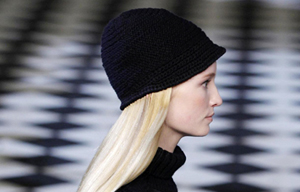
By the late 1990s, hair dye became a significant trend. As Chinese women embraced more possibilities for their hair shapes and colors, the country has also begun to see a growing variety of hair accessories and hair care products.
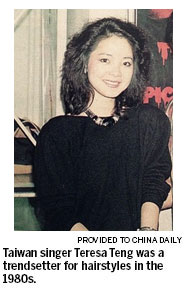
Since the late 1970s, trends have repeatedly shifted. Imported hairstyles, like the bob and afros have all left a significant mark in the history of Chinese fashion. Behind each of these trendy hairdos was trendsetters such as Momoe Yamaguchi, Teresa Teng and Maggie Chung.
"Chinese women have become increasingly reliant on their hairstyle to be a unique way to change their personal image and influence others' opinion of them," Chen concluded in his book.
It was during this period that China's beauty industry blossomed, with a growing number of local and international-branded hair salons opening their doors.
There has also been a growing international influence with local salons sending their stylists to be trained overseas and foreign talents coming to work in China. All these developments have helped Chinese fashionistas keep up with international trends.
 |
"Chinese mainland people are much richer now. They have a chance to travel and see more. They are now quite open-minded in terms of fashion. They are probably more adaptive to the latest trends than people in Hong Kong and Taiwan," said Casper Yeo, hairstylist with a Shanghai-based Vidal Sassoon training center.
A Malaysian who came to Shanghai in 2007, Yeo grew up with the stereotypical view that Chinese were provincial and rustic. But now he tells his friends to visit and be shocked by Shanghai's trendy looks.
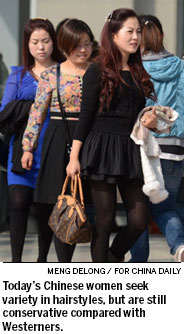
But he said unlike Westerners who are very individualistic in terms of fashion, Chinese are still conservative imitators. Yeo said one negative result of this is that sometimes the streets are full of hundreds of people sporting same hairstyle.
"That probably has something to do with Asian education that makes students fear looking different from others," he said.
"But hairstyles should be unique to each individual and solely be a reflection of one's own characteristics, profession and ideals. If I were to predict future trends, I think 'tailor-made' is the direction."
Contact the writer at hanbingbin@chinadaily.com.cn.

Copyright 1995 - 2010 . All rights reserved. The content (including but not limited to text, photo, multimedia information, etc) published in this site belongs to China Daily Information Co (CDIC). Without written authorization from CDIC, such content shall not be republished or used in any form. Note: Browsers with 1024*768 or higher resolution are suggested for this site.
License for publishing multimedia online 0108263 Registration Number: 20100000002731