|
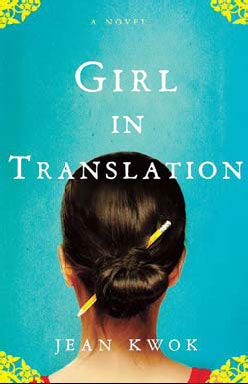
After 10 years of labor and incredibly disparate jobs, Jean Kwok attracted influential literary agent William Morris with her debut novel Girl in Translation. Provided to China Daily |
|
After 10 years of labor and incredibly disparate jobs, Jean Kwok attracted influential literary agent William Morris with her debut novel Girl in Translation. Provided to China Daily |
The debut novel from Jean Kwok draws on her own experiences as an immigrant to explore both sides of the American Dream. Chitralekha Basu reports
Several thousands of Asian migrants reach the shores of America every year, trying to make a new life against the tumultuous sea of odds. Only a few manage to triumph against the forces of circumstance. And still fewer get to tell their story.
Jean Kwok may be counted among the latter category. Girl in Translation, her just-released debut novel, is, recognizably, Kwok's own story.
"When the novel began to get so much international attention, people wanted to know if it was actually possible for immigrants to live under such difficult conditions in America, and to overcome them," Kwok says. "I understood then that it was an important part of my message to say: 'Yes, the world shown in the novel is based upon reality'."
Kwok's childhood memories of living in the vermin-invested back alleys of Brooklyn, where the family from Hong Kong had to keep their erratic stove on through the ruthless New York winter, will stay with the reader for a long time.
As will the lingering smell of chemically-treated fiber dust settling in her lungs from working in a China Town sweatshop in the evenings after school.
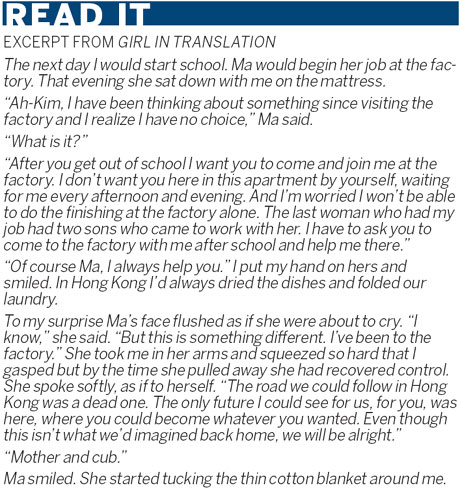
The similarities between Kimberly Chang, Kwok's pre-teen heroine, and her creator are evident. Chang arrives in the United States from Hong Kong with her mother and no assets, but through hard work and force of will she finally attains a respectable life and a career as a high-profile pediatric cardiac surgeon.
Kimberly's slow and faltering journey toward integrating with the American mainstream is representative of the long, winding road many Asians newly arrived in the US are compelled to take.
"The process of assimilation is often a difficult one, filled with sacrifices along the way," Kwok says. "The challenge is to assimilate without losing your own unique cultural identity."
The Chinese-ness in Girl in Translation lies in the use of literal translations of idiomatic expressions in Chinese, such as "make rice" and "give one little face", and succinct descriptions of Chinese rituals, like burning paper money on Tomb-Sweeping Day.
Was Kwok ever worried that these culture-specific detailing might be lost on the Anglophone world?
"It was my goal to introduce non-Chinese speakers to the rich world of Chinese idioms and expressions," Kwok says. "I wanted readers to know what it was like to be on the other side of the language barrier." She wanted them to have to struggle to understand her Sino-fied version of English.
As for adhering to traditional totems, like the five alters that Kimberly and her mother put up in their ramshackle American kitchen, when such practices may well have lost currency back home, Kwok feels especially proud writing about "China's rich cultural legacy without judging it".
She's happy that the older traditions "continue to flourish in places like the United States, even though they may be seen as old-fashioned in some parts of China. This diversity can only bring a deeper understanding of our past and culture to future generations."
Kwok's success story is prodigious. The 5-year-old who arrived in the US with her parents with no money and no English was noticed for her flair for the sciences in elementary schools. She was tested by a number of exclusive private elite schools and won scholarships to all of them. In her last high school year she was working in three labs on the side.
She started as a sophomore in Physics at Harvard, but buoyed by a new confidence switched track to study English and American literature. Kwok was working up to four jobs at a time to meet her living expenses: washing dishes in the dining hall, cleaning rooms, reading to the blind, teaching English, and acting as the director of a summer program for Chinese immigrant children.
She was "discovered" by big-time literary agents while still a student of creative writing at the coveted Columbia University, but subsequently dumped when she showed them her debut novel.
She moved to Europe after she met her man, a Dutch clinical psychologist, on a holiday, on a small Caribbean island off the coast of Honduras.
And her book has, after 10 years of hard labor and a number of incredibly disparate jobs - from Dutch-English translator at Leiden University to ballroom dancing instructor and raising two young children - been picked by William Morris, one of the most influential global literary agents.
It is being hailed as a fresh take on the American Dream, a moving document of a sustained battle to survive in a huge and confounding alien culture.
Understandably, Kwok finds it difficult to put her finger on the world map and pinpoint where she belongs.
"My identity is an ever-shifting concept, depending upon the issues I need to examine at that moment," she says. "I feel fortunate to have so many identities to choose from."
The two most important people to have had a role in the making of this book are Kimberly's mother and brother Kwan. While it was her mother's extreme hard work, resilience and selfless love that allowed Kimberly to follow her dreams, her brother Kwan, who entered MIT at 16 and "received his PhD with the highest honors in the history of MIT's general doctoral examination", was in fact the family prodigy on whom Kimberly's character was partially modeled.
"Some details of the novel, like the sweatshop owner cutting Kimberly's and her mother's wages because they were working too fast, were based on Kwan's experiences," Kwok says.
Kwan died in November 2009, flying a private plane in the mountains of West Virginia when it got caught in a storm. It happened around the time advance praise for Girl in Translation had started to pour in.
Kwan had a chance to look at the novel before he went. "He'd read it and helped me with the Chinese parts," Kwok says. "When I talk about the novel, I feel like I'm helping to keep Kwan's memory alive."
(China Daily 05/07/2010 page19)
