|
Hospital chief: Over 280 Iraqis killed
(Agencies)
Updated: 2004-04-08 17:28
More than 280 Iraqis have been killed and 400 wounded this week in the U.S. Marines' siege of insurgents in this city west of Baghdad, the director of Fallujah's hospital said Thursday.
Taher Al-Issawi told The Associated Press that the toll was likely higher.
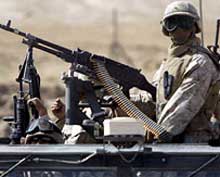 |
| U.S. Marines patrol outside Fallujah Wednesday. [AP] |
"We also know of dead and wounded in various places buried under rubble, but we cannot reach them," because of fighting, he said.
The U.S. assault on Fallujah began early Monday, when Marines surrounded the city of 200,000 people. Since then, U.S. forces have been waging heavy street battles, using warplanes and tanks against Sunni insurgents dug in heavily populated neighborhoods.
At least three Marines are known to have been killed since the operation began, but commanders have not given an official toll.
On Wednesday, U.S. Marines battled insurgents for control of this Sunni Muslim stronghold calling in airstrikes against a mosque compound where witnesses said dozens were killed in six hours of fighting. An anti-U.S. uprising led by a radical Shiite cleric raged for the fourth day in southern cities.
The Abdel-Aziz al-Samarrai mosque was hit by U.S. aircraft that launched a Hellfire missile at its minaret and dropped a 500-pound bomb on a wall surrounding the compound.
The U.S. military said insurgents were using the mosque for a military fire base. Iraqi witnesses estimated 40 people were killed as they gathered for afternoon prayers. U.S. officials said no civilians died and American commanders gave conflicting reports of insurgent casualties.
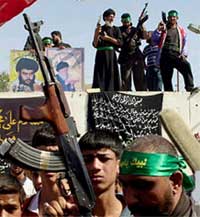 |
| Supporters of Shiite cleric Muqtada al-Sadr brandish their weapons as they chant anti-US slogans in Baghdad's Sadr City neighborhood April 7, 2004. [AP] |
An Associated Press reporter who went to the mosque said the minaret was standing, but damaged, apparently by shrapnel. The bomb blew away part of a wall, opening an entry for the Marine assault. The reporter saw at least three cars leaving, each with a number of dead and wounded.
The heavy fighting against the Sunni insurgency coincided again Wednesday with attacks on coalition forces in southern Iraq led by militiamen loyal to anti-American cleric Muqtada al-Sadr. For the first time Wednesday, Shiite militiamen battled Americans in the central city of Baqouba.
Since Sunday, 35 Americans, two other coalition soldiers and more than 230 Iraqis have been killed in fighting. The Iraqi figure did not include those killed at the mosque. Since the war began, at least 630 U.S. service members have died.
Marine Corps spokesman 1st Lt. Eric Knapp said the American force besieging Fallujah has killed more than 30 suspected insurgents and captured 51 since Tuesday night. Fifteen Marines were reported killed in fighting in Fallujah and neighboring Ramadi since Monday.
The Army said a soldier died Wednesday in the capital. Another had died Tuesday in Balad, the Sunni Triangle city north of Baghdad, the U.S. Central Command in Tampa, Fla. said.
U.S. Defense Secretary Donald H. Rumsfeld, at a Pentagon news conference with Joint Chiefs of Staff Chairman Gen. Richard Myers, discounted the strength of the al-Sadr force, which appears to have been bolstered by disgruntled, unemployed young men.
U.S. officials estimate the al-Sadr force at about 3,000 fighters.
"The number of people involved in those battles is relatively small," Rumsfeld said. "There's nothing like an army or large elements of people trying to change the situation. You have a small number of terrorists and militias coupled with some protests."
Myers said the fighting came in two broad categories. West of Baghdad in cities such as Ramadi and Fallujah, the main opposition is "former regime loyalists," including supporters of former president Saddam Hussein, and anti-American foreign fighters loyal to Abu Musab al-Zarqawi, a Jordanian-born terrorist believed linked to al-Qaida.
The Marines said they waged a six-hour battle around the Abdel-Aziz al-Samarrai mosque before calling in a Cobra helicopter which fired the missile at the base of its minaret. An F-16 dropped the laser-guided bomb, Marine Lt. Col. Brennan Byrne said.
During fighting elsewhere in Fallujah, U.S. forces seized a second place of prayer, the al-Muadidi mosque. A Marine climbed the minaret and fired on guerrilla gunmen, witnesses said. Insurgents fired back, hitting the minaret with rocket-propelled grenades and causing it to partially collapse, the AP reporter said.
Brig. Gen. Mark Kimmitt, the chief military spokesman in Iraq, said the Marines did not attack the mosque until it became clear enemy fighters were inside and using it to cover their attacks.
He told CNN the mosque was protected under the Geneva Conventions but the insurgents nullified that by attacking from the holy place.
At Camp Fallujah, Byrne said the Marines now control 25 percent of Fallujah.
The military gave widely varying casualty counts.
Marine Capt. Bruce Frame, in a statement issued from Central Command, said: "One anti-coalition force member was killed in the attack. There is no report of civilian casualties."
Byrne said those in the mosque were rebels, and "We believe we killed a bunch."
Kimmitt said, "I understand there was a large casualty toll taken by the enemy."
Rumsfeld said the United States knew risks would increase with the approach of the June 30 date for the handover of power to an interim Iraqi government.
U.S. commanders also fear violence could escalate during the religious ceremonies this weekend for al-Arbaeen, when millions of pilgrims gather in Shiite cities to mark the end of the mourning period for a 7th-century martyred Shiite saint.
The number of U.S. troops in Iraq is up, Rumsfeld said, because of the planned rotation of forces. The United States has about 135,000 troops there now.
"The United states will stay the course. We will stay until the task is complete," he said, warning that some U.S. troops ready to leave the country might have to stay a while longer.
Al-Sadr, meanwhile, said Iraq would become "another Vietnam" for the United States.
"I call upon the American people to stand beside their brethren, the Iraqi people, who are suffering an injustice by your rulers and the occupying army...," he said in a statement issued from his office in the southern city of Najaf. "Otherwise, Iraq will be another Vietnam for America and the occupiers."
Al-Sadr's al-Mahdi Army launched heavy gunbattles with coalition forces in the streets of at least six cities Wednesday and, for the first time, in the north.
Iraqis protesting the Fallujah operation clashed with U.S. troops outside the northern city of Kirkuk. The battles left eight Iraqis dead and 10 wounded.
Al-Sadr fighters battled American troops in the town of Baqouba, northeast of Baghdad, hitting a U.S. helicopter with small arms fire. The OH-58 Kiowa chopper was damaged and forced to land, but the two crew members were unharmed.
And Shiite gunmen drove Ukrainian forces out of the southern city of Kut — raising concerns over the ability of U.S. allies to combat al-Sadr's uprising.
After overnight fighting in which 12 Iraqis died, the Ukrainians withdrew from Kut with about 20 coalition officials, and al-Sadr followers swept into their base, seized weapons stores and planted their flag on a nearby grain silo.
The black-garbed gunmen of the al-Mahdi Army also had virtual control of the Shiite religious centers of Kufa and Karbala, where Iraqi police were laying low, allowing militiamen to move freely.
Militiamen in Karbala clashed with Polish patrols, and a cleric who was a senior official in al-Sadr's office was killed.
South Korea on Wednesday confined it approximately 460 troops in Iraq to their compound in the southern city of Nasiriyah and suspended reconstruction and medical efforts because of violence.
But South Korea's acting president Goh Kun said Seoul would go ahead with its decision to send 3,600 troops to northern Iraq later this year. The move will make South Korea the biggest coalition partner after the United States and Britain.
Also Wednesday, three explosions were reported near the camp where Japanese troops are based in the southern city of Samawa, a defense official said in Tokyo. No injuries were reported.
Al-Sadr and his militia are unpopular among most of Iraq's Shiite majority, and there was no sign that the Shiite public in the south was rallying to their side to launch a wider uprising.
But the week's fighting showed a strength that few expected from the al-Mahdi Army.
The country's most respected Shiite leader was silent until Wednesday, when he called for all sides to stop fighting.
"Grand Ayatollah al-Sistani condemned the methods used by occupation forces in the current escalating situation in Iraq... . We also condemn assaults on public and private property, and any action that disturbs order and prevents officials from carrying out their duties," said a statement from Sistani's office.
But there were signs of sympathy for the Sadr revolt among Sunni insurgents, who have been fighting the U.S.-led occupation for months and have often chided their Shiite countrymen for not joining in.
Portraits of al-Sadr and graffiti praising his "valiant uprising" appeared on mosque and the walls of government buildings in the Sunni city of Ramadi. Peaceful protests in support of al-Sadr occurred in the northern cities of Mosul and Rashad.
Monday night in Baghdad, al-Sadr gunmen went to a mainly Sunni neighborhood to join with insurgents in firing on U.S. Humvees — the only known instance so far of Sunni and Shiite militants combining forces.
Also in Kut on Wednesday, an AP photographer and his driver were detained by armed al-Sadr militiamen who accused them of being "traitors." They were bound, blindfolded and taken to the al-Sadr office in Kut. There they were well-treated and given food.
The photographer knew a cleric in another city who vouched for the pair when called by their captors. The Sadrists then took the two, in the drivers' car, to a Shiite neighborhood in Baghdad, where they were freed.
An AP stringer in Karbala, meanwhile, was told to leave the city by al-Sadr's militiamen on Tuesday, and he has not been allowed to return.
|