|
US editors on visit to gain deeper insight
By Raymond Zhou (China Daily)
Updated: 2006-03-16 05:41
A delegation of US newspaper editors are on a study tour in China to gain a
better understanding of its fast-growing economy and its culture; and to provide
more complete and insightful coverage to their large and interested audience of
readers.
The American Society of Newspaper Editors (ASNE) is the oldest and largest
organization of American newspaper editors, representing nearly all of the
largest American dailies. At the invitation of the Ministry of Foreign Affairs
of China, it has sent a delegation to visit Beijing and Shanghai.
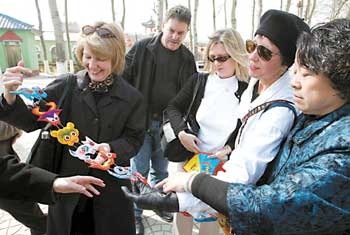
Pamela Luecke (left) and other US newspaper
editors admire handicrafts in the southern suburbs of Beijing as Zhang
Guanghui (right), deputy director of Liuminying Farm, explains the
significance of Chinese zodiac science. The American Society of Newspaper
Editors is making its first trip since 1978 to Beijing and Shanghai,
meeting senior Chinese officials and visiting places of interest to gain
more insight into China. [China Daily] |
The delegates visited China Daily's headquarters on Tuesday and met Beijing
Mayor Wang Qishan yesterday.
China Daily (CD) sat down with two of the senior ASNE office-bearers Rick
Rodriguez, ASNE president and executive editor of The Sacramento Bee, and David
Zeeck, ASNE vice-president and executive editor of The News Tribune for their
insight about presenting China to American newspaper readers.
Rick Rodriguez, ASNE president and executive editor of The Sacramento Bee.
China Daily (CD): What are the primary goals of your trip?
RR: The goals are to learn about China, with China obviously becoming a
superpower. It also has extensive trade relations with the United States,
manufactures a lot of our products. Not many editors get out of their office
into the real world on missions like this ?to discover other parts of the world.
CD: Any specific areas of interest?
RR: Obviously, trade relations are important, but we also try to learn more
about the people and the culture, and to know better about the internal workings
of politics, how the press operates in another country. We're interested in the
country as a whole.
CD: How much information about China do the American public get from
newspapers?
RR: In a given week, 70 per cent of the American public read newspapers at
least once. There are also television, magazines and books ?a variety of
sources. Whether the information comes in small or large bites depends on the
individual. It's a diverse audience.
CD: There has been a surge in China coverage in the US press.
RR: China is important in the global economy and in the whole structure of
world superpowers. The United States and its people are more aware of that.
CD: When a US newspaper does a report on China, what are the factors you
consider?
RR: Politics and where it plays in the global position, how it impacts people
in the United States. Editors try to make people understand how things that
happen in other parts of the world would impact them. Increasingly, China has a
greater role in the way people in the US view the world. That's how we try to
present China stories.
CD: Some suggest there's a glut of China reports. What's your opinion?
RR: I don't think there's a glut. On the contrary, I don't think we do enough
on China or other parts of the world. The American media is very localized. Some
newspapers have foreign bureaus that concentrate on international news. But most
newspapers don't.
CD: Are you satisfied with the quality of reports on China in general?
RR: I think a lot of the stories are being covered. Just as reporters in
China cover international news from a Chinese perspective, sometimes reporters
from the US come with perspectives they have formed in their own countries. What
I'd like to see in American newspapers is news from other parts of the world,
what they think of America and of the way they are being covered. There's some
interesting exchange on the Internet, but it could be available in newspapers.
CD: If you go out on the street and ask a random question, what would that
be?
RR: I'll ask: How has the country changed and has society become more free
and open?
David Zeeck, ASNE vice-president and executive editor of The News Tribune, a
newspaper in Tacoma, Washington State
CD: How is China covered by American newspapers?
DZ: In general, American newspapers cover China episodically, based on
events, not so much from a global or holistic perspective. Much of it is based
on trade agreements, trade differences or trade balances. I live near Seattle.
So when Boeing sells airplanes to the Chinese airlines, that's a huge story.
On a national basis, a big universe of news is available to American
newspapers from different correspondents. We've also sent reporters and
photographers here to cover things that are of particular interest to our
newspaper. But from that universe, my newspaper chooses a slice of stories that
depend on our local interest. We have a lot of military personnel in our market,
with air force, army and navy bases in the Pacific Northwest. So, military
issues in China, like trade issues, are of interest in our market.
CD: There was a surge in China reporting last year, wasn't there? Any
precedent?
DZ: There was an upswing in general because of China's growing importance as
a trade partner and as a member of the international community. The growing
perception among Americans is China matters to them individually. They see China
as a rising power. Consequently, there's a greater appetite for news about
China.
There's diminution of interest in the Soviet Union as it collapsed. Now
Russia is one of many countries, but for many years it was the opponent. So it
rises and falls. Twenty years ago, Japan was all Americans were talking about.
It was an incredible economic power. There was a trade imbalance with the US.
They were buying up a lot of US real estate. Now China has taken up that
position. To us, that doesn't seem unusual. There's an ebb and flow to public
interest in America.
CD: Do you feel the American public are gaining more understanding of China
from newspaper coverage?
DZ: Washington State, where I live, has more trade with China than most other
states, particularly with the Far East. We have paid attention to China for
longer than most of the US. And now, the rest of the country is catching up with
us. There are stereotypes that get in the way of real understanding. The more
Americans have interactions with Chinese, the more true their understanding will
be about what's going on.
CD: Some say that in the US, newspapers have readerships that are more mature
while younger people are more into TV and the Internet.
DZ: There's some truth to it, but newspapers also set the agenda for TV in
the US, to a great degree. Newspapers are a primary source for basic
understanding about China. Young people are more interested in pop culture. I
don't think there's much difference in perception between TV, print or the web
in terms of how to look at China. Similar stories are told on all three media.
Older people probably have a deeper sense of history and the recent
trajectory about American-Chinese relationship. Young people may have a better
understanding from a more modern perspective. I have a concern that young people
are isolated from world affairs. They may have more channels with growing
technology, but they shrink down to a narrow sphere of their own music, games
and movies. But that's also a stereotype because I know of many young people who
are interested in the world at large, who are taking Japanese or Chinese as a
foreign language. When I was growing up, it was almost exclusively French or
Spanish. So there's a slow shift in power.
CD: You visited China 10 years ago. Is there any surprise this time?
DZ: It's not so much a surprise. When I was here the last time, I felt the
power of the government and less power of the individual. It seems to me there's
much more power to the individual. The government is still powerful but it's
exercising its power in a different way.
I can see the growing economic power of individuals. The bicycle traffic is
much less. There's an explosion of automobiles. Even the way people dress on the
street, the fashion, the technology at their disposal, is much more modern than
it was 10 years ago.
CD: Do you notice any gap between what you read about China and what you see
with your own eyes?
DZ: It's not so much of a gap in information, but the texture and granularity
of information. When I'm here, I'm not thinking much of the government, but of
the people I meet. It's like the resolution of a picture: In America, the
pictures of China have big pixels and are a little bit out of focus, and over
here it's in sharper focus and more granular and offers more details. It's the
same as how a Chinese sees the US from here, all the big-picture things, but
when you travel to the US you meet individuals, have coffee and interact on a
personal level.
CD: Is there anything you specifically want to find out but don't have a
chance?
DZ: When I travel in Europe, one thing I like to do is to spend more time
with ordinary people, just wander the street and talk to people. But it's a
little frustrating here. So much time is packed with official meetings,
interviews and the like. I do wish to be able to walk some neighbourhoods and
just talk to ordinary people. I feel a little removed from that. But this is an
official visit and much of our business is official.
(China Daily 03/16/2006 page1)
|