|
Job hopping rampant as skilled workers chased
(Sunday Times)
Updated: 2006-02-22 15:59
On the day after the weeklong Chinese New Year holiday, Zhu Aihua went back
to work to find that seven desks around hers had been emptied.
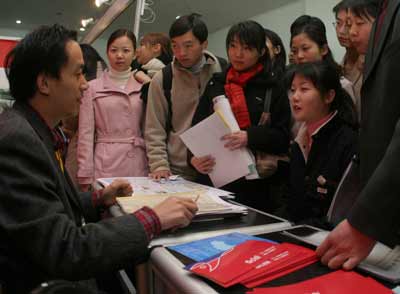
Students apply for jobs at a job
fair in Xi'an, Northwest China's Shaanxi Province, displaying 8,000
vacancies from companies across the country, November 14, 2004.
[newsphoto] |
Her colleagues at an
Internet company in Guangzhou had removed their tea mugs, pictures and other
personal belongings. They hadn't taken an extended vacation. They had bolted.
"It's like this every year," said Zhu, 25, a marketing specialist. Then she
glumly added, "I will have more work."
Similar scenes are playing out at workplaces across China, which is in the
throes of a job-hopping crisis. Amid booming economic growth and an erosion of
traditional values, this land of the socialist "iron rice bowl" — where people
once served their state-owned employers until death — has become a
revolving-door society.
China's overall turnover rate jumped to a record 14% last year from 8% in
2000, according to a survey by consulting firm Hewitt Associates. That doesn't
include people who were terminated. The current turnover rate in the United
States is about 3%, including firings.
In bustling areas such as Shanghai and Guangdong province, many companies
lose 1 out of 3 employees every year.
Experts say a shortage of skilled workers is the underlying cause of the high
turnover and its effects: large salary increases and extensive poaching of
high-performing employees.
Turnover is particularly rampant among urban China's youngest workers, who
grew up in a generation when Beijing allowed only one child per family. These
workers, in their early and mid-20s, enjoyed more prosperity and have higher
expectations of what employers and life should offer.
Government researchers say a record 4 million graduates will be entering the
job market this year.
"Young people just cannot calm their hearts," said Cui Yixiong, general
manager of City Supermarket, a private chain. Cui says more than half of his new
recruits don't last a year on the job.
"When I was young, I believed it took at least three years for you to learn
one industry thoroughly," said Cui, 39, who has spent his entire career in the
retail food sector, including 11 years at City Supermarket. "Nowadays many young
people will quit if they aren't promoted after one year's work."
That has driven up costs for employers, disrupted business and contributed to
wage increases. For higher-skilled jobs, companies have started offering some of
the same carrots as in the West: stock options, retention bonuses and housing
allowances.
Still, many young workers blame employers for the high turnover rates, saying
they don't do enough to retain employees. Benefits such as medical insurance and
pension plans tend to be similar from one workplace to the next. Training
programs aren't common, they say, and many companies don't offer opportunities
for advancement.
"What do you expect from workers?" asked Jiang Ning, 24, a business analyst
at Ping An of China, a state-owned insurer. "Companies haven't shown their
loyalty to employees."
Jiang graduated from prestigious Fudan University in Shanghai in July 2003
and has been job-hopping since. He quit his first job, at a large French
electronics manufacturer, after five months because the company wanted to
transfer him to Beijing. Ping says his second employer, a small German
consulting business, pushed him too hard. He lasted nine months in that job.
Koko Hu, 24, of Shanghai had a different reason for leaving her last job, her
fourth in three years. She wanted to travel around the country with her
boyfriend, and the national Chinese New Year holiday this month wasn't long
enough. So before the start of the weeklong festivities, the clothing designer
wrote a letter to her boss saying she wasn't coming back.
Hu had been on the job for only a few months and was on an interim salary of
about $350 a month.
"Since I didn't sign an employment contract with them, I can leave anytime,"
she said. Many workers in China sign one or two-year contracts and can face
fines from employers if they leave their jobs without a month's notice.
Job hopping also is high in rapidly developing economies such as India, and
it was widespread in the West in places such as Silicon Valley during the boom
years in the late 1990s.
But China's turnover crosses industry lines as well as job and pay
classifications, thanks to the sweeping changes in the demographics and economy
of China. Millions of migrants are pouring into cities to work at factories that
seem to pop up or disappear overnight.
New industries and globally ambitious companies have created a huge demand
for skilled workers and experienced managers.
For company managers, the worst time is around the Chinese New Year, when
most workers receive their annual bonus, which can be several times their
monthly salary. Some will bolt if they're dissatisfied with their 13-month pay,
as it is called. Others who plan to leave anyway will hold on just long enough
to take the bonus and run.
At Homemart Decoration Co., a national retail chain, Chief Financial Officer
Sun Bing said he took the departures in stride partly because there were plenty
of workers ready to fill vacancies.
"If someone in an important position wants to leave and we spent a lot of
time training him, we would try to persuade him otherwise," Sun said. "But if he
doesn't change his mind, then let's just say, 'Hao he, hao san,' " a Chinese
phrase that means, "Merrily meet, merrily depart."
Experts say China is going through what other Asian economies such as South
Korea went through when they saw a burst of job opportunities and galloping
salary increases.
Hewitt's latest attrition study found one striking difference between China
and other Asian nations: Money was the primary factor in prompting Chinese
workers to switch jobs, whereas career opportunities and work processes were
more important to other Asian employees.
"A lot of employees just see what they get out of their ATM every month,"
said Jihann Moreno, Hewitt's marketing manager for China.
Lu Le makes no apologies for that. The 24-year-old Web designer has changed
jobs six times in three years, boosting her salary an average of $100 a month
each time. The Shanghai woman now earns almost $700 a month, double the average
for the city. Lu has been at her job for six months and is contemplating another
move.
Chen Wei, product manager at Xiangcai Securities, calls people like Lu
"professional job jumpers."
There's no shortage of them at his firm, where a third of the employees leave
for other jobs each year.
"Sure, it brings extra cost to our company," he said. The trick is to keep
the best employees around long enough, he said, adding that workers tend to
settle down after they pass 30 years of age.
Some companies are turning to headhunters to do the dirty work.
Jin Yun of Beijing, who started one of China's first headhunter firms,
recalled how his staff targeted one high-performing salesman by repeatedly
calling and writing letters. It took nearly a year before he jumped to a rival
firm.
"It's like arranging dates and helping boys chase girls," Jin said of his
work.
Jin and others think that the massive job hopping and poaching will slow as
companies do more to retain employees.
China's job market should even out in three to five years, said Charles
Tseng, head of the Asian operations of Korn/Ferry International, a recruitment
firm based in Los Angeles.
"We don't see China being particularly different than the North American
model," he said.
Others, however, aren't so sure.
"To their parents who were born before or during the Cultural Revolution,
they valued social position and family responsibility greatly, and they couldn't
imagine losing their jobs, " said Lu Qiang, head of Mercer Human Resource
Consulting's Shanghai office, referring to the period in the 1960s and 1970s
characterized by purges of intellectuals and criticism of so-called bourgeois
values.
"For them it was an honor to work where they were needed and a great shame to
be jobless," Lu said. "But their children are in a different world. They may
work in a position very hard this month and quit next month to have fun or rest
without worrying that much."
Rick Dyck, an American technology entrepreneur with plants in Japan, South
Korea and China, said he struggled with this issue in employee relations.
"In Japan and Korea, you can appeal to an employee with a known value system"
when talking about workers' allegiance to their employer, said Dyck, who lives
in Japan. But, he said, young Chinese workers' values are not so easily
identifiable.
At the same time, Dyck observes that foreign companies, more than in other
countries, have had a direct hand in China's economic development. And many of
them, he says, have invested in China simply for the cheap labor, often with
local Chinese governments providing the land and even building factories for
them. Although it's easy to invest in China, it's just as easy to pick up and
leave.
"Everybody talks about employees moving and suddenly quitting," Dyck said.
"On the other hand, companies have done some of the same
things."
|