|
Home>News Center>World | |
|
|
|
|
|
|
|
|
|
|
|||||||||||||||||||||||||||||||||||||||||||||||||||||||||||||||||
|
|
Guessing game over Deep Throat's ID ends
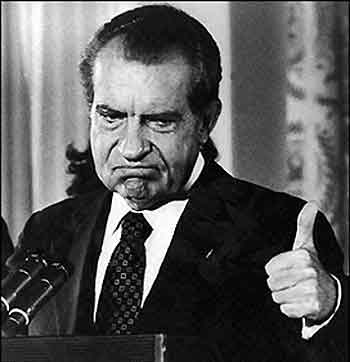
It was a mystery without a final chapter. For more than three decades, everyone seemed to have a theory about the identity of Deep Throat, the shadowy source who helped bring down the Nixon presidency in the Watergate scandal. A group of journalism students spent years sifting through FBI files. Former White House counsel John Dean pledged to expose the tipster, but only narrowed the field. Books and articles offered speculation and suspects, including Nixon chief of staff Alexander Haig and Secretary of State Henry Kissinger, as well as the suggestion that Deep Throat was not one person at all, but a composite.
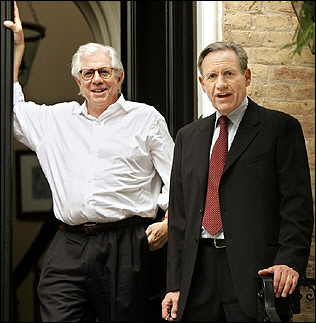
And so ended a 30-year guessing game whose players included Washington power brokers, Nixon aides, history buffs and journalists, all trying to identify the anonymous source who helped Washington Post reporters Bob Woodward and Carl Bernstein break the Watergate story that led to Nixon's resignation.
"Secrets are always tantalizing," Garment said. "And this was a jumbo secret. That's essentially it." Garment also said there was a David vs. Goliath aspect that made the Deep Throat story appealing. "It sort of symbolized the individual against the mass of government — that one person could reveal information that would lead to the resignation of a president," he said. "Of course, that wasn't actually what happened."
Many Americans learned about Deep Throat — a name borrowed from a 1972 porn movie — through "All the President's Men," the 1974 book by Woodward and Bernstein, and the movie based on it. Actor Hal Holbrook played the secret source, offering terse advice from the shadows of a dark, empty parking garage. "The movie so glorified the role of Woodward and Bernstein and Deep Throat, that's what lingered in the popular imagination," said Mark Feldstein, director of the journalism program at George Washington University. "Had we just seen a pasty-faced, gray-haired bureaucrat whispering a few things over the phone, that would be not nearly as dramatic." From the very start, Felt had been high on the list of likely Deep Throat candidates, though he had publicly denied he was the source and even threatened to sue. Woodward, Bernstein and Post executive editor Ben Bradlee had kept his identity secret at his request and said his name would be revealed upon his death. But that didn't stop the sleuths. William Gaines, a former Chicago Tribune investigative reporter and two-time Pulitzer Prize winner, supervised a group of student journalists at the University of Illinois who spent four years studying thousands of pages of FBI files and other documents. Two years ago, they announced their conclusion: Fred Fielding, who had been a deputy counsel to Nixon. After Tuesday's disclosure, Gaines posted a note on the journalism project's Web site, apologizing for misidentifying Fielding, who had long denied he was the source. John Dean also got in the act. To mark the 30th anniversary of the break-in at the Watergate complex, he held a news conference three years ago. Instead of revealing one name, he announced that he had narrowed down the Deep Throat candidates to four: Ron Ziegler, Nixon's press secretary; White House aide Steven Bull; and speechwriters Ray Price and Pat Buchanan. All denied being the source. After Felt was identified this week, Dean — author of "Unmasking Deep Throat" — said he did not see how the former FBI man would have had time to arrange clandestine meetings with reporters and have access to all the information. But Felt's name remained high on the suspect list. In the 2002 book "The Bureau: The Secret History of the FBI," Ronald Kessler, a former Post reporter, wrote that Deep Throat was probably Felt. Kessler said in an interview that Felt was one of many sources for Woodward and Bernstein. He "was important mainly because he gave them the reassurance they were on the right track," he said. "It was a very scary time in American history." A decade earlier, in a piece in The Atlantic Monthly, James Mann, another former Post reporter, said Deep Throat came from the FBI. Mann named Felt as one of three likely candidates. But speculation ranged far beyond that one agency. "The names that I read as possible Deep Throats were preposterous from the start," said Mann, an author in residence at the Johns Hopkins School of Advanced International Studies. Among those he cited: Buchanan, now a conservative commentator; ABC newswoman Diane Sawyer, who had worked in the Nixon White House; and former presidential adviser David Gergen. "These were people who had no connection to the government and law enforcement processes at work," he said. "I think the country sort of enjoyed the speculation ... but too many people seem to think the government is run day to day by the handful of familiar faces we see on television." Woodward tells how FBI man became 'Deep Throat' A chance encounter with a senior FBI official in 1970 grew into a friendship and as the Watergate scandal unfolded the official became the "Deep Throat" source for the stories that helped bring down President Richard Nixon, reporter Bob Woodward wrote in The Washington Post Thursday. Woodward said he was a young Navy lieutenant on a errand at the White House when he first met Mark Felt, who was unveiled this week as the instrumental source for the Post's Watergate stories written by Woodward and Carl Bernstein. "I asked Felt for his phone number and he gave me the direct line to his office," Woodward wrote. He said he came to regard the senior FBI official as a friend and a mentor and kept in touch with him. Felt was promoted to the No. 3 position at the FBI in July 1971, about a year before J. Edgar Hoover's death and the Watergate break-in, and two months before Woodward joined The Washington Post. Woodward said he turned to Felt after he and Bernstein wrote about the break-in at the offices of the Democratic National Committee at the Watergate complex in Washington. "This was the moment when a source or friend in the investigative agencies of government is invaluable," Woodward said. "I called Felt at the FBI ... It would be our first talk about Watergate." Woodward said Felt told him the Watergate burglary case was going to "heat up" for reasons he could not explain and abruptly hung up. But he started providing guidance on the story, Woodward said. "Felt believed he was protecting the bureau by finding a way, clandestine as it was, to push some of the information from the FBI interviews and files out to the public, to help build public and political pressure to make Nixon and his people answerable. He had nothing but contempt for the Nixon White House and their efforts to manipulate the bureau for political reasons," Woodward wrote. LITTLE TIME TO CONSIDER MOTIVES Given the complexity of the fast-breaking Watergate story, Woodward said, there was "little tendency or time" to consider the motives of sources. He also noted that Felt was immensely disappointed at being passed over to succeed Hoover. The clandestine exchanges began when Woodward went to Felt's home in suburban Virginia one night after failing to reach him by telephone. "He said no more phone calls, no more visits to his home, nothing in the open," Woodward wrote, saying he was instructed to follow strict counter-surveillance techniques for their meetings at a parking garage in Rosslyn, Virginia, across the Potomac River from the U.S. capital. He and Felt worked out a notification system for when either of them wanted a meeting, Woodward said. He said he signaled Felt using a small red flag in an empty flowerpot on his apartment balcony. Felt would put a signal in Woodward's copy of The New York Times delivered outside his apartment. "How this was done, I never knew," Woodward wrote. "Page 20 would be circled, and the hands of a clock in the lower part of the page would be drawn to indicate the time of the meeting that night." Woodward said he did not know at the time that in Felt's earliest days at the
FBI, during World War II, Felt had learned a lot about German spying and after
the war spent time keeping suspected Soviet agents under
surveillance. |
|
|
|
|
||||||||||||||||||||||||||||||||||||||||||||||||||||||||||||||
|
|
|
|
|||||||||||||||||||||||||||||||||||||||||||||||||||||||||||||||||