|
Home>News Center>Life | |
|
|
|
|
|
|
|
|
|
|
|||||||||||||||||||||||||||||||||||||||||||||||||||||||||||||||||||||||||||||||||
|
|
Theatre popularity all a show
With the largest number of theatrical troupes, directors and actors in China, Beijing is undoubtedly the centre of Chinese theatre.
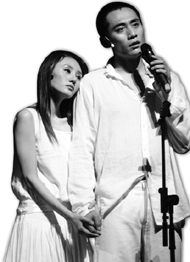
In addition, the third Beijing International Drama Festival, which opened on April 8 and will last until the end of this month, is bringing more than 20 shows to the capital's theatre venues. From musicals, to ballet, to spoken plays, local opera to Western opera, the festival features a diversity of programmes, including last year's top 10 plays awarded by the Ministry of Culture and some extremely expensive productions like the ballet "Casablanca," in which Warner Brothers invested US$6 million and the musical "Jin Sha" in which the Chengdu Perform & Art Group Co Ltd invested some 16 million yuan (US$1.9 million). But, under this apparent prosperity there is actually much to be concerned about. At least that was the shared viewpoint of a number of people at a seminar held by the Drama Research Institute of Peking University last week. There are many festivals every year, but few of them have attracted much attention from ordinary theatre-goers. Lin Zhaohua, arguably the most established theatre director in China, said: "Many of today's plays are produced for government-sponsored awards, which have become some prerequisite for managers or even local cultural officials in their achievement tallies." Exaggerated alarmist talk? Middle-aged director Li Liuyi thinks not, as he concurred with Lin's slating indictment. Li speaks from experience - companies purely seeking awards or as a means of attracting tourists and boosting local tourism - have often sought to commission him to direct plays. Such plays have little to do with theatric art itself, but are just for investment or political achievement, says Li. "China's theatre industry is inflated today and the booming market may be a beautiful soap bubble," said Lin. The on-going festival is testimony to this. For most shows, less than 30 per cent of the audience buy tickets themselves. Some one third enter the theatre with free tickets from various sources, while another third have been given tickets as a bonus by their employers, according to Wu Chunyan, a box-office manager with the Poly Theatre. An optimistic figure puts the number of regular theatre-goers in Beijing at 10,000, most of whom are students and people from theatrical circles, says Yuan Hong, producer and managing director of Beibingmasi Theatre, the only privately-run drama venue in Beijing and a well-known venue among theatre-lovers for its unique productions. High prices Why does such a huge metropolis have so small a group of theatre-goers? Why do people so seldom buy tickets themselves? One reason is that complementary tickets are always to be had since every show has to set aside a number for officials, VIPs, the press and employees. Another reason is that ticket prices in Beijing are far too high for the average man and woman. For Beijing People's Art Theatre's new rendition of the classic play "Thunderstorm," which was staged on April 18 and 19 at the Poly Theatre, tickets ranged in price from 200 yuan to 1,200 yuan (US$24 to US$145). Yang Yang, a 24-year-old who works in the finance department of a Beijing company, said he accepts paying 180 yuan (US$22) for an ordinary show, although for a really good production he would be willing to pay as much as 480 yuan (US$58). Yang said that for a trendy play like Meng Jinghui's "Amber," he and his colleagues would not baulk at paying 200-300 yuan (US$24-US$36), but for his uncle, a fan of the Beijing People's Art Theatre, only tickets below 100 yuan (US$12) are realistic or acceptable. Yang's level of acceptance clearly puts him among the upper echelons of theatre-goers, whereas his uncle typifies the majority. Mo Lan, a 25-year-old saleswoman says 40 to 80 yuan (US$ 4.8-US$9.6) is for her a reasonable price to pay. Why are theatre tickets so expensive? The answer given by Chen Jing, manager of a Beijing-based performance agency, sounds ridiculous, but reflects the reality. "To some extent, the higher the price is, the easier we sell the tickets," she said. This leads to another problem in Beijing's theatre market. Many presenters do not target individual audiences, but companies who buy tickets as PR gifts for their clients. And naturally, they want expensive gifts. Yang said his boss had bought 10 tickets for the up-coming dance drama "Dynamic Yunnan," each costing 980 yuan (US$118) to give to clients. If the price was not high, the buyer would be ashamed to give the ticket to his VIP client and the one who gets the ticket would not consider it a worthy gift, said Chen. But corporate driven theatre and ticket pricing can backfire. Take "Casablanca" for example, the production met its Waterloo in box-office terms and the sponsor even had to cancel two of the planned five shows. An insider with the China Arts and Entertainment Group, which co-invested in the show with Warner Brothers, blamed the cancellations not only on the show's so-so quality, but the fact that some expected "group bookings" never materialized. The losers in all this are ordinary theatre-goers who really love such shows, but can not afford them. Troupes' challenges Besides the artificially inflated and distorted ticket market, theatre is facing challenges from the instant entertainment forms of the fast-changing society. In the 1980s, almost every province and big city had its own drama troupes, and quite a few of them, such as the Sichuan People's Art Theatre and the Harbin Drama Troupe, enjoyed great fame across the country. But now, except for a few national theatres, the Beijing People's Art Theatre and Shanghai's several theatrical companies, many others in China have died or are in terminal decline. According to veteran drama critic Lin Kehuan, the Dalian Drama Theatre has closed down, while performers with the Wuhan Drama Theatre are facing the chop this year and the salary of actors and actresses with the Chongqing Drama Theatre are struggling on monthly salaries of just 500 yuan (US$60). Lin garnered the information during a national meeting of leaders of drama troupes late last year. Li Liuyi is greatly concerned that most of his classmates from the directing department of the Central Academy of Drama have quit the theatre and gone into other professions. "With both the drama companies and audiences becoming less and less, where will the directors and performers go, and what shall they do?" Fortunately there are still plays that have held the public's interest and make a hit at the box-office. Meng Jinghui's multi-media play "Amber," the Hong Kong production "18 Springs," and the "Thunderstorm" which starred Pan Hong and Pu Cunxin and produced by the Beijing People's Art theatre, made it. All these productions had one important thing in common - star-studded casts and crews. In addition, "Thunderstorm" tells a classical intriguing story. In "Amber," apart from stars Liu Ye and Yuan Quan, director Meng was a main attraction to audiences. Indeed, Meng is almost the only stage director in China today to have balanced art and commerce well in one production. His fans expect much from every new production he brings to the stage. Some critics point out that the Chinese theatre scene badly needs good scripts and talented playwrights. "In the history of Western drama in the 19th and 20th century, there were Alexandre Dumas, Richard Wagner, Henrik Ibsen and Arthur Miller. In Chinese modern drama, we have Cao Yu, Lao She and Guo Moruo. But why is it now only the names of star actors and actresses come to mind whenever we talk about a play," said He Lulu, senior theatrical correspondent of the Beijing Morning Post. A number of independent directors and playwrights often come up with creative works, but it is usually hard for them to find financial backers. "Only national companies or big theatres can get sponsors, investment and a star crew and cast. But they are not all of Chinese drama," said Yuan Hong. "In the last several years the works of some non-professional directors and producers, such as 'Celestial Human World' and 'The Spring, Summer, Autumn and Winter of Chou'er' won acclaim from both professional circles and theatre-goers. They are an important force in Chinese drama who offer a variety for the audience." Yin Tao can be regarded a successful independent drama director compared to most of his colleagues. His first work "Celestial Human World" has had 52 performances in several cities around China, but made only around 20,000 yuan (US$2,416) in profit after all the costs were covered. He said he did not expect to make any money out of his plays. For his second work, "Death in 1942," he chose the much heavier theme of the anti-Japanese war, which has a cast of 22 actors, adding heavily to the budget. "I believe as long as we do our work well, 'Death in 1942' can also attract enough audience numbers to cover the cost," he said. "This play is not only about the war, but also discusses the conflicts between cultures." Not as lucky as Yin, Yang Ting and her classmates produced the play with their own money but failed to attract large audience numbers. How to pull in audiences remains a challenging question. Apart from more
professional marketing and promotion work, what theatre people need most to do,
perhaps, is listen to the voice of the audience.
|
|
|
|
|
||||||||||||||||||||||||||||||||||||||||||||||||||||||||||||||||||||||||||||||
|
|
|
|
|||||||||||||||||||||||||||||||||||||||||||||||||||||||||||||||||||||||||||||||||