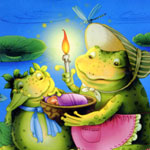
Front cover of the "Andersen Collection" in
Chinese, published by the Beijing Children's Publishing
House. |
When he created a Chinese nightingale in
one of his fairytales, Hans Christian Andersen would never have imagined that he
himself would become the "nightingale" singing in the dreams of 20th century
Chinese children.
The Dane has brought immeasurable happiness and a strong belief in the
goodness of the world to countless Chinese in their childhood and their days of
growing up, after he was first introduced to the Middle Kingdom in 1913.
And on the 200th anniversary of his birth on April 2 more than a billion
Chinese will be remembering Andersen and the treasure he buried in their hearts.
Celebrations throughout the year will also be hosted with a thrilling list of
more than 20 major events featuring exciting artistic, acrobatic, drama,
literary and cinematic renditions of the famed fairyteller's works.
"China is the country, if any, where the love of Andersen is perhaps almost
as great as in his own country," said Lars Seeberg, secretary general of the
Copenhagen-based Hans Christian Andersen 2005 Foundation, one of the organizers
of tomorrow's celebrations in the Danish capital.
While the Chinese love affair with Andersen's stories was greatest during the
last century, today the people are getting a deeper, more evocative insight into
the real Andersen - author, novelist, poet, playwright, but failed actor and
dancer.
Numerous translations and comments of his works and research papers have been
published between 1913 and 2005.
It was during the enlightenment of modern China in the 1910s and 1920s that
Andersen was first introduced to the ancient country, five decades after his
death, as a standard bearer of a literary reform. His works emphasize the
respect for children as human beings with independent characters, who have a
right to a spiritual life, one which includes their own literature.
"Andersen...observed the world through the eyes of children and wrote it down
with the affection of a poet. His works are so natural and beautiful that they
are unparalleled in history," renowned Chinese writer Zhou Zuoren (1885-1967),
an activist in China's enlightened New Culture Movement, wrote in a 3,000-word
article about the Dane.
Published in 1913, Zhou's "Biography of Danish Poet Andersen" marked the
first informed introduction of him in China. It was something of a pity the
storyteller made his debut in a translated name - An Dui'erran - that looked
somewhat alien to the not-that-scholarly Chinese. On Zhou's recommendation, the
Dane immediately caught the attention of China's literary world, and in 1914,
Liu Bannong (1891-1934) published the first Chinese version of Andersen's "The
Emperor's New Clothes."
It was entitled "Yang Mi Xiang Ying," which translates as "Portrait of a
Foreign Cuckoo."
As was the case with many other Western literary masterpieces, one of the
first Chinese versions of Andersen's fairytale was completed in classical
Chinese writing.
Published in 1918, the translation by Chen Jialin was called "Shi Zhi Jiu"
(Nine out of Ten). From the title it is difficult to tell from which particular
story by Andersen it was translated.
The Chinese adaptation of the fairytale aroused profound debate in China's
literary circles.
"The version killed the greatest characteristics of Andersen's work - the
children's language and their angle of observation, and turned it into an
awkward piece by an ancient literati," said Zhou in a scathing commentary
published in the New Culture Movement's flagship magazine New Youth in 1918.
"Andersen has been understood around the world except in China. It's his
great misfortune," he critiqued.
The debate triggered a flurry of children's literature. And in 1924 the first
"Selected Fairytales of Andersen," translated by Zhao Jingshen, was published in
Beijing.
Since then Andersen has been known by the more intimate Chinese name - "An
Tusheng." It has several meanings including "An, born with little property,"
which was true about the son of a shoemaker and a washer woman.
Zhao's book spearheaded more than 200 Chinese versions of "Selected
Fairytales by Andersen" and the more than 10 Chinese versions of the "Complete
Works of Fairytales by Andersen," which continue to be published on the Chinese
mainland.
The most popular versions of the above are those translated by Ye Junjian,
Lin Hua and Ren Rongrong.
Ye is reputedly the first Chinese to translate Andersen's original works from
Danish instead of from the English or French. He set about the task inspired by
his first encounter with Andersen's original works in England in 1944.
Thereafter he continued to publish his translations after the first volume
appeared in 1953.
"Reading the Danish stories I was shocked and came to realize that there were
so many poems and philosophies of life in the fairytales. The English and French
versions that I had read before merely showed Andersen as an eloquent
storyteller," he said in the preface of the first edition of his "Complete Works
of Andersen's Fairytales," published by the Shanghai New Arts and Culture
Publishing House in 1978.
Ye believed Andersen's stories are "modern fairytales combining fantasies,
political scepticism and poetic language," and that the storyteller was himself
"a romantic poet and a great humanist."
His translation has been widely praised in both China and Denmark, for it
retained the poetic air, the witty humour and the lively language of the
original works.
Among translators of Andersen's works in contemporary China, Lin Hua, a
retired diplomat, is also known as an authoritative researcher on the
storyteller.
He began his research in 1955, inspired by the celebrations of the
storyteller's 150th birthday which coincided with his time at the Chinese
embassy in Copenhagen.
After four decades of research, translation and editing, Lin's version of the
"Complete Works of Andersen's Fairytales" was first published by the China
Teenagers and Children's Publishing House in 1994 and has been greatly welcomed
by the Chinese children.
"I didn't spend much effort on the delicacy of language, but I really put all
my feelings towards Andersen into the translations. It's my greatest happiness
to have an opportunity to express these sentiments," said Lin who is in
Copenhagen attending the local galas commemorating Andersen's 200th birthday.
For his part, Lin sees Andersen as a tragic hero, who possessed a great
passion for the world and for life, but paid too big a price, including his own
happiness, for his fairytales.
"Everyone of his more than 170 stories is filled with a real human being.
Every story of his is some kind of autobiography," he said.
But the focus on the Dane's fairytales in China has been at the expense of
his other writing, including novels, poems, dramas and travelogues, which have
largely been ignored, suggests Lin.
"I hope the different new renditions of his works created on the bicentenary
celebration of his birth can give the Chinese a wider perspective of Andersen's
literary achievements and also of Danish culture and history," Lin added.