|
Home>News Center>China | |
|
|
|
|
|
|
|
|
|
|
|||||||||||||||||||||||||||||||||||||||||||||||||||||||||||||||||||||||||||||||||||||||||||||||||
|
|
Fertility industry takes off in China
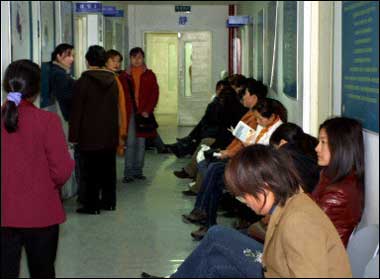
It is considered a slow day at the Peking University Third Hospital in China's capital, but the fertility clinic's waiting room and hallways are overflowing with women seeking help.
Slowly but surely, women in China who struggle to conceive are realizing there is hope out there and they do not have to helplessly suffer the intense stigma of being childless in a society that places supreme importance on having kids. "In China, the responsibility is often placed on the women. In the past, couples who can't have kids either adopt or divorce," says Qiao Jie, director of gynecology and obstetrics at Third Hospital, China's biggest authorized fertility center and its first to produce a test-tube baby. "Now, more and more people are becoming open to fertility treatment. There are more than 200 reproduction centers in China, but this is not enough to meet the demand." Statistics from China's Ministry of Health indicate more than 3,000 test-tube babies, or babies conceived through in vitro fertilization (IVF), have been born in China since the country's first successful case in 1988, according to state media.
The industry is believed to be huge. Statistics are hard to come by because the sector is largely unmonitored, but more than 10 million Chinese families need artificial fertilization, according to Xinhua news agency. Many of them are undergoing fertility treatment, which is much more affordable in China than overseas. "There's a huge demand," says Zhao Lixin, deputy director of the reproduction center in east China's Shandong Province Hospital. "There is a Sino-US joint-venture hospital in Shanghai which treats more couples than any other in China. Just that hospital alone probably helped conceive 3,000 babies." Increased public awareness is one key reason spurring couples to seek treatment.
Stressful and unhealthy lifestyles linked to China's dramatic socio-economic changes -- including obesity, drinking, smoking and environmental problems -- have also hiked infertility rates, experts say. Most experts believe the percentage of Chinese couples suffering from infertility is rising and is around 10 percent of total couples. In China, the success rate for fertility treatment -- measured by whether the women get pregnant -- is around 35 percent for IVF, on par with Western countries, doctors say.
It costs around 3,000 yuan (361 dollars) to have an assisted insemination -- insemination of sperm into the ovary -- and 20,000 yuan (2,400 dollars) to have in vitro fertilization, where the egg and sperm are fertilized in a lab, with the embryo then inserted into the woman. The price tags are prohibitive for most people -- worth several or many times their annual salary -- but an increasing number of Chinese families are able to afford treatment. Capitalizing on the demand, many unauthorized clinics with ill-trained doctors and inadequate technology have popped up. Licensed hospitals say the government needs to step up regulations of the industry not just to prevent people being duped but also to stop abuses -- such as couples using fertility treatment to bypass the country's one-child policy. "A lot of patients come to our clinic not because they are infertile, but because they want to have multiple births or want us to help them have a boy," says Zhao. "We turn them away but other less reputable clinics do not." China's population control policy restricts urban couples to having one child and rural couples to having two if the first one is a girl, but twins and other multiple births are exempt from fines. Techniques are available in fertility treatment to create multiple births or select the sex of children. But multiple births are generally avoided to lessen the risks for the baby and mother and gender selection is usually used only to prevent sex-linked genetic disorders. About 20 percent of China's fertility treatment that result in births result in multiple births, experts estimate. "The multiple birth rate is definitely higher in China than overseas because it's not controlled very well here," Zhao says, adding that many hospitals in China lack the skills to eliminate extra embryos. "Some hospitals boast quadruplets born there to attract business. We see it as a problem in treatment," says Zhao. Multiple pregnancies carry risks such as infant mortality, premature births as well as breathing difficulties and developmental delays for babies. Mothers also can suffer from high blood pressure and or require Cesarean sections. As more people find out about fertility treatment, Zhao says, more will use treatments to have multiple births. "Not many people know about these drugs yet, but once they do, it will be a bigger problem," Zhao says. Chinese who traditionally wish newlyweds "double happiness" see twins as signs of good luck. Fertility drugs, which can help women produce two or more eggs instead of one at a time, are cheap and widely available in drugstores with no prescription needed. "Imposing laws can't solve this problem, we need to educate people that multiple births are dangerous," he says. The Third Hospital, meanwhile, looks like a busy bus station. Several women stop Qiao as she walks down the hallway, anxiously asking her about their ovulation and hormonal cycles. Zhang Yanyun, 31, a farmer from northern Hebei province is one of them. "I've had two miscarriages," says Zhang. "Usually if you're not pregnant after being married for two years, people begin to ask. A friend of mine told me about this clinic. I'm not ashamed. When there's no way, this is a way." The health ministry did not respond to a request for interview.
|
|
|
|
|
||||||||||||||||||||||||||||||||||||||||||||||||||||||||||||||||||||||||||||||||||||||||||||||
|
|
|
|
|||||||||||||||||||||||||||||||||||||||||||||||||||||||||||||||||||||||||||||||||||||||||||||||||