|
Home>News Center>Life | |
|
|
|
|
|
|
|
|
|
|
|||||||||||||||||||||||||||||||||||||||||||||||||||||||||||||||||||||||||||||||||||||||||||||||||||||||||||||||||||||||||||||
|
|
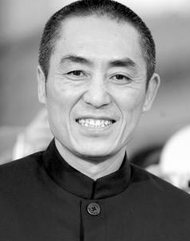
Rotten tomatoes for Zhang Yimou
"Zhang Yimou's artistic life is terminated," was Hong Kong movie director Zhu Yanping's unhesitating comment after watching his distinguished peer's latest offering, House of Flying Daggers.
House of Flying Daggers has also been nominated for the 2005 Golden Globe Best Foreign Language Film, won by Hero in 2002. Even so, Zhang Yimou's domestic critics are ever more scathing in their assessments of his recent works. Chinese cinemagoers have expressed disappointment in House of Flying Daggers for several reasons. Set in a specific dynasty, they say it fails to reflect the era's most prominent characteristics, that its kungfu sequences are tame, and that its main characters appear two-dimensional -- little more than marionettes manipulated by their dogmatic director. The flame of passion in this so-called lovers' tragedy has also failed to ignite the romantic imagination of its viewers. While acknowledging that the movie is well made and beautifully shot Zhu Yanping says it does not do justice to Zhang's reputation. Nowadays his films are 55 times more costly to produce than his early works, and many in China would agree with Zhu Yanping that, "On such a lavish budget any director could make a hit movie." Zhang Yimou is criticized for employing cinematographic "tricks" that substitute technique for true artistry. He has also been slammed for his use of red lanterns as a motif instantly recognizable to both his Eastern and Western audiences. They feature in the 8-minute performance he directed for the Athens Olympic Games closing ceremony that displeased Chinese viewers to whom, in context of his namesake film, red lanterns symbolize an age best forgotten. Some Chinese critics regard Zhang Yimou's portrayed concept of Chinese civilization as over simplified. They say his works draw Western attention to Chinese national culture without conveying its true diversity, and that his work mirrors his own view rather than offering a window on China through which the world may make its own observations. Yet Zhang Yimou's huge contributions to Chinese film and its credibility in world film circles are indisputable. He first gained international recognition as cinematographer for Yellow Earth (1984) and has since won best director awards at the Berlin, Venice and Cannes film festivals. His Old Well (1986), in which he also acted, won him Best Actor Award at the Tokyo International Film Festival, and Ju Dou (1989), Raise the Red Lantern (1991), and Hero (2002) were all Oscar nominees. New Beijing, Great Olympics also won the Best Film Award at the 21st International Sports Film and Television Festival. Zhang has been successful in whatever medium he has applied himself to, for example his staging of Puccini's Turandot (2000) and adaptation of Raise the Red Lantern into a ballet in 2002. "Zhang Yimou's success is directly attributable to his Western audiences," says Wang Yichuan, author of Termination of the Zhang Yimou Myth and professor of aesthetics at Beijing Normal University, adding, "It was only after he achieved fame abroad that his foreign-fêted films were put on public release in China." Filmgoers' cultural background and psyche undoubtedly influence their reaction to Zhang's films. Chinese scholars insist that those from the West judge oriental art forms according to Western values and aesthetic standards, and that long-term cultural barrier between East and West has lent further mystique to the orient. As one expert observed, "The Western perception of the East as a romantically mysterious and exotic land is its own invention." Those of Zhang Yimou's films set in former times depicting Chinese social mores that are long since defunct endorse this fond Western fantasy, along with his portrayal of pre-liberation Chinese history, but to the Chinese viewer, they distort China's realities. "Zhang Yimou's passion for film has diminished since he began directing," says influential Beijing film critic Xie Xizhang. He finds Zhang's recent films unconvincing because he permits no spontaneity on the part of the actors, their performances being constrained by the dictates of his rod-of-iron style direction. It was in the early 1980s that Zhang Yimou started out as one of the now famous fifth-generation directors. He and his peers were part of the massive cultural reconstruction that took place in the wake of the "cultural revolution" (1966-76). All of them wanted to establish a contemporary style of Chinese cinema that they felt could only be created by thoroughgoing innovation. Zhang and his comrades indeed led the Chinese film industry revolution, and their works made China a major player in world film circles. As chief cinematographer of the 1984 film One and Eight Zhang broke all conventions. He shot from obscure angles, and positioned actors and actresses at the side, rather than center of a shot to heighten dramatic effect. He focused on the essential elements of sound, light and the artistic quality of projected images in the interests of undiluted realism, totally rejecting the didacticism and stereotyping that had dominated Chinese film of the previous decade. This progressive approach was, however, out of step with the more cautious advance of the Chinese government. When he sent One and Eight to the cultural administration department for assessment, it narrowly escaped being banned, gaining approval for public screening only after dozens of revisions had been made. The film nevertheless impressed cinemagoers and filmmakers with its unique cinematographic style, and the name Zhang Yimou began to be known. "Whether emphasizing artistic pulling force or information, visual expression is essential," Zhang Yimou states, time and again. He was cameraman rather than director on One and Eight but his striking style is nonetheless evident. Few could deny his talent, whether or not they like his later films. An aspect of Zhang Yimou's work that is particularly distinctive is his use of color. Red was the predominant color throughout Red Sorghum (1987), most notably at its conclusion when sorghum, characters and the very air are tinted crimson. Distinctive use of color is also an integral aspect of Ju Dou (1989) and Raise the Red Lantern (1991). In Hero (2002) color filters were used to distinguish the film's four sectors. This is according to Zhang's technique of "using colors to tell a story." Others might say it is his way of manipulating Western audiences into believing they are watching a truly Oriental spectacle. Yet Zhang has a deep insight into human nature and, within the scope permitted by mainstream ideology, a talent for portraying it. Not One Less (1999) was shot in a no-frills documentary style, yet brings tears to the eye of the most cynical of viewers. To Live (1993), winner of the Special Jury Prize at the Cannes Film Festival, is an account of the pain and hardship endured by one family over China's most turbulent span of history, presented in conventional style with no special effects or trace of Zhang's so-called fascination with artistic form. Although at times extreme, the film is credible by virtue of its being based on true events rather than the director's social ideology, and is testament to Zhang Yimou's true artistry. Unfortunately it was banned from public screening in China, an unexpected blow as at that time his films had been highly praised by both Chinese film critics and the general public. Zhang appears subsequently to have suspended his pursuit of art and ideology and changed his direction to commercial films in order "to live." His first film in this genre was Shanghai Triad (1995). It must be remembered that fifth-generation directed films of the 1980s were made in state-owned film studios under the auspices of state-funded artistic exploration. Upon reform of their ownership, state allocated funds became commercial investments that were made in expectation of economic returns. This adjustment curtailed artistic experimentation by these formerly privileged directors. In Shanghai Triad (1995) Zhang Yimou obviously garnered the infallible ingredients of violence, nostalgia and a lone sex goddess guaranteed to bring commercial success: it was a gangster movie set in 1930s Shanghai starring Gong Li. Zhang Yimou is one of the few Chinese directors able time and again to hit on formulas that both consolidate his following and guarantee high box office returns. His Red Sorghum begins as a pastoral romance and ends in flames of war; Raise the Red Lantern is set in the 1920s and depicts the fierce vying for favor among a wealthy clan leader's four wives; Ju Dou tells of a young woman's semi-incestuous extramarital affair against a sternly Confucian background; and To Live reflects human endurance throughout physical privation and spiritual torment. All are utterly compelling viewing. "One of Zhang Yimou's main goals is to recapture the Chinese-made film market share," says Zhang Weiping, producer of House of Flying Daggers. Zhang Yimou's acquaintance of more than 16 years' standing and the person responsible for guiding him into a more commercial style of direction, Zhang Weiping has since Zhang Yimou's Keep Cool (1997) invested in all his films. Formerly a pharmacist before entering real estate, and current owner of an airline food catering company, Zhang Weiping is chairman of the board of the New Picture Film Co., Ltd. There must be a heterogeneous mixture of mainstream and art house films on the movie market in order for it to flourish, and Zhang Yimou has proved himself a master of both genres. But there is one criticism of him that persistently arises on his home ground: that he should pay more attention to his ideological orientation and bear in mind the social influence of his works. Bei Ye, a scholar of ancient Greek civilization and philosophy, believes that
Zhang Yimou should, like ancient Greek artists, express his unique insight into
life in his works. As he puts it, "Zhang passes up angles of focus that could
otherwise directly penetrate the public consciousness."
|
|
|
|
|
||||||||||||||||||||||||||||||||||||||||||||||||||||||||||||||||||||||||||||||||||||||||||||||||||||||||||||||||||||||||||
|
|
|
|
|||||||||||||||||||||||||||||||||||||||||||||||||||||||||||||||||||||||||||||||||||||||||||||||||||||||||||||||||||||||||||||