|
Home>News Center>World | |
|
|
|
|
|
|
|
|
|
|
||||||||||||||||||||||||||||||||||||||||||||||||||||||||||||||||||||||||||||||||||||||||||||||||||||||||||||
|
|
Probe enters atmosphere of Saturn's moon
DARMSTADT, Germany - A European space probe plunged into the hazy, mysterious atmosphere of Saturn's moon Titan on Friday, and elated mission controllers said it had opened its parachute to slow its descent as it gathers data.
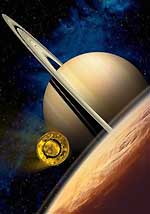
"It has entered the atmosphere, and entered it correctly," Lo Verda said. "We know the batteries are switched on, the parachute has deployed and it has slowed down sufficiently." Mission officials — who have waited seven years for Huygens to reach its destination — had tears in their eyes as the first signal was picked up, indicating that the probe had successfully powered up dormant systems and begun transmitting to its mother ship, the international Cassini spacecraft. ESA's science director, David Southwood, said the mission had successfully passed a difficult and critical step. "We didn't promise we could do this. We were pushing the limit just to do this," Southwood said. Huygens was spun off from Cassini on Christmas Eve to begin its free-fall toward Titan, the first moon other than the Earth's to be explored by spacecraft. Named after Titan's discoverer, the 17th-century Dutch astronomer Christiaan Huygens, the probe carries instruments to explore what Titan's atmosphere is made of and find out whether it has the cold seas of liquid methane and ethane that have been theorized by scientists. Timers inside the 705-pound probe awakened it just before it entered Titan's atmosphere. Huygens is shaped like a wok and covered with a heat shield to survive the intense heat of entry. Its slow parachute descent to the moon's reddish surface was expected to take about 2 1/2 hours, during which it will use a special camera and instruments to collect information on wind speeds and the makeup of Titan's atmosphere. The data will be transmitted back to Cassini, which will relay it to NASA's Deep Space Network in California and on to ESA controllers in Darmstadt, Germany. Titan is the only moon in the solar system known to have a significant atmosphere. Rich in nitrogen and containing about 6 percent methane, its atmosphere is believed to be 1 1/2 times thicker than Earth's. Alphonso Diaz, science administrator for NASA, said Titan may offer hints about the conditions under which life first arose on Earth. "Titan is a time machine," Diaz said. "It will provide us the opportunity to look at conditions that may well have existed on earth in the beginning. It may have preserved in a deep freeze many chemical compounds that set the stage for life on earth." Part of a $3.3 billion international mission to study the Saturn system, Huygens is also equipped with instruments to study Titan's surface upon landing. Scientists don't know exactly what it will hit when it lands at about 20 kilometers per hour. "It could land on something solid ... it could land in liquid methane, which is what they think a lot of the black seas on Titan are," said Alan Smith, deputy head of operations at ESA. "Because the temperature is so cold and the pressure is so high, gases like ethane and methane exist in liquid form, so it could well land in a sea of methane." The probe floats and should survive such a landing, despite the temperature of minus 292 degrees Fahrenheit. One hazard would be landing on a solid slope in a position that doesn't permit a strong signal back to Cassini. Engineers at ESA are counting on the probe having at least three minutes to transmit information and images from Titan's surface, before its battery runs out or Cassini gets out of range. The Cassini-Huygens mission, a project of NASA, ESA and the Italian space agency, was launched on Oct. 15, 1997, from Cape Canaveral, Fla., to study Saturn, its spectacular rings and many moons.
During the nearly seven years Cassini took to reach the ringed planet, the attached probe was powered through an umbilical cable and awakened from sleep mode every six months for tests. |
|
|
|
|
|||||||||||||||||||||||||||||||||||||||||||||||||||||||||||||||||||||||||||||||||||||||||||||||||||||||||
|
|
|
|
||||||||||||||||||||||||||||||||||||||||||||||||||||||||||||||||||||||||||||||||||||||||||||||||||||||||||||