|
Home>News Center>Life | |
|
|
|
|
|
|
|
|
|
|
|||||||||||||||||||||||||||||||||||||||||||||||||||||||||||||||||||||||||||||||||||||
|
|
Log on, open heart and blog out
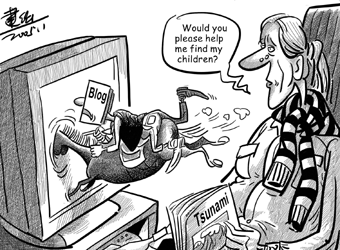
Wei Wei was among the first Chinese who used blogs as a platform to broadcast her situation in the killer tsunami in the Indian Ocean.
"I've been glued to the television in the past two days," she wrote. "My eyes are sore. Many of my schoolmates are from Phuket. Some live by the sea. Some had their houses destroyed. I don't know how to comfort them. In a day or two, our school will send food and clothing to the devastated island." Her coterie of online readers heaved a collective sigh of relief that she was safe. Even though she does not live near the disaster area, Wei's blog is unique for its first-hand reports of how Thai people are coping with the tragedy. What's in a blog? Blog is short for weblog. For those who are familiar with websites and online forums, blog represents something from both.
"A blog is a personal website for dummies," analyses Fang Xingdong, an Internet veteran in China. "It is a simple tool available to anyone with online access." Fang compares an online forum to a public square - or a public sphere - where, though there are moderators, everyone can have a voice. A blog, on the other hand, is a personal room that the owner can choose to open to the public. The degree of openness is controlled by the blogger, the person who does the blogging. In China, a recent survey shows that 56 per cent use blogging as a personal diary and 83 per cent for sending messages to friends, claims Fang, who is considered a pioneer in China's short history of blogging. Fang reveals that most blogs function as personal journals. But there is an East-West difference. In places like the US, those blogs that offer journalistic information tend to attract the largest number of readers whereas Chinese blogs are mostly likely to be devoted to sharing personal feelings. "It is still the handful of well-known names that create heavy traffic in blogosphere." When one examines China's blogosphere, there does not seem to be a dichotomy between the political and the personal. Rather public interest seems to lie in the inexorable push for exhibitionism. An online journal is the most common Chinese definition for a blog. But is it a private space or a public exhibition hall? Do people use their private intimacy as a bait for the mass of voyeurs out there? It used to be common practice that a child's diary would be subject to the random perusal of the parents and teachers. But in recent years educators have called for respect of children's privacy. The turnaround of public mindset towards the privacy of diaries is almost complete as can be validated by new legislations being passed or under consideration in places like Shanghai and Shenzhen. These specifically forbid the unauthorized reading of children's diaries. Wu Wei is one of China's most authoritative observers of the blog phenomenon. As editor of the influential Southern Weekend, he first wrote about it in 2002 and has been keeping track of it since. Wu approaches this paradox with a unique explanation. "A blog is not just a diary, but something between a diary and an open letter. It exists in the middle ground between private and public. The beauty of blogging is you can choose to be in either state. If you want to be private, you can give access to a select few; and if you want to cry out, you can go around and ask others to post links to your blog." But there may be a deeper rationale for the public display of private sentiments. "In China, a lot of children write diaries not as a private record, but as homework or other writing assignments to be rated by teachers or parents. The urge to bare one's mind is deep rooted but more than spontaneous," contends Wu. Blogs present opportunities for people to share a distinctive side of their personality, says Wu. He cites examples of his acquaintances who also work in media. "A friend I know has always given me the impression that he is carefree, simple-minded and sometimes tongue-tied. But when I read his writings in the newspaper he works for, he is orthodox, conservative and sometimes grand. And now I have to wrestle with a third side of him. On his blog, he has a wicked sense of humour, which I never knew he had." Philosophical musings The Asian tsunami disaster has aroused much response from Chinese blogs. Most tsunami-related Chinese blogs are philosophical musings on the transience of life or discussions of how we as a developing nation with a significant share of poor people can pitch in and help. The East-West divide on blogging has manifested itself again in the covering of this latest big event: While blogs in Western countries focus on news, Chinese blogs offer mostly views. Reports show that many blogs in the West have put up virtual notice boards with names, phone numbers, photographs and appeals for information about missing friends and relatives. But blogs like Wei Wei's, named Maidou, are few and far between. The underlying rationale is, the population of Chinese students or residents in the stricken areas is much smaller than that of Southeastern Asians in the West. These are the people who are most likely to use blogging as a clearinghouse for speedy information to help victims get aid and find each other. In recent days a swelling of blog pages regarding the tsunami has occurred. A search of the top three bloggoing houses in China, Blogcn, Blogbus and Blogchina, yielded dozens of pages. Many are repostings of newspaper articles. But some nuggets of insight or debates have still come through. "911, SARS, killer tsunami... These words represent disasters that face human beings as a whole and have left indelible images of pain in our collective memory," Shizhehun wrote in Blogchina. "What is wrong with the world? These disasters are affecting universal safety of the human race and are threatening to derail world civilization. "Why are we so helpless in front of nature's brute force and man's cruelty?" the author added. The most common explanation from bloggers is heavily tinged with Hollywood-style environmental protectionism. Many cited the movie "The Day After Tomorrow" as a reference point as images of the tidal waves swept through television and blamed environmental deterioration as the cause for the earthquake/tsunami. "I thought the plot of 'The Day After Tomorrow' only belonged in a Hollywood movie and has nothing to do with ordinary people," wrote viva_he on Blogcn. "When I watched in horror the reported increase of about 10,000 more deaths each day, I wondered whether it was dejavu of (the) Titanic all over again. The fact that some of my friends were vacationing in the Indian Ocean area brought the calamity even closer home." Kaolu is not angry, only a little sad. "I'm not religious," she wrote in Blogcn, "all I can do is pray for the souls of the dead. I sneer at those who yell for others' destruction. This kind of apathy also surfaced in the post-911 days. What makes it so ridiculous is they're not ashamed of their behaviour. I don't even have the strength to be angry at them." "I pray that, in 2005, all disasters will be far away from us, just like the old year," wrote Wu Xiaozhi in Blogchina.
|
|
|
|
|
||||||||||||||||||||||||||||||||||||||||||||||||||||||||||||||||||||||||||||||||||
|
|
|
|
|||||||||||||||||||||||||||||||||||||||||||||||||||||||||||||||||||||||||||||||||||||