|
Home>News Center>China | |
|
|
|
|
|
|
|
|
|
|
|||||||||||||||||||||||||||||||||||||||||||||||||||||||||||||||||||||||||||||||||||||||||||||||||||||||||||
|
|
Reining in world's largest population
The world's most populated nation is quietly marking an important day in its long history. In the early hours of this morning, Thursday 6 January 2005, the population of the Chinese mainland officially reached the 1.3 billion mark. The number is much more about mathematical significance. Official recognition that "The Day of 1.3 Billion" has arrived gives a small cause for celebration.
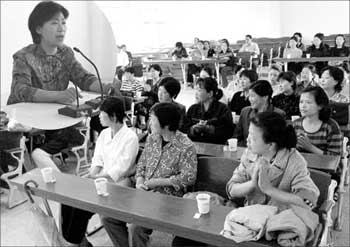
In the past decade, government statistics show the total fertility rate of Chinese women has stayed below the replacement level, figures to champion. But the last quarter of a century bears with it a long and painful process of family planning. Four years late or not, 1.3 billion people poses both challenges and hopes for China's sustainable growth, as well as its population development strategy. Today offers a chance to review how far China has come in its effort to manage its population, the largest in the world and about 21 per cent of the world's total. Rapid growth In the early years after the founding of the People's Republic of China in 1949, the population started to grow at an incredibly fast pace. The first national census in 1953 showed the Chinese population already stood at 600 million. Nearly a decade later in 1964, it had increased to 700 million. The dramatic population growth aroused heated debate among economists and administrators. Ma Yinchu (1882-1982), a former president of Peking University, represented a group of scholars who vigorously proposed the adoption of a national family planning policy. An article about Dr Ma by Zhang Youren, a retired professor from Peking University, shows in the year after the first census, Dr Ma went to East China's Zhejiang Province three times to learn about the lives of locals post the land reform. He found the local population was growing too rapidly. In 1957, after several surveys, he published his article the "New Population Theory" in the People's Daily, which advocated policies to ensure an "appropriate population growth." He calculated that if the number of the Chinese grew by 20 births per 1,000 a year continuously and unchecked, in 50 years the population would reach a staggering 2.6 billionthe world total in that year. "The country would face tremendous difficulty feeding its people," Ma warned. But few in the then leadership agreed. Instead Ma suffered severe criticism and population studies were virtually banned. "Until 1970, no national policy on family planning had been formed, so the population basically witnessed a runaway increase," said Yu Xuejun, head of Department of Policy and Legislation under the National Population and Family Planning Commission of China. In 1970, the total fertility rate jumped to 5.8 per woman and the population reached 800 million. "We lost one Ma Yinchu but we gained an extra 300 million people," so goes a saying in the late 1970s and early 1980s. Many problems the Chinese face today arose in the early 1970s as Dr Ma had predicted. "Unemployment and resources shortages are among them," Zheng Zhenzhen, a professor with population research institute under the Chinese Academy of Social Sciences, said in an interview with China Daily. From the early 1970s, the Chinese Government realized the rapid population growth was unfavuorable to the nation's economic and social development. In 1971, the central government for the first time, incorporated population policies into national economic planning, encouraging late marriage and childbearing. It promoted longer birth spacing and advocated the practice of "one couple, one child, and at best, no more than two." "The theory of Dr Ma has greatly influenced the later family planning policy, which basically embraced the thoughts he advocated," Zheng said. Millions of family planning workers visited families and talked about the concept of family planning and provided free contraceptives. "Though the family planning policy was not mandatory at that time, the effect was obvious," said Zhai Zhenwu, director of the population research institute under the Renmin University of China. The birthrate decreased rapidly from 33.43 births per 1,000 in 1970 to 18.25 per 1,000 in 1978. Meanwhile, the total fertility rate reduced to 2.72 per woman. Deng and the people At the end of the 1970s, late Chinese leader Deng Xiaoping further contributed to the solution. He believed that the heavy population burden hindered the target set for the national economic and social development. In accordance with Deng's ideas, the Chinese Government made it a State policy to carry out family planning and population management, encouraging all couples to have only one child. China's 1982 Constitution stipulates that the State should promote the practice of family planning. In 1984, after considering the labour demand in the countryside, a modified policy was set forth, allowing certain couples who have only one daughter to have a second child with appropriate birth spacing. Three or more children was strongly discouraged. In 1990, the birthrate fell to 14.6 births per 1,000 and women's total fertility rate reduced to 2.17 per woman, parallel to the replacement level. The birth rate and natural growth rate further decreased to 15.23 per 1,000 and 8.77 per 1,000 respectively in 2000. The total fertility rate of Chinese women fell below the replacement level, one of the lowest in the world. Though economically still a developing country, China has accomplished a historic transition in population reproduction pattern, turning round a high birth rate, high mortality rate and high growth rate in a relatively short period of time. This is a change that took decades or even up to a hundred years for developed countries to achieve. The nation's continuous effort has contributed to global endeavours which seek to enable every family on earth to have "universal access to a full range of safe and reliable family planning methods," as stipulated in the International Conference on Population and Development in 1994. During the past five or six years, considering the traditional Chinese concept of having more children against old age, couples both from one-child families are free to have a second baby under most regions' family planning policies, said Zhai. Challenges Despite the achievement, the Day of 1.3 Billion population also signals the difficulties and problems an ever larger population poses to the country's sustainable development. It is still estimated that the total population will maintain a strong momentum of increase over the next 10 years. In big cities like Beijing and Shanghai, most of the young people of marrying age are from one-child families. "Though their aspiration for a second child is not high, the total fertility rate is expected to increase by a small margin in the coming years," said Zhai. Especially owing to the persistent gap between the public child bearing aspiration and family planning, the present low fertility level still faces rebounding pressures. The floating population, mainly moving from the countryside to the city, jumped to 140 million in 2003 from 70 million in 1993, accounting for about 30 per cent of the rural labour force. Health services are still poor for this large social group, which places great pressure on family planning. While the family planning policy has demonstrated its notable effect, management measures are undertaking significant changes, according to Yu. During early stages, it depended on mandatory administrative measures. Entering the 1990s, more and more incentive mechanisms have been established to encourage citizens to practice sensible birth control. Families with only one child have been offered preferential treatment such as land management, employment, medicare, and children's education. "An integrated family planning measure will show more respect to the rights of the public," said Yu. By 2010, China will have a population within 1.4 billion on the mainland, and its annual birth rate no more than 15 per 1,000, officials suggest. And the issue being addressed is normalizing the boy/girl ratio. The fifth census indicates that for every 100 newborn girls in 2000 there were nearly 120 newborn boys, exceeding the normal ratio by 14 per cent. Meanwhile, the country will also encounter a serious ageing problem. The 2000 national census also showed that the percentage of people aged 65 and older reached 6.96 per cent, which is estimated to increase to 11.8 per cent of the total by the year 2020. Supporting the large population of senior citizens will pose a significant challenge for the country's social security system. It is estimated that in the first half of the new century, China will successively greet the arrival of the peak of its entire population strata. "Many foreseeable and unforeseeable side effects of the family planning policy will manifest themselves gradually. The sustainable development of the population will encounter unprecedented complex situations," said Yu Xuejun. Despite the difficulties, Yu pointed out that the present low fertility level will win precious time to focus more on the issues of population quality and structure. "Future population and family planning policy will be directed at stabilizing a low fertility rate to gradually realize a moderate population total where healthy births, balanced population structure and reasonable distribution are the norm," said Yu. |
|
|
|
|
||||||||||||||||||||||||||||||||||||||||||||||||||||||||||||||||||||||||||||||||||||||||||||||||||||||||
|
|
|
|
|||||||||||||||||||||||||||||||||||||||||||||||||||||||||||||||||||||||||||||||||||||||||||||||||||||||||||