|
Home>News Center>China | |
|
|
|
|
|
|
|
|
|
|
||||||||||||||||||||||||||||||||||||||||||||||||||
|
|
Cabbages out for Beijing's winter
How many dishes can be made from da baicai, or Chinese cabbage? Chinese cabbage in sour sauce. Cabbage soup. Cabbage and bean curd soup. Steamed cabbage. Cabbage with dried shrimp. Cabbage salad. Cabbage with mustard. Pickled cabbage. And on special days, dumplings of cabbage and minced pork.
Two decades ago, a Chinese housewife needed to learn how to vary the evening meal by using da baicai in different dishes as it was the only vegetable that sustained the masses through the icy months in northern China. A lost tradition To the Chinese capital, the dawn of November meant one thing - the invasion of winter Chinese cabbages. For old Beijingers, storing up green vegetables before the cold weather hit was an annual tradition.
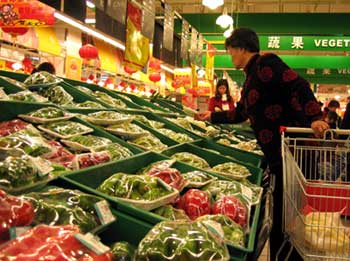
This week, the Chinese cabbages are still coming, right on schedule. But it's not like it used to be. The average wholesale price of this year's winter Chinese cabbage reached 0.23 yuan (3 US cents) per kilogramme, only half what it was in 2003, according to officials with Beijing Agriculture Bureau. Beijing's output of winter Chinese cabbage this year has shrunk by 9 per cent from last year's to 740 million kilogrammes, officials said. At a grocery market in Andingmen in Beijing's Dongcheng District, piles of cabbages were stacked neatly on shelves but were seldom bought. The market's inventory this week includes about 100 varieties of vegetables including many that farmers hadn't heard of a decade ago, such as the iceberg lettuce and monkey-head mushrooms. Grandpa Li, in his early 70s, bought just four cabbages. He said he used to buy 100 kilogrammes of the vegetable in time for winter. "Why hoard Chinese cabbages when so many other delicacies are available?" Li said. The rows upon rows of greenhouses in the city's suburbs mean Beijing can now stock a host of fresh vegetables and fruit in the winter season. Cabbages now account for just 7 to 10 per cent of all vegetable sales in Beijing, agricultural statistics indicate. Twenty years ago, the figure was 95 per cent. Ten years ago, it was between 50 and 70 per cent. Urbanization has led to a decline in cabbage-growing in Beijing and a better choice of veg has relegated the former favourite to the pantry. However, some residents' tastes have not changed. "I still have fond memories of da baicai - it was our daily food, like rice and steamed bread," said Wang Qingfu, a retired engineer in his early 60s in Beijing. But he now doesn't feel the need to store it up. "I don't need to fill my home with da baicai anymore because the nearby community market restocks its fruit and vegetable section every morning with fresh ones," Wang said. "And I no longer need to get my children to compete for cheap cabbage at the beginning of winter and then bargain with my neighbours for space to store it," he said. In today's Beijing, more than 11 million kilogrammes of fresh vegetables, of about 300 kinds, are sold daily, agriculture officials said. Many large supermarkets, such as the French superstore Carrefour and US-based Wal-Mart, sell lots of canned vegetables. As the winter comes, many truckloads of da baicai head south - where it seems diners like those in South China's Guangdong Province are hungry for a taste of old Beijing. "It's a delicacy there," said Yang Meixia, a Guangzhou resident in the capital city, Guangdong. "Now southern vegetables come north and northern vegetables go south and we enjoy more food varieties." Legend of da baicai The most common form of Chinese cabbage has a cylindrical tight head 10 centimetres wide and up to 40 centimetres long. The outer leaves are light green with a white midrib and the inner leaves are creamy yellow.
"There were basically no other vegetables in winter. No one could afford other vegetables anyway," said Yang Jingting, 48, an owner of a Beijing restaurant. Every winter, rickety trucks laden with the vegetable streamed into the city. People loaded up their donkey carts and wheelbarrows, anxiously stocking up. Families without fridges lined them up on their grey rooftops. A 1988 shortage caused panic buying, and a glut in the next year left 80,000 tons piled in the streets. The only way to clear it was for Beijing government officials to order public offices, schools, factories and army units to stock up. Da baicai was once called "patriotic vegetable" in Beijing and some buyers even received subsidies from the government to buy it. In 1992, the government cut its cabbage subsidy. Five years later, it deregulated the price. To guarantee that Beijingers could get enough of the veg, local government granted special permits to vehicles bringing it in from other provinces. They would get priority at inspection stops along the roads and the usual transport fees were waived. The Chinese cabbage heyday has passed. It's left to the old, who admit they still buy it from habit, to keep it on the shelves at all. |
|
|
|
|
|||||||||||||||||||||||||||||||||||||||||||||||
|
|
|
|
||||||||||||||||||||||||||||||||||||||||||||||||||