|
Home>News Center>World | |
|
|
|
|
|
|
|
|
|
|
|||||||||||||||||||||||||||||||||||||||||||||||||||||||||||||||||||||||||||||||||||||||||||||||||||||||||||||||||||||||
|
|
White House race now boils down to Ohio
With Ohio looming as a Florida redux, US President Bush climbed within 16 electoral votes of a second term Wednesday and held a solid lead in the popular vote over Democratic rival John Kerry who insisted the race framed by war, terror and joblessness wasn't over.
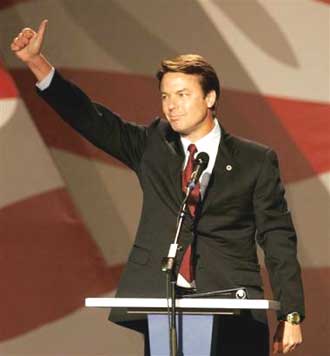
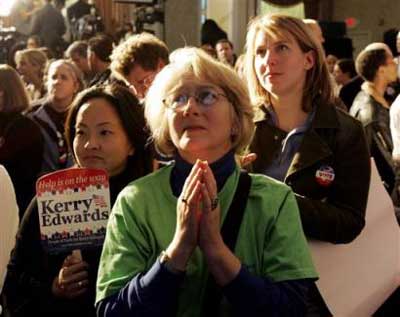
"We will fight for every vote," Kerry's running mate, Sen. John Edwards, told supporters in a scene eerily reminiscent of the Florida cliffhanger in 2000. Within hours, a 10-person political and legal team from Bush's headquarters was dispatched to Ohio to brace for a Florida-like fight.
After winning Nevada to inch closer to the 270 electoral votes required for a second term, Bush made plans — later revisited — to declare victory in Ohio and claim re-election was his no matter what the Kerry camp does. "We will not base our decision on a concession," said Bush adviser Dan Bartlett. Several other top aides said Bush would go before supporters in the wee hours Wednesday to claim victory, but they pulled back on that prediction when the Republican's electoral total stalled at 254. Ceding nothing, Kerry dispatched Edwards to tell supporters in Boston: "We've waited four years for this victory. We can wait one more night." The night proved grim for Democrats. Republicans expanded their majority in the Senate, knocking off Senate Minority Leader Tom Daschle of South Dakota, and the GOP extended its decade-long hold on the House for another two years. As for Bush, declaring victory would be nothing more than a weapon in political warfare. It has no bearing on who will serve as president a minute past noon Jan. 20, 2005, but the White House thought the tactic would undercut challenges and create a sense of inevitability about Bush's second term. Not so fast, said Kerry's team. Democrats were considering sending political and legal teams to Ohio, already the scene of dueling lawsuits over provisional ballots. Inside the Bush campaign, an intense debate waged into the early hours as some aides said parachuting teams into Ohio would only create a political stalemate in a state Bush hopes he has already won. Florida fell into Bush's lap with relative ease. Kerry took New Hampshire from Bush — the first and perhaps only state to switch parties — but it has just four electoral votes. That left Ohio as Kerry's only hope. The holdup was over provisional ballots — those cast by people whose qualifications to vote were challenged. At 3 a.m. EST, Bush had a lead of 125,000 votes; there were more provisional ballots outstanding. "There's no mathematical path to victory for Kerry in Ohio," said Nicolle Devenish, spokeswoman for the Bush-Cheney campaign, arguing that Bush would get his share of the provisional ballots. The White House had contacted Ohio Secretary of State Kenneth Blackwell, urging the Republican to clarify the number of provisional ballots. Nationwide, with 96 percent of the nation's precincts reporting, some 111 million people had voted — up from 105 million in 2000. Bush was winning the popular vote by nearly 4 million, or 51 percent to Kerry's 48 percent. Early in the voting, Kerry allowed himself to muse about the problems he might face in the White House, including a soaring deficit and a war that has claimed more than 1,100 lives. "I'm not pretending to anybody that it's a bed of roses," said the 60-year-old Massachusetts senator.
The Electoral College count was excruciating: With 270 votes needed, Bush won 28 states for 254 votes. Kerry won 19 states plus the District of Columbia for 252 votes. With three states out, Kerry was still on the hunt for electoral votes that the GOP won four years ago. The states' won by Gore in 2000 are worth just 260 votes this year due to redistricting — 10 short of the coveted number.
Kerry could pick that up plus some in Ohio with 20 electoral votes. A 269-269 tie would throw the presidential race to the House. Sen. Byron Dorgan, D-N.D.: "Obviously the presidential race is going to keep us up most of the night." Alongside the White House and congressional races, a full roster of propositions and local offices kept voters busy. But all eyes were focused on Kerry's bid to make Bush the first president voted out of office in the midst of a war. "I've given it my all," Bush said after voting in a firehouse at Crawford, Texas, hoping to avoid being the first wartime president bounced from office. Save Ohio, the race was a carbon copy of 2000, a narrowly fought battle waged by lawyers and politicians alike. In 2000, Bush lost the popular vote to Gore but won the Electoral College count and the presidency after a ruling by the Supreme Court gave him Florida. The incumbent sought to avoid the fate of his father — former President George H.W. Bush, who was ousted by voters in 1992 after waging war against Iraq and overseeing an ailing economy. Legions of lawyers and election-rights activists watched for signs of voter fraud or disenfranchisement. New lawsuits sought clearer standards to evaluate provisional ballots in Ohio and a longer deadline to count absentee ballots in Florida. While complaints were widespread, they weren't significant. "So far, it's no big, but lots of littles," said elections expert Doug Chapin. Voters were torn over the presidential race, in ways all too familiar. Exit polls suggested that slightly more voters trusted Bush to handle terrorism than Kerry. A majority said the country was safer from terrorism than four years ago, and they overwhelmingly backed Bush. However, among those who said they were very worried about a terrorist strike, Kerry held a slight lead. A majority of voters said things were going poorly in Iraq, and they heavily favored Kerry. With nearly 1 million jobs lost in Bush's term, Kerry was favored by eight of 10 voters who listed the economy as a top issue. The nation's mood? There was division on that, too. Half said the country was headed in the right direction, a good sign for the incumbent. Voters welcomed an end to the longest, most expensive presidential election on record. "It's the only way to make the ads stop," Amanda Karel, 25, said as she waited to vote at a banquet hall in Columbus, Ohio. Both sides spent a combined US$600 million on TV and radio ads, more than twice the total from 2000. Bush won among white men, voters with family incomes above US$100,000 and weekly churchgoers. Three-fourths of white voters who described themselves as born-again Christians or evangelicals supported Bush.
The president had hoped to increase his support among the religious right since 2000, but exit polls suggest there was little change. Kerry retained Gore's margins among blacks and union households, key parts of the Democratic base. His voters named the economy and Iraq as top issues. One in 10 voters were casting ballots for the first time and fewer than 10 percent were young voters, hardly the groundswell that experts had predicted. Kerry was favored by both groups, according to the surveys conducted for The Associated Press by Edison Media Research and Mitofsky International. Bush won Alabama, Alaska, Arizona, Arkansas, Colorado, Florida, Georgia, Idaho, Indiana, Kansas, Kentucky, Louisiana, Mississippi, Missouri, Montana, Nebraska, Nevada, North Carolina, North Dakota, Oklahoma, South Carolina, South Dakota, Tennessee, Texas, Utah, Virginia, West Virginia and Wyoming. Kerry won California, Connecticut, Delaware, the District of Columbia, Hawaii, Illinois, Maryland, Massachusetts, Michigan, Minnesota, New Hampshire, New Jersey, New York, Oregon, Pennsylvania, Rhode Island, Vermont, Washington, Wisconsin and statewide in Maine. Eleven gubernatorial contests were being decided Tuesday, along with 5,800 legislative seats in 44 states. Former Bush administration budget director Mitch Daniels won the governorship in Indiana, taking the seat from the Democrats. Among the notable ballot measures, voters in 11 states approved propositions that would ban gay marriage. In California, voters approved spending US$3 billion on stem-cell research. The war on terror aside, there were fresh reminders of the election's stakes. Eighty-year-old Chief Justice William H. Rehnquist, cornerstone of a conservative Supreme Court, disclosed Monday he was undergoing radiation and chemotherapy for his thyroid cancer, a sign that he had a potentially grave form of the disease. While neither candidate offered a specific exit strategy for Iraq, Kerry asserted that the election of a new president alone would persuade allies to take a greater share of the costs and sacrifices born by the United States. The Democrats said he hoped to start withdrawing troops from Iraq in the first months of his presidency. Bush said such talk only encouraged terrorists. The weapons of mass destruction Bush said were in Iraq were never found and more than 1,100 Americans have died in the conflict — 976 of them since he declared an end to combat operations May 1, 2003.
Bush blamed the Sept. 11 attacks for the sluggish economy and said his tax cuts put the nation on the road to recovery. Kerry noted that Bush was the first president in eight decades to end his term with net job losses. Unabashedly conservative, Bush said he shared with voters the values of faith and family. Kerry said his faith and activities — hockey and hunting — put him in the mainstream, too.
|
|
|
|
|
||||||||||||||||||||||||||||||||||||||||||||||||||||||||||||||||||||||||||||||||||||||||||||||||||||||||||||||||||||
|
|
|
|
|||||||||||||||||||||||||||||||||||||||||||||||||||||||||||||||||||||||||||||||||||||||||||||||||||||||||||||||||||||||