|
Home>News Center>World | |
|
|
|
|
|
|
|
|
|
|
|||||||||||||||||||||||||||||||||||||||||||||||||||||||||||||||||||||||||||||||||||||||||||||||||||||||||||||||
|
|
Bush wins Florida; Race comes down to Ohio
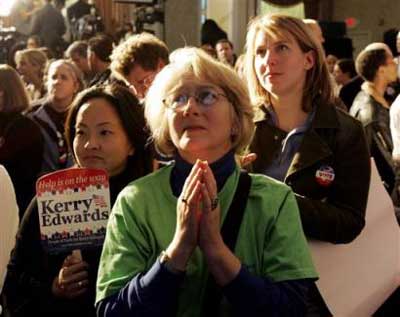
US President Bush and challenger John Kerry traded big-state victories Tuesday night, then sweated out a tension-packed conclusion to the race between an embattled incumbent and a Democrat who questioned the war the Republican waged in Iraq. Ohio loomed as this year's Florida, the decisive state.
"I've given it my all," Bush said after voting in a firehouse at Crawford, Texas, hoping to avoid being the first wartime president bounced from office. The Electoral Math was excruciating: Bush won 25 states including a contested West Virginia for 237 electoral votes. Kerry won 12 states plus the District of Columbia for 188 votes, including three from swing-state Maine. At midnight with several battleground states still unsettled, neither man had managed to turn around a state from 2000, a requirement for Kerry because states won by Democrat Al Gore four years ago are worth just 260 votes this year due to redistricting — 10 short of the total needed to win the presidency.
Independent candidate Ralph Nader could play the spoiler in New Hampshire and Nevada. A 269-269 tie would throw the presidential race to the House. Sen. Byron Dorgan, D-N.D.: "Obviously the presidential race is going to keep us up most of the night." Bush lost Pennsylvania, a major blow after courting voters with steel tariffs and 44 visits — the most of any state — in a bid to steal it from the Democrats. The loss raises the stakes in Florida and Ohio, both won by Bush in 2000. Independent candidate Ralph Nader could play the spoiler in New Hampshire and Nevada. There was little suspense in Congress, where Republicans were reaching to expand their majorities. They seized Democratic seats in Georgia, South Carolina and North Carolina, ensuring their grip on the Senate. The GOP was virtually assured of holding the House. Alongside the White House and congressional races, a full roster of propositions and local offices kept voters busy. But all eyes were focused on Kerry's bid to make Bush the first president voted out of office in the midst of a war. "I believe I will win, thank you very much," Bush said while awaiting results from the hard-fought Midwest and Florida with his family and dog Barney.
"I'm not pretending to anybody that it's a bed of roses," the Democrat said. The race showed signs of being as close as 2000, when Bush lost the popular vote to Gore but won the Electoral College count and the presidency after a ruling by the Supreme Court gave him Florida. The incumbent hoped to avoid the fate of his father — former President George H.W. Bush, who was bounced by voters in 1992 after waging war against Iraq and overseeing an ailing economy. Braced for a replay of the 2000 recount, legions of lawyers and election-rights activists watched for signs of voter fraud or disenfranchisement. New lawsuits sought clearer standards to evaluate provisional ballots in Ohio and a longer deadline to count absentee ballots in Florida.
While complaints were widespread, they weren't significant. "So far, it's no big, but lots of littles," said elections expert Doug Chapin. Voters were torn over the presidential race, in ways all too familiar. Exit polls suggested that slightly more voters trusted Bush to handle terrorism than Kerry. A majority said the country was safer from terrorism than four years ago, and they overwhelmingly backed Bush. However, among those who said they were very worried about a terrorist strike, Kerry held a slight lead. That was a troubling sign for the incumbent as was this: A majority of voters said things were going poorly in Iraq, and they heavily favored Kerry. With nearly 1 million jobs lost in Bush's term, Kerry was favored by eight of 10 voters who listed the economy as a top issue.
Voters welcomed an end to the longest, most expensive presidential election on record. "It's the only way to make the ads stop," Amanda Karel, 25, said as she waited to vote at a banquet hall in Columbus, Ohio. Both sides spent a combined $600 million on TV and radio ads, more than twice the total from 2000.
The president had hoped to increase his support among the religious right since 2000, but exit polls suggest there was little change. Kerry retained Gore's margins among blacks and union households, key parts of the Democratic base. His voters named the economy and Iraq as top issues. One in 10 voters were casting ballots for the first time and fewer than 10 percent were young voters, hardly the groundswell that experts had predicted. Kerry was favored by both groups, according to the surveys conducted for The Associated Press by Edison Media Research and Mitofsky International. Officials predicted a turnout of 117.5 million to 121 million people, the most ever and rivaling the 1960 election in the percentage of eligible voters going to the polls. Poring over exit polls and field reports, Bush's aides in Arlington, Va., identified low-turnout precincts and dispatched more walkers to them. In Boston, advisers gave Kerry a longer-than-expected list of TV interviews to conduct by satellite to Wisconsin, Minnesota, Colorado, New Mexico, Nevada and Oregon. That was an interesting list: Oregon was supposed to be safely Democratic and Colorado had seemed to be tilting toward Bush heading into Tuesday. In the final hours of the campaign, Kerry's aides tried to boost turnout in Hispanic areas by having the candidate's wife, Teresa Heinz Kerry, do Spanish-language television interviews. Exit polls showed the Democrat winning the Hispanic vote, but not by as much as Gore in 2000. Voters in Wisconsin, Michigan and Ohio received a wave of last-minute telephone calls as Kerry's strategists sought to nail down victories in those key Midwest battlegrounds. Bush won Alabama, Arizona, Arkansas, Florida, Georgia, Idaho, Indiana, Kansas, Kentucky, Louisiana, Mississippi, Missouri, Montana, Nebraska, North Carolina, North Dakota, Oklahoma, South Carolina, South Dakota, Tennessee, Texas, Utah, Virginia, West Virginia and Wyoming. Kerry won California, Connecticut, Delaware, the District of Columbia, Illinois, Maryland, Massachusetts, New Jersey, New York, Pennsylvania, Rhode Island, Vermont and statewide in Maine. One Maine vote remained a tossup. In the Senate, Republican Johnny Isakson took the seat held by retiring Democratic Sen. Zell Miller in Georgia. Republican Rep. Jim DeMint won the South Carolina seat held by retiring Democratic Sen. Fritz Hollings. And in North Carolina, Republican Rep. Richard Burr won the seat left open by Democratic vice presidential candidate John Edwards. Only nine of 34 Senate races on the ballot appeared competitive. One of them was held by Senate Minority Leader Tom Daschle, who was in a pitched fight against Republican John Thune. All 435 House seats were up for election, but Democrats had little hope of a takeover. Republicans hold 227 seats, Democrats 205, with one Democratic-leaning independent and two vacancies in Republican-held seats. With strategies molded by polls throughout the campaign, Kerry promised voters a new direction while Bush played up the risks of change. Eleven gubernatorial contests were being decided Tuesday, along with 5,800 legislative seats in 44 states. Former Bush administration budget director Mitch Daniels won the governorship in Indiana, taking the seat from the Democrats. Among the notable ballot measures, voters in 10 states approved propositions that would ban gay marriage. In California, voters approved spending $3 billion on stem-cell research. The war on terror aside, there were fresh reminders of the election's stakes. Eighty-year-old Chief Justice William H. Rehnquist, cornerstone of a conservative Supreme Court, disclosed Monday he was undergoing radiation and chemotherapy for his thyroid cancer, a sign that he had a potentially grave form of the disease. While neither candidate offered a specific exit strategy for Iraq, Kerry asserted that the election of a new president alone would persuade allies to take a greater share of the costs and sacrifices born by the United States. The Democrats said he hoped to start withdrawing troops from Iraq in the first months of his presidency. Bush said such talk only encouraged terrorists. The weapons of mass destruction Bush said were in Iraq were never found and more than 1,100 Americans have died in the conflict — 976 of them since he declared an end to combat operations May 1, 2003. Kerry voted against the Persian Gulf War waged by Bush's father. He voted in favor of the 2002 resolution authorizing war in Iraq. On the stump, Bush called Kerry's a record of political expedience. Bush blamed the Sept. 11 attacks for the sluggish economy and said his tax cuts put the nation on the road to recovery. Kerry noted that Bush was the first president in eight decades to end his term with net job losses. Unabashedly conservative, Bush said he shared with voters the values of faith and family. Kerry said his faith and activities — hockey and hunting — put him in the mainstream, too. |
|
|
|
|
||||||||||||||||||||||||||||||||||||||||||||||||||||||||||||||||||||||||||||||||||||||||||||||||||||||||||||
|
|
|
|
|||||||||||||||||||||||||||||||||||||||||||||||||||||||||||||||||||||||||||||||||||||||||||||||||||||||||||||||