|
Home>News Center>China | |
|
|
|
|
|
|
|
|
|
|
||||||||||||||||||||||||||||||||||||||||||||||||||
|
|
China stresses foreign policies
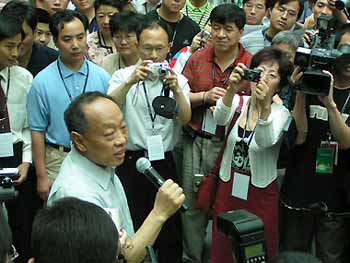
Zhao Hao, a teenage reporter for Chinese Teenagers' News, had a lot to write about after he attended a meeting between Chinese Foreign Minister Li Zhaoxing and his Namibian counterpart, Marco Hausiku, on July 21.
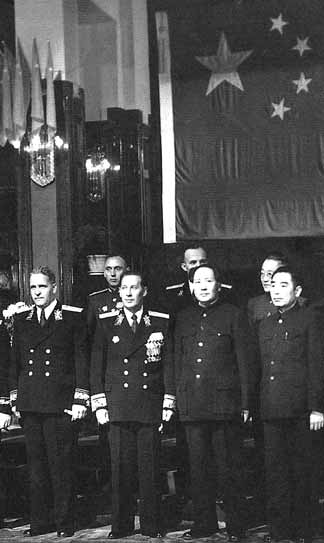
"Foreign Minister Li and his Namibian counterpart held very amiable talks and they seemed to be extremely good friends," Zhao wrote in his report that was published by his newspaper. The report echoed Li's June remark about the job of Chinese foreign diplomats during his brief meeting with a group of the ministry's special guests - international affairs watchers from the Chinese public who often participate in the ministry's online forums and air their views about the nation's foreign policy. Li said he and his colleagues' job is to maintain world peace and make friends while upholding national interests, safeguarding the country's territorial integrity and Chinese dignity. The objectives are to secure a favourable environment for the Chinese people to further improve their lives and realize the age-old dream of the Chinese mainland's reunification with Taiwan island. More emphasis was put on the current Chinese foreign policy by President Hu Jintao at the end of last month, during his address at a national meeting of leading Chinese diplomatic envoys. Hu stressed that China will stick to the independent foreign policy of peace and peaceful development, while promoting peace, development and co-operation to better serve the country's strategic goal of building a relatively affluent society and contributing to world peace and common development. As China celebrates the 55th anniversary of the founding of the People's Republic of China this week, Hu's statement testifies to the fact that China's most recent diplomacy has maintained a distinctive continuity in fundamental principles during the course of its growth and development. A fresh start Months before late Chairman Mao Zedong announced the founding of the People's Republic of China on the Tian'anmen Rostrum on October 1, 1949, he and his colleagues had already started outlining the foreign policy of the New China. Drawing on China's history, its current affairs and the then international environment, Chairman Mao stipulated three points as the basis for the nation's foreign policy. The first and second were "making a fresh start" and "putting the house in order before inviting guests." In September 1949, the National Committee of the Chinese People's Political Consultative Conference, in its first session in Beijing, adopted "the Common Programme of the Chinese People's Political Consultative Conference."
It stipulated: "The principle of the foreign policy of the People's Republic of China is (the) protection of the independence, freedom, integrity of territory and sovereignty of the country, (the) upholding of lasting international peace and friendly co-operation between the peoples of all countries, and opposition to the imperialist policies of aggression and war." A "fresh start" was necessary as Mao and his colleagues considered that the ruling Kuomintang had turned China into a semi-colonial state and that the Old China had cast aside the dignity and independence of the Chinese people and the country's territorial integrity. The Kuomintang had allowed foreigners to run China's customs and continue their colonial concessions in major cities such as Tianjin, Shanghai and Guangzhou, where Chinese had no say in the local affairs and even in affairs that concerned their own welfare. The New China had to turn a fresh page in the country's diplomatic history. It reviewed all the treaties and agreements that the Old China had inked with other countries and gradually cleared up the claims and influence that imperialist countries had within China. The New China was willing to establish fresh diplomatic relations with countries on the basis of mutual respect for sovereignty and territorial integrity, and equality and mutual benefit. Chairman Mao's third point was "leaning to one side," meaning China would ally itself with socialist countries. It was only natural for the leadership of the New China to adopt such a policy as the United States had backed the Kuomintang when it launched the civil war in 1945. Moreover, after the birth of the New China, the United States showed an inclination to carry out armed intervention against it. In contrast, the Soviet Union had long been sympathetic to and supportive of the national democratic revolution of the Chinese people. The Soviet Union was the first country to officially recognize the New China. China and the Soviet Union established diplomatic relations on October 2, 1949, right after the establishment of the New China. In the first decade of the People's Republic, the New China was able to unite with the Soviet Union and other socialist countries, and it actively established and developed friendly relations and co-operative links with the Asian and African countries that had won their independence. As former Chinese Vice-Premier and Foreign Minister Qian Qichen recalled in his memoirs entitled "Ten Stories of a Diplomat," China and the Soviet Union enjoyed the strongest links during the middle of the 1950s. At one point, some 4,000 Chinese students were studying in the Soviet Union, learning Soviet experiences as the New China was trying to build itself up from near ruins. In 1950, when the Korean War broke out, China was forced to send volunteers to the Korean Peninsular after the US bombed Chinese territory. However, China actively participated in the Korean armistice negotiations, during the Geneva Conference for the peaceful settlement of the Korean issue, the restoration of peace in Indo-China (1954, 1961) and in the Asian-African conference (1955). It was in those years that China proposed the Five Principles of Peaceful Co-existence, namely mutual respect for territorial integrity and sovereignty, mutual non-aggression, non-interference in each other's internal affairs, equality and mutual benefit, and peaceful coexistence. The principles were put forward as the fresh but basic norms of developing state-to-state relations that would transcend social systems and ideologies.
They were also clear messages to the United States and the Soviet Union, which were working hard to maintain bipolarity. The US continued to pursue a hostile policy toward China while the Soviet Union, in its efforts to become a superpower, attempted to control China so it could implement its own global strategy. The two countries' differences over such principles concerning international relations and socialism further aggravated Sino-Soviet relations. Starting in 1960, the relations between China and Soviet Union deteriorated. The principles delivered strong opposition to the power politics that had dominated international relations over the last few centuries. China's clear-cut foreign policies were warmly welcomed. From the late 1950s to the end of the 1960s, China established diplomatic ties with many more countries, thus enjoying a second upsurge in its diplomatic successes. China's relations with Western Europe and Japan also made unprecedented progress. And in 1955, China initiated negotiations with the US Government to discuss the possibility of reducing tension in the Far East, especially in relation to the Taiwan question. At the start of August in the same year, Sino-US talks at the ambassadorial level started in Geneva. They lasted until February 1970, with a total of 136 rounds. In 1964, China set up official diplomatic ties with France, which represented a major breakthrough in the normalization of relations between China and major Western countries. At the end of 1969 there were 50 countries with diplomatic ties with China, more than doubling the figure from the end of 1955. |
|
|
|
|
|||||||||||||||||||||||||||||||||||||||||||||||
|
|
|
|
||||||||||||||||||||||||||||||||||||||||||||||||||