|
Home>News Center>China | |
|
|
|
|
|
|
|
|
|
|
||||||||||||||||||||||||||||||||||||||||||||||||
|
|
Internet 'codewords' widen digital gap
Do you know what the following numbers mean: "7456," "246" and "995"? Or can you tell the meaning of these English letters such as "GG," "GF" and "PLMM"?
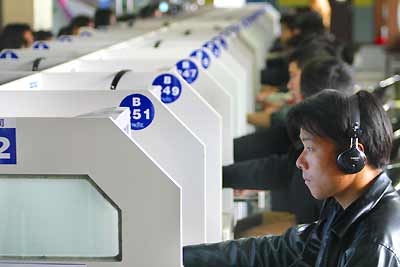
Stay calm and do not lose your self-confidence if you are confused by the questions. They are actually not a test of your intelligence and wisdom but kind of quiz of your know-how about so-called Internet language. In fact, even experienced Chinese linguists and long-standing Chinese teachers are getting puzzled by the new language, commonly used in online Chinese-language chat rooms. The language is becoming more and more popular among the country's more than 87 million Internet users, especially young Internet surfers. It consists of Chinese characters mingled with English letters and words, images, symbols and numbers. Over the past few years, the use of Internet language has become so common that some netizens have compiled a special dictionary consisting of more than 1,000 newly-designed cyber words. These cyber words are roughly classified into four categories - the number, Chinese character, letter and signal parts. The number part includes words consisting of a series of numbers which have similar pronunciations of some Chinese characters. For instance, 7456 is pronounced as qisi wole (I'm extremely angry), 246 as esile (I'm very hungry) and 995 as jiujiuwo (Save me). Included in the letter part are different letter combinations either derived from English abbreviations or pinyin (sounds forming syllables). For example, "GG" means gege (elder brother) while "GF" means girl friend. PLMM is spelled out as piaoliang meimei, meaning beautiful girl. In the Chinese character part are Chinese words composed of Chinese characters that are given newly-defined meaning by Internet users. For instance, konglong (dinosaur) and qingwa (frog) refer to ugly people and cainiao (literally meaning vegetable bird) refer to a green horn. In the symbol part are various combinations of symbols such as punctuations and alphabets, aimed at expressing different expressions. For instance, :-) means a smiling face while (:-...... refers to a broken heart. Lin Yunfu, an associate professor with the Xi'an-based Northwest University, says Internet language is characterized with conciseness, better visualization and strong humour. The language fully reflects the creativity and personality of young people, he notes. The associate professor suggests the public hold a tolerant attitude towards the use of Internet language. "Since it is used in a very limited scope, Internet language has little negative impact on the Chinese language as a whole," he says. Other proponents go further to say that the emergence of Internet language is a normal phenomenon and a necessary stage in the development of Chinese. Some new words from Internet language may finally be accepted by the public to enrich the Chinese vocabulary, they say. Opponents, however, blast the toleration of Internet language as "inappropriate" and "irresponsible." "Some linguists have adopted incorrect attitudes towards the disordered Internet language by calling for toleration and non-interference of the non-standard use of language," says Liu Bin, former minister of education. "Any responsible linguist should criticize and help rectify the disorder." He stresses that the abusive use of Internet language will finally undermine standard use of Chinese and even jeopardize its purity. Educators share the view and warn that young people, especially primary and middle school students, may fall victim to Internet language. "Frequent use of Internet language, though in a small scope, among primary and middle school students will affect their learning of standard Chinese ," says Professor Li Shengmei of Nanchang University in Jiangxi Province. "In the long run, they may not be able to use Chinese correctly and suffer troubles in communication with others." Indeed, her worry has already been testified by media reports that Internet language has been creeping into primary school students' spoken Chinese and even their school work. A teacher in a middle school in Changsha, capital city of Central China's Hunan Province, recently was surprised to see scores of strange words such as "200" and "PMP" in a Chinese composition written by one of her students. The Dongfang Xinbao newspaper reported that the teacher had to ask the student to translate these words into standard Chinese. The student explained that in Internet language, "200" means dongwuyuan (zoo) and "PMP" means paimapi (bootlicker). Meanwhile, more parents reportedly express deep worry about the "digital gap" between them and their teenage children, who prefer to use Internet language to show off their personality. "Is it normal that we cannot even understand what my son says?" a perplexed father was quoted as asking Xinhua News Agency. |
|
|
|
|
|||||||||||||||||||||||||||||||||||||||||||||
|
|
|
|
||||||||||||||||||||||||||||||||||||||||||||||||