|
Home>News Center>China | |
|
|
|
|
|
|
|
|
|
|
||||||||||||||||||||||||||||||||||||||||||||||||
|
|
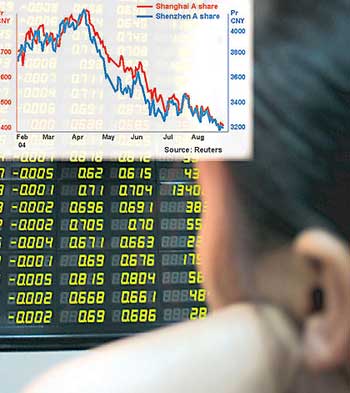
Slipping stock market causes stir among investors
China's stock investors - given that nine out of 10 investors lose money - work in the nation's sixth-riskiest vocation, indicates a recent poll by Beijing-based China Business Times. The nation's stock investors have suffered more family tragedies, social conflicts and crimes than workers in other occupations, the poll indicated.
The findings, however, surprised few people, given the country's US$500-billion A-share market has plummeted to the point where even the most prudent institutional investors - who tend to invest conservatively in large-cap blue chips - claim they have lost considerable amounts of money. The market's freefall, however, has rekindled speculation that China's financial authorities will soon ease restrictions on foreign investors, through the qualified foreign institutional investor (QFII) scheme, so they can buy A shares. There is also speculation China's financial authorities are considering some once-and-for-all solutions to heal the market's fundamental deficiencies - possibly including long-awaited reforms to reduce State-owned stakes in listed companies. But market analysts warn policy-makers must move cautiously with the plan to sell off State-owned shares. Meanwhile, allowing small QFII investors to buy domestic shares will lead to greater volatility of share prices and weigh on the market, they said. "Allowing more QFII investors to buy domestic A shares, the funding channel for the market will clearly be widened, but only marginally,?Zuo Xiaolei, said a financial expert with China Galaxy Securities Co. "But the ... symbolic move by financial authorities will boost investor confidence, which has been severely beaten during the recent market fall." Officials from the China Securities Regulatory Commission (CSRC), the industry's watchdog, the People's Bank of China, the nation's central bank, and the State Administration of Foreign Exchange held a high-profile conference on August 12 to discuss lowering the barriers for QFII investors. Total investments by QFII investors currently stand at a mere US$1.95 billion, a small fraction of the US$500 billion capitalized in China's A-share market. Small and medium-sized foreign investors, especially those from other regions of Asia, will be allowed to enter China's stock market by year's end. The move will encourage more overseas funds to stream into the country's sagging market, while offering domestically listed companies more opportunities to introduce overseas investors as their strategic investors, Zuo said. But the opening of China's stock market to more foreign investors will probably cause more fluctuations in share prices, given the speculative nature of small and medium-sized investors, said Liu Jingde, a senior market analyst with Beijing Securities Co. "In the future, large QFII investors will focus on long-term, strategic investments, while small overseas investors might prefer speculating." China's policy-makers must be cautious "to ensure they prevent the market from tumbling " when they implement plans to sell off State-owned shares, he said. "Reducing State-owned stakes will clearly benefit the market in the long run," Zuo said. "But choosing the best timing, preferably in a bull market, is more important." Shanghai's benchmark A-share index last Friday dipped to 1,314.6, the lowest point this year, indicate CSRC statistics. On July 28, the market value of all floating A shares totalled 1.15 trillion yuan (US$139 billion), below last year's low, on November 13, of 1,307 points. "In a market that does not contain securities for investors to profit by taking a short position, they have to play the buy-and-keep strategy," Liu said. "That is why the four-month-long bearish market has hurt all participants who are enthusiastic about the economy's strong performance."The ups and downs of China's stock market - with more than 1,300 listed companies from more than 30 industries - have, for a long time, had little to do with the country's stellar economic growth, he said. China's economy grew 9.69 per cent in the year's first half, indicate updated statistics released last week by the National Bureau of Statistics (NBS). China's GDP in the period reached 5.878 trillion yuan (US$708.3 billion), NBS said. China's real gross domestic product (GDP) will average around 9 per cent this year, despite the government's measures to softly land the economy, the International Monetary Fund (IMF) said last Wednesday. In contrast, during the 54 trading days from April 7 to June 29, some 380.9 billion yuan (US$46.03 billion) in market capitalization, or 7.054 billion yuan (US$852 million), evaporated daily, indicate official statistics. "China's stock market, given its fundamental problems, is largely irrelevant to how well the economy performs,"Zuo said. "Many of the QFII investors, who bet on the country's fast economic growth, have inevitably experienced losses in the market's meltdown." Six out of 10 large-cap stocks in which QFII investors are involved have, over the past eight months, performed worse than the benchmark A-share index, although the other four stocks - ZTE Telecommunications, Fuyao Glass, Yili Group and Yangtze Power - are generating comparatively fair returns, indicate official statistics. China's mutual fund industry has also experienced considerable losses and has been struggling since the market dropped sharply after it peaked in April. "Mutual funds, with assets more diversified into bonds and convertibles, have seen their investments dwindle, but by a smaller margin than individual investors,"said Liu Bei, a fund manager with China Hua'an Fund Management Co. "Nobody can tell when the market will recover. But if the bearish mood lasts much longer, fund management companies will see more trouble than opportunities." China's mutual funds are now able to buy shares at a lower price compared with four months ago, but fund managers are having more difficulty in selling fund units to investors, she added. The size of new fund IPOs (initial public offerings) shrunk to about 2 billion yuan (US$241.7 million) in the last two months. Comparatively, two fund IPOs - by Fortis Haifutong Fund Management Co and CITIC Fund Management Co - each exceeded 10 billion yuan (US$1.2 billion) earlier this year. China's mutual funds, including 57 funds established prior to April 7 and 19 funds established between April 7 and June 30, have suffered a combined loss of nearly 10 billion yuan (US$1.2 billion) in the past four months, indicate CSRC statistics. |
|
|
|
|
|||||||||||||||||||||||||||||||||||||||||||||
|
|
|
|
||||||||||||||||||||||||||||||||||||||||||||||||