|
Home>News Center>China | |
|
|
|
|
|
|
|
|
|
|
||||||||||||||||||||||||||||||||||||||||||||||||
|
|
Hainan sets agenda for development
Walking in downtown Haikou, capital of South China's Hainan Province, one can still find some of the brooding skeletal concrete structures local people call lanweilou, or unfinished buildings, left unfinished mostly because of lack of capital. They stand out starkly, quite out of keeping with the hustling city life around them.
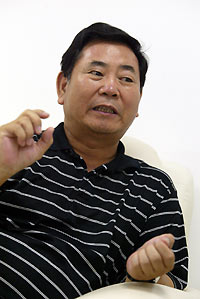
Even people who have only a limited knowledge of Hainan's recent history are likely to remember the property investment frenzy that hit the island in the early 1990's, when investors swarmed to this tropical paradise seeking quick profits, but which was soon followed by the institution of national macro economic controls and the Asian financial crisis, resulting in the bursting of the economic bubble, especially in the real estate sector. Since that time, investors have largely been turning a blind eye to the province. Fully aware of the bumpy financial road Hainan has traversed, the newly elected governor seems determined to open a dynamic new chapter in the economic life of this tropical island province. Before taking up his current post, Wei was the chairman and chief executive officer of the China National Offshore Oil Corp (CNOOC), the country's youngest and fastest-growing oil company, which is listed on the Hong Kong and New York stock exchanges. Wei was appointed acting governor of Hainan in October last year and was elected governor in February of this year. "The provincial leadership has already worked out a development strategy emphasizing economic efficiency, harmony and sustainability, and my job is to fully implement this strategy," said Wei during a recent interview with China Daily. He explained the strategy as focusing on developing new industries, tropical agricultural products, and high-quality tourism options which are unique to Hainan. Hainan's industrial sector has long been weak, with nothing more than an automobile manufacturing company, a power plant and a chemical firm as its major industrial players. The sector accounted for only about a quarter of the province's 69.83 billion yuan (US$8.41 billion) economic performance last year, with agriculture and the service sector taking up 36 and 38 per cent respectively. But now, Hainan is again attracting investment in its industrial sector, the governor said. A 16 billion yuan (US$1.93 billion) tree-growing and paper pulp project invested by Asia Pulp & Paper Co started full-scale construction last year. A fiber cable plant in Haikou owned by Korea's Samsung is expected to go into operation in November. Dutch chemicals giant DSM is expected to sign a deal to invest in a plant this month. Sibelco from Belgium is in talks for quartz sand exploration, and a US glass maker has expressed interest in investing in Hainan. To build up its industry, Wei explained, the island will try to attract investment in large projects with new and high technology. Oil, natural gas and related industries can take advantage of the bountiful resources off the coast of Hainan to become a new economic pillar for the province. The government is hoping that construction of a 6 million-ton oil refinery project will start soon this year. Priority on environment When asked whether these new projects would cause any pollution to the relatively clean environment of the island, Governor Wei said, in a rather definite tone, "No, we will never let that happen. All these projects have been okayed only after environmental impact studies indicated that they would not pose a threat to the island's ecology." The provincial authorities have decided that all the industrial projects must meet world environmental protection standards, and that they should mostly be located in the western part of the province, in the Yangpu and Laocheng economic development zones and Dongfang and Changjiang cities, reserving the rest of the island mainly for the development of tourism. Polluting, resource-damaging and redundant low-level projects will not be approved, Wei said, stressing that "without a beautiful environment, Hainan would not be the Hainan people dream of visiting." Wei noted a price has to be paid to keep a reasonable balance between developing the economy and protecting the environment. He recalled a case in which a magistrate from a poor county came to him seeking for approval for a proposed million-ton cement plant in the county, which would be of great help in lifting the local people out of poverty. The proposal was turned down. "We must stand firm. We cannot leave a polluted environment to our children, their children and the generations after them," Wei said. At a recent conference in the Pan-Pearl River Delta Region, Wei told delegates from other provinces that Hainan would say no to any polluting firms seeking to move to the island, although Hainan is more than willing to participate in and contribute to regional co-operation. The Pan-Pearl River Delta Region is an economic bloc in South China, consisting of eight provinces, one autonomous region and Hong Kong and Macao, which was set up last month. Ambitious plan A well-protected environment is vital to developing tourism, another pillar of the province's economy. Although the ocean, beaches and tropical scenery are every bit as inviting as those of Hawaii, Hainan has yet to become a strong tourism province, Wei said. The future of the sector lies in high-quality planning, infrastructure construction and efficient management, he said. "We will invite world-class tourism planners to work out an overall strategy," Wei said, "and stop the old practices, which allowed small investors to gain access to a scenic spot and build poorly-designed tourism facilities that damaged the natural beauty of the area." Wei pointed out earlier last month that tourism development projects in Hainan would cost at least 100 billion yuan (US$12.05 billion). The government has set a goal of quadrupling revenue from tourism in 10 to 15 years. Hainan's tourism sector generated 9.36 billion yuan (US$1.13 billion) in revenue last year. A stronger tourism industry should lead to a boom in the property and transportation sectors and other related industries, Wei said. That all the uncompleted property developments in the resort city of Sanya and 70 per cent of those in Haikou left after the burst of the property bubble are now back on track, is an encouraging sign, he said. Official statistics indicate that the area of residential developments and sales surged by 94 per cent and 91 per cent, respectively in Hainan last year, with the average unit price rising 19 per cent. "People have started to come to Hainan to invest in land, but we are not going to allow the creation of bubbles this time," he said, adding that the government would keep strict control of land planning and allocation. Hainan also hopes to expand its civil aviation industry, following acquiring approval of a fifth air traffic flight route for foreign airlines on a trial basis in March last year. The fifth air route gives civil aircraft from one country the right to land in a second country to pick up passengers and then fly on to a third country where the passengers deplane. Also on the island's agenda is its plan for a bigger financial services sector, including setting up a share-holding commercial bank, restructuring of Hainan Securities Co and the introduction of one or two foreign banks on the island. Efficient execution Now that all the island's goals have been defined, Wei's next task is to see that the new government policies are properly implemented. "Our officials at various levels are by no means lacking in good ideas, but the execution of those ideas has been a big issue," he said. He has set efficient execution of administrative policies as his top priority as governor. Having attracted wide attention in the media as a former entrepreneur who turned his hand to the challenge of acting as a provincial governor, Wei said he has basically completed the transition to his new role, pledging to ensure continuity of the policies set by the provincial government in the past few years. To his delight, Hainan recorded the first double-digit growth rate in its economy since 1995 last year - 10.5 per cent - and signs of economic recovery have emerged, he said. Instead of blindly racing to turn the island into a so-called economic power or chasing after GDP growth, Wei says he will devote himself to enhancing the real economic strength of Hainan. As a CEO, his motto was: "Maximize shareholder's interest." And as a governor, he said he wants to see real benefits come to the people of Hainan. |
|
|
|
|
|||||||||||||||||||||||||||||||||||||||||||||
|
|
|
|
||||||||||||||||||||||||||||||||||||||||||||||||