|
Home>News Center>China | |
|
|
|
|
|
|
|
|
|
|
|||||||||||||||||||||||||||||||||||||||||||||||||||||||||||||||||||||||||||||||||||
|
|
Drought, floods likely to continue
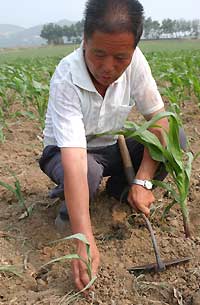
The dry weather in North China, increasingly evident in ongoing and continuous droughts, may very likely continue for the next five to eight years due to cyclic variations of the climate in East Asia, scientists say.
Huang, speaking at an international symposium this Monday, said rainfall has been steadily shrinking over the past half century in North China but the situation has worsened particularly in the past few years. Drought has struck the area twice every three years on average, causing serious problems to the local economy and people's livelihood. "The only solution to the problem is water conservation," Huang said. Drought is not the only type of disaster belting China. Two sides of a coin Southern parts of the country have been suffering from excess rainfall and floods. In 1998, the Yangtze River, the largest river in China, swelled and led to the worst flood in 40 years, claiming 3,000 lives. Four decades earlier, a similar flood claimed 10 times more lives. In the meantime, floods have been a constant threat in southern China. Droughts and floods cause approximately 200 billion yuan (US$24 billion) in damages each year, according to Huang. For Huang, a researcher with the Institute of Atmospheric Physics under the Chinese Academy of Sciences, the drought-versus-flood phenomenon shows two sides of one coin. Both are consequences of a series of climatic events resulting from variations of the East Asia Climatic System. The cyclic movement of the climatic system seems to be the major reason behind the climatic anomalies in East Asia, including China, over the past few years, Huang noted in a key-note speech at the International Chinese Ocean-Atmosphere Conference held in Beijing. The drought-versus-flood phenomenon in northern and southern parts of China has been of great interest to atmospheric scientists. It is not the only such scenario in the world. A study by researchers from the School of Natural Resource Sciences of the University of Nebraska at Lincoln in the United States shows alternating dry and wet periods seem to have happened periodically over the past 500 years. Based on climatic records, researchers Qi Hu and Song Feng found historic evidence that when a dry condition or drought was observed in southern China, a wet or flood situation was found in the northern part of eastern China and vice versa. The phenomenon, it seems, tends to happen over ever-shorter periods today. Observational records show that rainfall in East Asia has generally increased since 1880, though only very slightly. But the region has begun to experience more dry years since the early 1960s. Huang and his colleagues' research suggested today's severe drought in North China is just part of that process. Statistics of the past 50 years suggest the dry weather seems to have migrated from northwestern China eastward to North China, said Huang. Rainfall has steadily increased over the past 50 years in China's northwestern region, dominated by deserts and mountains. "It is quite an interesting phenomenon as people used to think northwestern China has the least rainfall in China," said Huang. "It is true, in part, but few expected the rainfall there has steadily increased," he added. But the increase in rainfall has largely been offset by the high rate of evaporation there, making it less palpable. Coinciding with that trend, drought seems to have taken root in North China. The Yellow River, the major river running through North China, has gone through ever-longer periods of dry-ups, while the water source in Beijing has shrunk by around 50 per cent in 30 years. In fact, drought has become the top disaster in China, Huang said. Reasons for climate anomalies The dry weather in North China, matches a periodical climate process in East Asia, Huang says. And there is little people can do about it. "Although human activity has played an increasingly influential role in climatic variations, it still is minimal when compared to the power of nature," he said. Some researchers have blamed human activity supposedly the leading cause of global warming for the persistent drought in North China. Huang disagrees. Seemingly conflicting drought-versus-flood phenomenon can hardly be explained by human activities, he said. If people have contributed to the persistent drought in North China, it is hardly conceivable that they could have had the opposite effect on the climate in southern China at the same time. Huang and his colleagues have come up with a set of theories and models to describe and explain the recurring climatic anomalies in China. Their preliminary conclusion is that the drought-versus-flood anomaly may have been the result of the inter-annual variation of the East Asia Climate System, in which the Qinghai-Tibet Plateau, the highest in the world, and the Warm Pool in western Pacific Ocean played a crucial role. The Warm Pool refers to the body of water that spans the western section of the equatorial Pacific to the eastern Indian Ocean. This area holds the warmest sea water in the world. Scientists found that, over a period of roughly two decades, the Warm Pool's average annual temperatures and dimension increase and then decrease like a slowly pulsating beacon. Huang and his colleagues' research found that the oscillation of the Warm Pool seems to have a direct impact on the atmospheric circulation influencing weather in China. They also found the inter-annual thermal variation of the air over the Qinghai-Tibet Plateau may have a direct correlation with flooding in the Yangtze River running through southern China. For instance, it has been observed that air temperature variations over the Qinghai-Tibet Plateau have led to an increase in the snow cover which in turn gives rise to flooding the next summer, said Huang. Based on their models, they successfully forecasted the onset of the La Nina event from 1999 to 2001 that caused severe drought in China. Notwithstanding that, Huang admitted to the complexity of climatic variations, saying they will keep close watch of the drought-versus-flood phenomenon in China, which may create new and challenging scenarios in the years to come. |
|
|
|
|
||||||||||||||||||||||||||||||||||||||||||||||||||||||||||||||||||||||||||||||||
|
|
|
|
|||||||||||||||||||||||||||||||||||||||||||||||||||||||||||||||||||||||||||||||||||