|
Home>News Center>China | |
|
|
|
|
|
|
|
|
|
|
||||||||||||||||||||||||||||||||||||||||||||||||||||||||||||||||||||||||||||||||||||
|
|
Control on breast milk substitutes urged
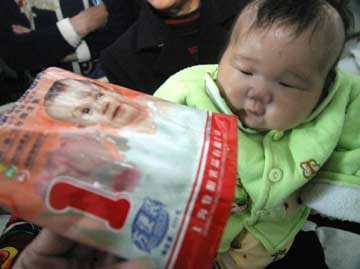
An allout war against fake powdered milk has been launched across China following the deaths of 12 babies from malnutrition in Fuyang, in East China's Anhui Province. Investigations have revealed the infants, aged between four and six months, died after being fed milk powder with little, if any, nutritional value.
As a result of consuming these products, More than 100 other infants in Fuyang are suffering from "big head disease," so-called because their heads grew abnormally large, while their torsos, arms and legs were reduced to skin and bone. Experts say that some of these babies may suffer from further problems as they grow up. Worst of all, is the fear that killer milk powders like this could affect tens of thousands of other infants across the country, if their existence is not discovered in time. The incident shocked the country, where at least 13 million babies are born each year, with over one-third of them mainly being fed breast milk substitutes for the first six months of their lives. To date, a total of 47 people have been detained in the fake milk powder incident in Fuyang, which was exposed last month. The case involves 40 enterprises spread over 10 provinces. Breastfeeding imperative "The deaths of the babies (in Fuyang) might have been avoided if they were breastfed," said Dai Yaohua, a senior researcher with the Beijing-based Capital Institute of Paediatrics (CIP). An increasing body of scientific evidence, especially in recent years, indicates that breastfeeding and the use of human milk for infant feeding offer diverse and compelling advantages for infants, mother, families and society. Epidemiologic studies have shown that human milk and breastfeeding have positive effects on growth, development and the general health of children. For babies in developing nations, experts say that breastfeeding is even more imperative, as babies' very survival largely depends on the immune-boosting properties of mother's milk.
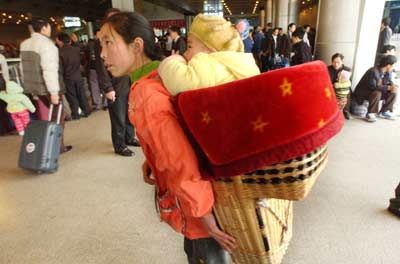
However, a survey found that less than 58 per cent of the infants born in 2000 were breastfed in Anhui Province, where "big head" infants were first reported. The number of babies in China fed exclusively on breast milk during their first four months of life has declined from around 76 per cent in 1998 to only 64 per cent today. In urban areas, maternity leave can be as long as seven and a half months for working mothers with stable incomes, meaning that they are in a position to be able to breastfeed their babies for the first few months, but nonetheless, the use of infant formula milk is on the rise. Mothers in rural areas, however, have to give up breastfeeding within six months because more and more of them are moving to cities to work as migrant workers. In Fuyang, many mothers were found to have gone to work in urban areas before their babies were six months old. The babies are usually left in the care of their grandmothers, who frequently are unable to distinguish genuine from fake infant formula. Investigations have shown that poor families, particularly in rural areas, often dilute costly formula with unclean water and mix it in unclean bottles, adding to the risk of illness among infants. Behind the tragedy Experts also attribute the recent tragedy to irresponsible promotion and marketing of breast milk substitutes. "The real issue is the increasing use of breast milk substitutes in China for infant nutrition, with insufficient attention being paid to the quality of the substandard powdered milk," UNICEF authorities said in their latest report on the issue. Last summer, Dai and other CIP experts participated in an International Baby-Food Action Network (IBFAN) project, monitoring how the International Code of Marketing of Breast milk Substitutes was observed in six major cities in China, including Beijing and Shanghai. The code, adopted by the World Health Assembly (WHA) in 1981 and recommended to its member states, bans all advertising and promotion of breast milk substitutes to the general public. The code applies to all products marketed as partial or total replacements for breast milk, such as infant formula, follow-up formula, special formula, cereals, juices, vegetable mixes and baby teas. It also applies to feeding bottles and nipples. Entitled "Monitoring Code Compliance in China," the report submitted by Dai and her colleagues is trying to look into what such promotion is doing and how it has undermined breastfeeding for mothers and their infants. And they found that relentless promotion of breast milk substitutes has affected breastfeeding patterns in China. Infant health in China is under attack, the IBFAN report cries out, saying that "with the opening of the lucrative market, foreign companies have swarmed to the country like flies to a honey pot." Advertising promoting breast milk substitutes, including powdered milk, for infants, although banned by the international code, can be easily found in shops, supermarkets and many of the so-called baby-friendly hospitals, which are becoming increasingly financially dependent on baby-food companies to carry out their services and activities. Baby-friendly hospitals are identified by the Ministry of Health for better mother/baby service. Media blitzes coupled with some hospitals' activities have given millions of Chinese parents wrong ideas about infant feeding. "The health of following generations of the Chinese nation might be threatened if breastfeeding is replaced by milk powder," said Cao Bin, an official with the Ministry of Health. According to Cao, the present breastfeeding rate during the first four months of life in China is much lower than the target breastfeeding rate set by the government in its "Outline Plan for Chinese Children's Development, 2001-10." The plan specifies that the rate should reach 85 per cent across China by the end of the period. Although there is a special regulation in China which stipulates rules for the marketing of breast milk substitutes, enforcement remains a problem. Six governmental ministries and agencies including the Ministry of Health and the State Administration of Industry and Commerce are jointly responsible for the enforcement of the regulation. With so many parties involved, lack of co-ordination has made it difficult to implement the Rules Governing the Administration of Marketing of Breast milk Substitutes, which embody the principles set out in the international code. Action needed Before the monitoring, experts were already aware of the fact that the ever-increasing promotion of breast milk substitutes posed serious problems for breastfeeding in China. Sponsors of the monitoring programme, including the Ministry of Health and UNICEF, are seeking countermeasures to raise breastfeeding rates in China. UNICEF says "the recent tragedy (in Fuyang) may be seen as 'a wake-up call' to the medical community, the health systems and the community at large to take action now to restore breastfeeding." The Chinese Government was urged to take action against random promotion of breast milk substitutes and to intensify administration and supervision of health facilities. The State Administration of Industry and Commerce, a watchdog for advertising violations, was also asked to participate in the action. Experts also urged health authorities to re-assess the qualifications of baby-friendly hospitals. IBFAN hopes to extend surveillance of code compliance to all hospitals that deal with babies, especially paediatric hospitals, where such products are aggressively promoted. The government, IBFAN suggested, should conduct continuous and systematic monitoring to determine the effectiveness of regulations concerning the promotion of breast-feeding substitutes, which will facilitate the review of the existing law and policies affecting the feeding of infants and young children. |
|
|
|
|
|||||||||||||||||||||||||||||||||||||||||||||||||||||||||||||||||||||||||||||||||
|
|
|
|
||||||||||||||||||||||||||||||||||||||||||||||||||||||||||||||||||||||||||||||||||||