|
Home>News Center>Life | |
|
|
|
|
|
|
|
|
|
|
||||||||||||||||||||||||||||||||||||||||||||||||||
|
|
Va people celebrate progress
A gala show with hundreds of local residents of the Va ethnic minority dancing and singing on Sunday kicked off a two-day carnival in Cangyuan, a remote county in Southwest China's Yunnan Province on the border between China and Myanmar.
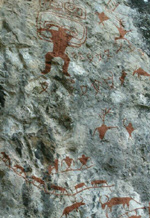
Thirty-nine years ago, Yunnan College of Ethnic Minorities archaeology professor Wang Ningsheng arrived at the foot of a cliff in Cangyuan, about 400 kilometres southwest from Kunming, the provincial capital. Called "padianm," meaning "cliff with paintings" in the local tongue, the Va people came to the cliff to pay their respects to ancient drawings there. When Wang set his eyes on the dark red and deep brownish sketches, he was amazed. The ancient cliff paintings, spreading out over 60 square metres, vividly portrayed the lives of the earlier settlers. He and other experts dated the cliff paintings back 3,000 years to about the 9th century BC. After extensive treks, Wang and other researchers discovered about 1,063 individual cliff paintings, spreading over a stretch of 20 kilometres in the mountains in the northern part of the county. The drawings feature some 785 human figures, 187 animals, 25 houses, 13 roads and some 35 symbols, in addition to images of trees, boats, caves, the sun, clouds, mountains and pastures. Standing before the cliff paintings, a number of ethnologists and historians have taken to the notion that history was almost frozen in this part of the country. The lives and customs of the local Va people hadn't changed much over the centuries. Enclosed in the Ava Mountains, the county area covers some 2,000 square kilometres, with only narrow mountain trails leading to the outside world. It takes about seven days trekking in the mountains and forests before one arrives at the closest road.
Although the region has plenty of rainfall and is suitable for growing dry rice, maize, millet, buckwheat, tobacco, sugarcane and other crops, the harvest barely yielded enough to fill the stomachs of the Va people for four to five months, Li Yueqing recalled. They also hunted for necessary proteins. They worshipped nature, believing that the mountains, rivers and other natural phenomena had their deities. They still engaged in barter trade but were shy traders, often watching their produces displayed at the local fairs from afar. They experienced considerable bullying from cunning tradespeople - most of them Han - from outside the mountains, and did not trust them. Social and economic progress was so slow that even in the county town centre, there were only three houses with tiled roofs. Of the 50,000 Vas, only one Va finished primary school. The Va spoken language belongs to the Austroasiatic family and before 1949, the Va people had no written language. They kept records and accounting or passed messages by using various objects, or by engraving bamboo strips. While sugarcane, bananas or salt symbolized friendship, hot peppers signified anger, feathers meant urgency, and gunpowder or bullets the intention of tribal wars.
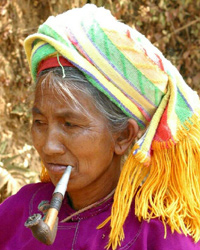
With all kinds of assistance from around the country, the Va people embarked on a journey towards modernization. The first rammed earth road leading to the outside world that stretched 120 kilometres was built in 1958. That year, the first motor vehicle entered the county centre. Modern villages have replaced the old tribal settlements. Upon entering Wengding Village, a hilly hamlet about 50 kilometres away from the county seat, visitors invariably are drawn to the newly opened primary school, attended by some 70 students. Li Liuren and the other four members in his family live in a wood house with a thatched roof, along with rice paddies and some hilly land on the property. "We villagers have learned from the Dais to grow rice and vegetables and raise our own pigs and sheep," Li said. "We have also learned how to grow tobacco and sugarcane. We have no problem getting enough to eat and clothe ourselves." Today, the Va people in Cangyuan number about 140,000, accounting for some 80 per cent of the county's population. The rest of the county residents are of the Han, Yi, Dai, Hani, Lahu, Jingpo, Blang, De'ang and Lisu ethnic groups. In China, the Va population is 352,000, living in Cangyuan as well as in Ximeng, Menglian, Gengma, Lancang, Shuangjiang, Zhenkang and Yongde counties in Yunnan. According to Hong Bin, the county magistrate and himself of Va origins, the county today has paved some 400 kilometres of asphalt roads so that all of its 93 villages have better access to roads. The county now has two six-year middle schools, eight junior middle schools and a vocational middle school. Some 280 primary schools are spread out across the county in villages. As a result, 90 per cent of school-age children now study in schools. Over the past four decades, more than 1,000 Va people from the county have completed college education, Hong said. The county also has 11 hospitals, with each township having a hospital to provide medical care to local residents. In the past, the local people only knew a little about agricultural practices, but today, they have developed industries such as mining, building materials, leather-making, sugar and tea processing, hydraulics and electricity-generation. Barter trade is now a thing of the past. In fact, the local tradespeople have better organized themselves and are now able to carry out transactions with the people the world over. While experiencing these changes, the Va people have preserved their own ethnic cultural heritage and made efforts to display their proud history to the outside world. At present, between 700 to 800 young Va women and men are on performing tours throughout the country and the world. The villagers have also maintained many of their folk traditions. At Wengding Village, whose historical records go back several hundred years, the residents have insisted on electing a village head specialized in hosting village festivities and religious ceremonies, according to Li Wenbing, the head of the village committee. Despite all this progress, the county will still have to work harder to help those who are still suffering from financial difficulties. Li Liuren said that now with enough to eat, they worry about furthering their children's schooling once they finish primary school. "We have trouble making enough money to support our children in middle school," he said. "They may have to drop out if we cannot afford the fees." Notes about the Va ethnic group Costumes Va clothing is generally black. Men wear black, collarless jackets and short, loose trousers, often with a black or red turban on their head. Young men may also be seen wearing earrings with tassels. The women, too, wear collarless jackets, but along with skirts patterned in black, red, purple, blue and yellow. They keep their hair long and braided at the back. They wear a headdress that is a collection of silver bands combined with a headscarf. The women also wear long, silver earrings. Their 10-centimetre-wide bracelets are a particularly important ornament for them. A woman's age can be determined from the small bands of rattan or bamboo worn around her wrists or ankles - for each year of her life, a new one is added. Religion The Va are worshipers of nature. The highest god in the Va pantheon is Mujij, who had five sons who were the deities in charge of the creation of heaven, earth, lightning, earthquakes and bringing up the Va people. There are also deities of water, trees and so on. Even stomach aches and itchy skin are believed to be caused by gods. Many Va families make their own sacrificial offerings. The Va ethnic group holds not only these ancient beliefs, but also follows Buddhism and Christianity.
Performing arts Singing and dancing are very important in the lives of the Va people. They dance and sing during religious ceremonies, daily work, funerals and weddings. The wooden drum The wooden drum, called the Keloke is the most important instrument in traditional sacrificial ceremonies, as well as the traditional instrument and an early-warning device. With a hollowed tree trunk as the main body, the drum is usually 2-metres-high and measures 50 centimetres to 1 metre in diameter. The drums are divided by gender. The male drum produces a low and heavy timbre, while the female drum gives off higher and clearer tones. These pairs of drums are usually kept at the drum house, built with six pillars and three girders. The drum house is always the landmark of a village; some villages even have more than one drum house. Va people believe that the drums are the vehicles with which they can communicate with the gods and the heavens. |
|
|
|
|
|||||||||||||||||||||||||||||||||||||||||||||||
|
|
|
|
||||||||||||||||||||||||||||||||||||||||||||||||||