|
Home>News Center>World | |
|
|
|
|
|
|
|
|
|
|
||||||||||||||||||||||||||||||||||||||||||||||||||||||||||||||||||||||||||||||||||||||||||||
|
|
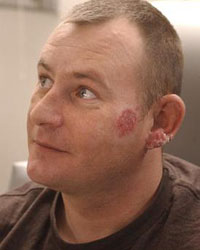
'Baghdad Boil' afflicting US troops Eric DiVona didn't notice the small bumps on his face and left earlobe until he returned from serving nine months in Iraq. Nothing much, he thought, probably just a spider bite. But soon those bumps erupted into open sores, one growing to the size of a half dollar.
The left side of DiVona's face puffed up, a swelling that wouldn't go away. And he noticed he was not the only one in his unit with such symptoms.
"A lot of people started coming down with sores," he said, sitting at Walter Reed Army Medical Center with an IV taped to his right arm. "It was like, 'You ain't cool unless you got it.'"
Scientists and doctors refer to the disease caused by the parasite as cutaneous leishmaniasis. But soldiers serving in sand-fly rich Iraq call it, with little affection, the "Baghdad boil."
The sores are not painful or contagious, but left untreated they can last up to 18 months and leave permanent, burn-like scars. Since the flies bite exposed areas, many soldiers have sores on their necks, faces and arms.
Doctors at Walter Reed have seen 653 cases of leishmaniasis, and the hospital's infectious disease wards until recently overflowed with soldiers undergoing a 20-day treatment regimen.
"We see a few cases every year, but not the numbers we saw come out of Iraq," said Col. Dallas Hack, chief of preventive medicine at Walter Reed.
The military has made a big effort to treat leishmaniasis, even pulling soldiers out of the field who have confirmed cases and flying them back to Washington for medical care.
But Walter Reed doctors say it was almost inevitable that they would see a high number of cases this year.
Leishmaniasis occurs in hot and tropical countries where sand flies dwell, Hack said. Still, only about 20 soldiers got leishmaniasis during the first Gulf War, and a handful more contracted it in Afghanistan.
This time, though, American forces arrived in Iraq during the peak season for sand flies and were in the field much longer. Many slept outside at night, exposing themselves at the sand fly's favorite feeding time.
Iraqis have also done little to control the problem, such as using insecticide to kill off the flies, Hack said. Local residents have come to accept the disease, he said, exposing young children to sand flies in hopes of building immunity.
Doctors have told soldiers in Iraq what to look for and implored them to wear bug spray. Medical teams with front-line combat troops have tested sand flies for the parasite.
But with enemy bullets flying, the first concern of most soldiers was not slathering on bug spray every morning.
"You didn't think about leishmaniasis too much," said Maj. Eric Moore, who contracted the parasite on the Iran-Iraq border with the 4th Infantry Division.
The lesions will eventually go away on their own and would not affect a soldier's ability to serve. Even so, the military thought it was important that soldiers with bad cases be flown out of Iraq for treatment so they wouldn't be disfigured.
In Moore's unit of about 750 men, more than 200 came down with leishmaniasis during a 10-month tour that ended in March. He was relatively lucky — he has only one quarter-sized sore on his left arm. Others had lesions all over their bodies, he said. Moore isn't too worried about scarring. He predicts it will delight his children, especially his 3-year-old, who has a fascination with Band-Aids. "They will probably think it's cool," he said while getting his daily dose of a drug called Pentostam. "They'll probably say, 'Daddy has an ouchie.'" "For most soldiers, it isn't a war stopper," said Lt. Col. Glenn Wortmann, an infectious disease physician at Walter Reed. "But most patients want treatment so the thing will go away." Walter Reed is one of only two hospitals where patients are sent because the treatment can only be done in a clinical trial setting. With domestic cases a rarity, Pentostam is not licensed in the United States. However, the Army is developing a treatment that can be used in the field. Many soldiers didn't realize they had the boils until weeks after exposure. DiVona remembers being bitten constantly by flies, but he and other members of his unit didn't see any sores until after they got home in November to Fort Campbell, Ky. |
|
|
|
|
|||||||||||||||||||||||||||||||||||||||||||||||||||||||||||||||||||||||||||||||||||||||||
|
|
|
|
||||||||||||||||||||||||||||||||||||||||||||||||||||||||||||||||||||||||||||||||||||||||||||