
|
2004Edition>News Center>Life | |
|
|
|
|
|
|
|
|
|
|
|||||||||||||||||||||||||||||||||||||||||||||||||||||||||||||||||||||||||||
|
|
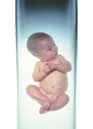
Storm in a test tube The recent clarification by the Health Ministry of the ban on all medical sectors from providing test tube baby services to single women, seems to have drawn a conclusion to the long disputed issue about whether single women have the right to bear a child.
The Jilin Provincial People's Congress, as the first and also the only one to challenge the country's ethical stance by writing into its regional law the position that single women are entitled to bear a child with the assistance of medical technology, has now once again caught the attention of those concerned about the destiny of this sharply disputed law. Under the law, women who have reached the age of marriage but choose to remain single can apply to have a baby with the help of medical technology, such as test tube baby services. In China reproduction without marriage has long been treated as illegal, and this is still the situation in all places except Jilin. From September last year China's Population and Family Planning Law came into effect. Different provinces and municipalities could, according to their own economic and demographic situations, establish their own regional laws. After two months, the Jilin Congress passed its regional population and family planning law which for the first time included the controversial right for single women to seek medical assistance to have children. Minority rights During the period of legal review, reporters asked the legislators how they thought the new law could be reconciled with existing policies issued by certain ministries which ran against such "unnatural" reproduction. Zhang Manliang, a local official who also participated in the legislation, was quoted as saying that it was normal for new laws to conflict with old standards, as society was changing and new situations have appeared. Yet it seems that the central government doesn't see eye to eye with Jilin.
He said the new standard set by the ministry actually meant that hospitals are not allowed to provide "illegal" medical services to assist single women bear a child. But in Jilin, as there is already a law which the medical sectors can follow, this is surely not illegal. Besides, the province hasn't received any notification from the National People's Congress questioning the new law so far. Over the past year, quite a few women have dialed the commission asking about the law, yet no one has so far stepped forward to bear a test tube baby. "We clearly understand that only a few people would really do that, but it doesn't mean that we can neglect their rights just because they are few in number," Zhang Manliang said. "In our past legislation, we paid a lot of attention to protecting the rights of the majority. Sometimes we neglected the demands of the minority, which is unfair." With the development of technology, the province would consider giving similar rights to men, the official said. In his eyes, legislation should not be designed to restrict people. Instead it should ensure as much right and freedom for citizens as possible, so long as this does not violate social order. If the law wins applause, it is mainly because of its respect for human rights. Liu Linping, a professor from Zhongshan University, praised the law as a great contribution to the country's legal development. "With the development of society, ever more people choose not to marry. How to protect the rights of these people will become an important social issue," he said. "The legislation is a sign of progress in terms of adapting to the developing of society's economic, technological and cultural situation." Worries and disputes Mixed with the applause are also worries and objections. It seems that the "landmark" event in Jilin has not been greeted warmly by business insiders in Shanghai. Sheng Guoming, director of the Legislation Division of the Shanghai Municipal People's Congress, said his first response to the news was that Jilin might get itself into trouble. "Those policies which relate to people's basic rights and obligations should be made by the National People's Congress," he said. "Jilin is on the brink of making a law which is not within their authority, and this will be a great threat to the law's further survival." More importantly, the law has posed a direct challenge to the country's - and the world's - longstanding ethics of the family and reproduction. "It has actually separated reproduction from marriage and sex," Sheng said. "People should remember that they are members of just one of the races in this world, under the control of natural law. But if even legislators have forgotten that, it could be really terrible." Echoing his words, Gu Jun, a professor from Shanghai University, said Jilin's legislation is actually toppling the marriage system. "Even in foreign countries, there is no such law - giving women the rights to be mothers without a father being involved," said Xia Yi, from the Shanghai Population and Family Planning Commission. Another worry is that the law stipulates that only those women who are determined not to marry for the rest of their lives are entitled to the reproductive right. But what if a woman was to fall in love with a man later? Would it mean her right to get married had been impaired? If so, a law intended to give additional rights to people may actually deprive them of their existing rights. Fortunately, Jilin has also noticed the contradiction here. In the explanation of the law, it clarified the situation. Women can still marry, even after a medically assisted pregnancy, and if the man has no child, the couple can also have a baby. "But that actually increases the chances of bearing two children, which may not be appropriate in China which is still under pressure from an excessive population," Xia said. The new practice has also added more chances for "incestuous" marriages, since the children's "fathers" - the sperm providers - are unknown. Another sharply disputed point was whether the legislation violated children's rights. The child, once born, had to face an identity problem. From neither the biological perspective nor from the social perspective would they be "natural" people. "If there was a way to consult their opinions, I think few of them would choose to be born into the world in this way," Sheng said. "The most basic right of children is to have a father and a mother, since the parents' roles are irreplaceable. But these children would not even know who their fathers were. It would be hard for them to lead a normal life, like other children." It might be too early to say whether the Health Ministry's latest standard will put a stop to the dispute, or merely re-start it at a new level. |
|
|
|
|
||||||||||||||||||||||||||||||||||||||||||||||||||||||||||||||||||||||||
|
|
|
|
|||||||||||||||||||||||||||||||||||||||||||||||||||||||||||||||||||||||||||

 The newly issued standard by Health Ministry is no doubt a
hard blow to the province, but it hasn't frightened it into backing down. An
official from the provincial Population and Family Planning Commission, who
refused to give his name, said they had no intention of changing their law at
the moment.
The newly issued standard by Health Ministry is no doubt a
hard blow to the province, but it hasn't frightened it into backing down. An
official from the provincial Population and Family Planning Commission, who
refused to give his name, said they had no intention of changing their law at
the moment.



