|
English>News Center>lifestyle | |
|
|
|
|
|
|
|
|
|
|
|||||||||||||||||||||||||||||||||||||||||||||||||
|
|
Qu Yuan to rise again Zigui, a small county in the western part of Central China's Hubei Province, is known to visitors as the hometown of Qu Yuan, a great poet and statesman of the Warring States Period (475-221 BC).
With the completion of the second phase of the damming of the Three Gorges Reservoir in June 2003, the water level rose to 135 metres, inundating a large part of the centuries-old county proper. A total of 100,000 residents of this area have been relocated to make way for the dam project over the past years. Meanwhile, efforts have also been made by local authorities and experts from all over the country since 1994 to save the precious historical and cultural heritage of the county, as has been done in other areas in western Hubei Province and eastern Chongqing Municipality. A blueprint has been mapped out for a large-scale relocation and reconstruction project for a cluster of historical and cultural items in the Fenghuang (Phoenix) Hill historical heritage site, which is called the "Qu Yuan Cultural Heritage Village." At least 50 million yuan (US$6 million) has been allocated for this relocation and reconstruction drive by the Three Gorges Project Construction Commission, the co-ordinating and organizing body directly under the State Council, according to Kong Gangqiang, the Planning and Development Division chief of the Zigui County Culture and Tourism Administration. On the relocation list are 24 items of cultural significance which would be submerged by the rising water if they are not moved up to Phoenix Hill, said Ji Shiqing, head of Zigui County Culture and Tourism Administration. Covering an area of about one square kilometre, Phoenix Hill is situated to the east of the newly established city proper and only 800 metres upstream from the water level of the Three Gorges Dam. The highlights of the new heritage site include the 200-year-old Jiangdu Temple, 13 ancient residential complexes, six ancestral halls of local families, 4 ancient stone bridges, four cliff carvings, all of the stone city walls, city gates and wooden archways of the ancient Guizhou city seat and a large portion of the existing Qu Yuan Memorial Hall. Qu Yuan lived more than 2,000 years ago. He once served as a supervisor and imperial household administrator in the state of Chu. But later he was banished by the state's muddle-headed ruler to a remote place south of the Yangtze River. When he got the news that the state of Qin had captured the Chu capital, he was so overcome with indignation and sorrow that he drowned himself in the Miluo River, in today's Hunan Province.
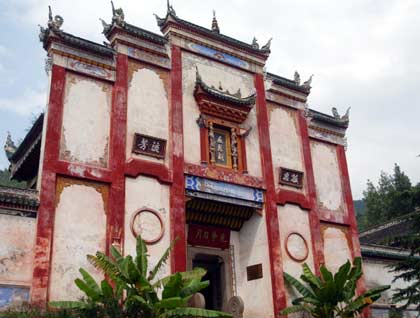
The Duanwu Festival, a traditional Chinese festival falling on the fifth day of the fifth lunar month each year, when people hold dragon boat races and eat zongzi, special dumpling wrapped in leaves, is believed to have been started in commemoration of Qu Yuan's death in 278 BC. The original Qu Yuan Memorial Hall was built in AD 820 in the Tang Dynasty and was rebuilt several times in the course of the country's history. The present memorial hall was built in 1982, and is four times larger than the previous ones. It consists of a complex wooden archway, a magnificent gate, two roofed corridors featuring carvings and calligraphic inscriptions eulogizing Qu Yuan, a 7-metre-tall statue of Qu Yuan, a Qu Yuan Museum and a Qu Yuan Tomb. As the centrepiece of the Phoenix Hill Qu Yuan Culture Village, the relocation and reconstruction of the Qu Yuan memorial and museum will begin later next year. But the preparation work is already under way. Other Qu Yuan related structures on the hill include the Qifeng (Perching Phoenix) Pavilion and the Wentian (Questioning the Sky) Platform, according to Ji. River God The relocation work of the Qu Yuan memorial has an already completed example to follow. The Jiangdu Temple and six ancient residential building complexes have already been reconstructed on Phoenix Hill. Covering a floor space of about 600 square metres, the Jiangdu Temple, or Temple of the River God in Zigui County, is believed to be the largest and best-preserved of its kind in China, according to Luo Zhewen, a renowned expert in ancient architecture protection and preservation. It was first built in 1051 in the Northern Song Dynasty (960-1127) and was rebuilt in the Qing Dynasty (1644-1911). The temple is considered by experts to be an architectural treasure displaying typical features of ancient architectural art in the Three Gorges area. It used to be located on the Qingtan Dock in old Guizhou city proper. It was located at one of the most dangerous parts of the Xiling section of the Three Gorges. Sailors and merchants in past times prayed to the River God for protection before setting out on the Yangtze River. The temple is laid out like a huge siheyuan quadrangle courtyard with surrounding grey brick walls. It consists of two grand halls, two wings, and a spacious courtyard. The major structure was made of best quality wood in the region. The use of dragon-fish shaped decorations in the pillars in the temple is unique and is not to be found in other parts of China, experts say. But the temple is most noted for the rich, diverse, delicate carvings on its wooden parts including ancient coins and animals such as bats, which are a symbol of good fortune in local culture, as well as flowers and lotuses. The relocation and reconstruction of the temple reportedly cost about 2 million yuan (US$241,000). In the relocation of Jiangdu Temple, experts worked with great patience and care, as many of the items were really too old and fragile to be moved, Kong said. The experts first videotaped and photographed the entire building and many of its details. Then the parts of the building were numbered and disassembled one by one. Each wooden part was wrapped in thick cotton sheeting to ensure its safety during transport to the new site. The major restructuring of the temple was completed and checked last June by a special examination and appraisal team formed of cultural heritage protection and preservation experts from the provincial and State Cultural Heritage administrations. But the interior decoration and the remolding of the deities have yet been done. The relocated temple, facing south, has a superb view of the Three Gorges Dam and will open to the public early next year. Folk culture The relocated ancient residential complexes, each representing a major influential ancient local family, display diverse, distinctive local architectural flavours, such as the unique flying eaves and roof decorations in the shape of ancient coins. Six of them had been rebuilt by this summer. The residential complexes will serve as exhibition sites for local culture, especially folk culture. Over the past few years, the local cultural heritage administration has launched a campaign to collect a large number of original exhibits which reflect local culture, including ancient common household effects, old furniture, house decorations, books, sculptures, paintings, clothes, and tools, according to Kong Gangqiang. Along with the relocation of historical and cultural sites, an International Dragon Boat Club will also be set up at Xujiachong Bay at the Phoenix Hill as Zigui is the cradle of the dragon boat race. This project will be jointly developed next year by Zigui County and the State General Sports Administration. All the relocation and reconstruction work is expected to be finished by late 2005 and the sites will be opened to visitors and admirers of Qu Yuan from home and abroad.
|
|
|||||||||||||||||||||||||||||||||||||||||||||||||