| .contact us |.about us | |
|


|
|
|
|
|||||
|
|
|
|
|||||
 |
||
|
|
|
|
|
|
|
||
|
|
|
|
|
| Advertisement | ||||||||||||||||||||||||||||||||||||||||||||||||||||||||||||||||||||||
|
New chapter opens in Sino-European space co-op ( 2003-12-31 00:20) (China Daily)
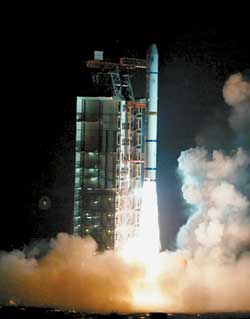
Sino-European space co-operation took a major step forward Tuesday with the launch of the first of two "Double Star" scientific satellites early Tuesday morning from the Xichang Satellite Launch Centre in Southwest China. The launch ended a landmark year for China's space programme, with the nation's first man in space and a record six satellites blasted into orbit.
An improved version of the Long March 2C, the Long March 2C/SM contains multiple technological improvements in order to ensure a steady rocket attitude-adjusting system and higher reliability, said the spokesman. At 3:18 am, the satellite, Probe-1 or TC-1, was sent into its preset elliptical orbit ranging from 555 kilometres and 78,051 kilometres from the Earth, making it the farthest operational spacecraft China has ever catapulted into space, according to the spokesman. Extending his congratulations to Chinese scientists, David Southwood, director of the Scientific Programme of the European Space Agency (ESA), said he anticipated the launch will be followed by further Sino-European space co-operation. "The year 2003 was a year of miracles for China," he said. "We'll see what we could do together after this launch." Probe-1 is expected to fly in space for 18 months to study the impact of the Sun on the Earth's environment, and in particular the magnetotail, where storms of high-energy particles are generated, according to Zhang Yongwei, chief engineer of the Double Star project. The launch was the 75th flight of Chinese-made Long March rockets. It is also the country's 33rd straight successful space mission since October 1996. "The successful launch of Probe-1 has further testified the reliability and maturity of China's space technology," said Zhang Qingwei, president of the China Aerospace Technology Corp. Probe-1 was designed and developed jointly by the Chinese Academy of Space Technology, the Chinese Academy of Sciences and eight scientific research institutes from Europe. The "equatorial" satellite will be followed by a polar-range satellite (Probe-2), which is scheduled to be launched in mid-2004 from the Taiyuan Satellite Launch Centre in North China's Shanxi Province, according to Zhang. The project was initiated by Chinese scientist Liu Zhenxing in 1997. It has attracted keen interest from the international geophysics community. The ESA is contributing to this Double Star mission by providing eight on-board scientific instruments -- five on Probe-1 and three on Probe-2. It is the first time Chinese hardware and European equipment have been wired together, Liu said. By combining the Double Star satellites and the mini-flotilla of four identical spacecraft the European agency launched in 2000 in its Cluster II Programme, scientists will be able to probe space from a six-dimensional perspective, the first time this has ever been possible, Liu said.
|
|
 |
||||||||||||||||||||||||||||||||||||||||||||||||||||||||||||||||||||
| .contact us |.about us | ||||||||||||||||||||||||||||||||||||||||||||||||||||||||||||||||||||||
|
|
|
|
|
|
|
|
| Copyright By chinadaily.com.cn. All rights reserved |