| .contact us |.about us | |
|


|
|
|
|
|||||
|
|
|
|
|||||
 |
||
|
|
|
|
|
|
|
||
|
|
|
|
|
| Advertisement | ||||||||||||||||||||||||||||||||||||||||||||||||||||||
|
No decision so far on trial for ex-Iraqi leader ( 2003-12-14 21:45) (Agencies)
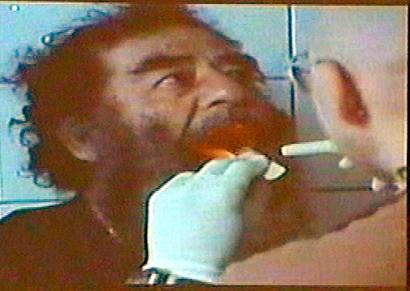
U.S. officials said they still haven't decided what to do with Saddam Hussein now that he's been captured, but one option is putting him before a special tribunal established just days ago. A member of Iraq's Governing Council said Saddam would face public trial.
Lt. Gen. Richardo Sanchez said at a news conference Sunday that the U.S.-led coalition was still deciding what to do with Saddam. "At this point, that has not been determined, we continue to process Saddam at this point in time and those issues will be resolved in the near future," Sanchez said. Ahmad Chalabi, a member of Iraq's Governing Council, said Saddam would be tried. "Saddam will stand a public trial so that the Iraqi people will know his crimes," Chalabi said on Al-Iraqiya, a Pentagon-funded TV station. "Saddam will be punished for those crimes.'' Chalabi is a leading member of the U.S.-appointed council who has close links to the Bush administration. The tribunal will cover crimes committed from July 17, 1968 -- the day Saddam's Baath Party came to power -- until May 1, 2003 -- the day President Bush declared major hostilities over, said Abdel-Aziz al-Hakim, the current president of the Iraqi Governing Council. Saddam became president in 1979 but wielded vast influence starting from the early 1970s. The tribunal will try cases stemming from mass executions of Iraqi Kurds in the 1980s, as well as the suppression of uprisings by Kurds and Shiite Muslims soon after the 1991 Gulf War. Al-Hakim said it would also try cases committed against Iran -- with which Iraq fought a bloody 1980-88 war -- and against Kuwait, which Iraq invaded in 1990, sparking the Gulf War. The first suspects brought to trial could include top officials of Saddam's government who appeared on the U.S. 55 most-wanted list. Some of those are already in coalition custody, including former foreign minister Tariq Aziz, former vice president Taha Yassin Ramadan and Ali Hassan al-Majid, known as "Chemical Ali" for his role in chemical attacks on Kurds in the 1980s. The coalition authority now holds at least 5,500 people in detention centers, but it isn't known how many of those are war crimes suspects. The U.S. occupation authority suspended using the death penalty, and Iraqi officials have said they will decide whether to reinstate it when a transitional government assumes sovereignty as scheduled on July 1. The trials would be open to the public, human rights groups and news media, suggesting they could be televised. Their work is not expected to begin for months. The legal framework also draws on international law, including Rwanda's genocide tribunal and the legal code used to create the United Nations' International Criminal Court, a body the Bush administration opposes. Al-Hakim said it would also use the Geneva Conventions as a point of reference. Prosecutors will use a growing cache of documents seized from the former regime. Evidence also will come from the excavation of some of the 270 mass graves in Iraq that are believed to hold at least 300,000 sets of remains.
|
|
 |
||||||||||||||||||||||||||||||||||||||||||||||||||||
| .contact us |.about us | ||||||||||||||||||||||||||||||||||||||||||||||||||||||
|
|
|
|
|
|
|
|
| Copyright By chinadaily.com.cn. All rights reserved |