|
|
|
||||||
 |
|
|

|
|||||
 |
|
|
|
|
|
|
|
|
|
||
|
|
|
|
|
| Advertisement | ||||||||||||||||||||||||||||||||||||||||||||||||||||||
|
Chinese rethink relationship with wildlife ( 2003-06-16 08:56) (China Daily)
China's epicureans are putting down their chopsticks and the people of the world's most populous nation are starting to review their relationship with wildlife as the country recovers from severe acute respiratory syndrome (SARS).
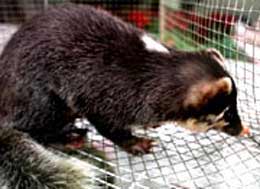
On April 29, the Chinese State Forestry Administration and the State Administration for Industry and Commerce (SAIC) announced jointly a ban on the hunting and sale of wildlife and called for all-round monitoring and control of wildlife breeding and trainingcenters. The China Wildlife Conservation Association also has written a public letter to appeal for people to stop eating wild animals. On May 30, director of SAIC Wang Zhongfu said restaurants that served wildlife dishes have to be halted and south China's GuangxiZhuang autonomous region even banned circuses from using animals in shows. Liang Congjie, a prestigious environmentalist and member of theNational Committee of the Chinese People's Political Consultative Conference (CPPCC), made a proposal to call for a breakthrough on the traditional old concept or guideline on wildlife protection, namely, protection of wildlife is simply for the sake of usage andprotection is for the sake of limiting within rare animals, which China has kept to for years. "It shows that human beings are recovering their awe for nature," said Deng Xuejian, a zoology professor of central-south China's Hunan Normal University. "Humans possess the strongest power for protection as well as destruction in the biosphere, so whether or not they can make a timely self-reflection will affect the all of nature," said Deng. Archaeologists have discovered the proof showing that the Peking Man, who lived in the southwestern areas of the Chinese capital some 500,000 to 40,000 years ago, used fire to cook wildlife meat. In the New Stone Age (10,000 to 4,000 years ago), the Chinese were raising animals. China already had the world's largest population in the Han Dynasty (206 BC-AD 220), when animals were exploited for meat foodand medicines. Also during this period, Shen Nong's Materia Medica, a famous monograph on medicine, was compiled and completed, with 65 medicines made of animals recorded. The number rose to 461 in the Ben Cao Gang Mu or the Compendium of Materia Medica, the best-known and revered Chinese medical manual written by the eminent Chinese pharmacologist Li Shizhen of the Ming Dynasty (1368-1644). By the 1990s, the number surged to 1,574 in the Chinese Medicines Resources in China, including 161 kinds of animals underthe state protection. The world-renowned inscriptions on animal bones or tortoise shells of the Shang Dynasty (1600 BC to 1046 BC), which are believed to be earliest Chinese characters, were first spotted anddiscovered in traditional Chinese medicine stores - the splendid Chinese civilization seemed to be closely associated with animal slaughter at its very beginning. Just over 100 years ago in the late Qing Dynasty (1644-1911), the Chinese had opened their first public zoo, where they could study animals at close quarters. With the persevering and widespread promotion of the Chinese government, animal protection has become a widely acknowledged public issue, especially since the 1950s. Liang Haitang, director of the World Wide Fund for Nature's Yangtze River program, said that with the rapid growth of the world's economy and Man's power to exploit resources, human beingsshould "keep a proper distance" from wildlife. However, the growing gap between the rich and the poor and the temptation of considerable profits has brought the wildlife into danger again. Driven by the high profits of selling pelts to international traffickers for pricey shawls, poachers have killed a large numberof Tibetan antelopes on the vast Tibet-Qinghai Plateau. As a result, the animal's population fell from millions in the early 20th century to 90,000 in 1997. In Guangxi, an underdeveloped autonomous region of south China,more than 10,000 masked palm civets have been raised by local residents. "The number is even larger than those in the wild in Guangxi," said Su Yong, director of the local animal protection station. "Local residents have already acquired the expertise to raise this animal at home because it has always been a popular way of making money." This practice may soon disappear as it has been banned by the government. But the price of the government's decision may be veryhigh. For example, in southwestern Sichuan province and its neighboring Shaanxi province in the northwest, ecological protection zones have been created to protect the endangered GiantPanda, and local farmers have been compelled to leave their homes for generations -- a new rivalry has formed between wildlife and human beings. "If we cannot help those needy families out of their poor living conditions and realize the target of building a well-off society in an all-round way in China, the fate of the wildlife will remain a worry," said Su Yong. But what makes the future of the wildlife more worrying may be the lack of sympathy among some people even if the majority of people in China are beginning to enjoy a better life. In February 2002, a student of Beijing's prestigious Tsinghua University burned and hurt five bears with sulfuric acid at Beijing Zoo in an experiment to test the bear's intelligence, an act which aroused heated debate on society's concern for animal welfare. Whether or not the SARS virus comes from the wildlife, the outbreak of the epidemic disease has resent all Chinese a warning signal, which has repeatedly appeared over recent years. In the country's coastal provinces and regions, overfishing hasalready caused some species of fish to dwindle and vanish. As a result, local fishermen have suffered from their greed and finallyhad to appeal to local governments to ban fishing from February toJune every year to allow marine resources to recover. More than 1,700 nature reserves have been established around China as more people in the country accept the idea that animals also have a right to exist in peace. In the past few weeks, many newspapers in China have started special columns on animal protection, like "Animals and Me", whichhas been welcomed by the general public. A large number of readerscontributed touching stories on their own experience with animals. Meanwhile, in the zoos of Shanghai, China's leading economic center, some animals' descriptions, like "edible", "vermin", and "fur usable", have been replaced with words like "Please love me", which are considered more humane. "These actions show the love and affection for life," said Prof.Zhou Keda, a noted sociologist with the Guangxi Regional Academy of Social Sciences. "We should take more actions to prove to the whole world that the Chinese people don't lack love and affection for animals." In addition, China has accelerated the development of substitutes for animal organs used in traditional Chinese medicines. For instance, experts have found that 54 kinds of herbscan have the same medical functions as bear gallbladders, which are regarded as a valuable ingredient of traditional Chinese medicine. Meanwhile, peasant farmers are encouraged to earn money with sideline production or working in the cities. Su Yong went on to note that China is working very hard to improve the relationship between people and wildlife by means of promoting equality, respect and harmony among all the creatures onthe earth. "More benevolence and sympathy may benefit the ancient Chinese culture," he
said.
|
|
 |
||||||||||||||||||||||||||||||||||||||||||||||||||||
| .contact us |.about us | ||||||||||||||||||||||||||||||||||||||||||||||||||||||
|
|
|
|
|
|
|
|
| Copyright By chinadaily.com.cn. All rights reserved |