|
|
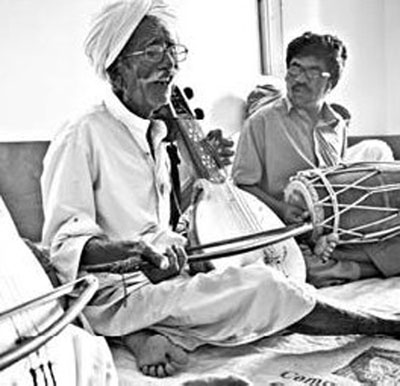
RANERI, India - In this village 640 kilometers southwest of New Delhi, where women wash dishes in the sand to conserve water, and electricity is scarce, Lakha Khan sat on the floor of a stone hut. There, he coaxed a bright, dizzyingly fast melody from his violinlike sarangi. |
 |
|
Sakar Khan, left, has toured the world. Top, Lakha Khan, right, is one of the few remaining players of the violinlike sarangi. Photographs by Sanjit Das for The New York Times |
Mr. Khan, 66, is one of the few remaining Sindhi sarangi players among the Manganiyars, a caste of hereditary Muslim musicians who live in this desert state of Rajasthan. He plays for hours, usually with no more company than a couple of passing goats.
But recently he had an audience of two: Ashutosh Sharma and Ankur Malhotra, who were crouching over their gear, including a five-channel mixer and two analog recorders.
"There's an exuberance or just kind of a lack of inhibition when they're performing at home," Mr. Malhotra said of the Manganiyars, whose music is a mix of traditional melodies and arresting vocals. "Here these performances are genuine and real and filled with emotion."
Mr. Sharma and Mr. Malhotra, both 37, want to preserve the music of the Manganiyars, whose songs - devotionals and stories of births, deaths and love, often about the Hindu families that are their patrons - have no written record. The two men said they were inspired by Alan Lomax, the musicologist who more than half a century ago traveled the American South recording previously unknown blues musicians.
They hope to preserve the music and to bring it to a wider audience through a small, independent record label they began, Amarrass Records. Yet they realize that trying to popularize Manganiyar music is a daunting task in India, where most young people would rather download Bollywood ringtones than listen to an ancient folk music.
Mr. Malhotra and Mr. Sharma are undeterred. They grew up in New Delhi, listening to Sufi and Hindi music. As they got older, they turned to Western rock, though the music was difficult to find. Mr. Sharma's father, a British Airways pilot, brought him Grateful Dead and Rolling Stones records he got during trips to the United States and Britain.
Later, Mr. Sharma began a travel agency in New Delhi. Mr. Malhotra moved to the United States, earned a Master of Business Administration degree and created an education technology start-up. But the men became "fed up," as Mr. Sharma put it, by the lack of music in their lives.
This spring, they stayed at Mr. Khan's house for three days. "When he gets up in the morning and feels like singing a certain song a certain way, we're there," Mr. Malhotra said. "That doesn't happen in a studio."
Later, they drove 160 kilometers to the village of Hamira, the home of Sakar Khan, 76. He is a master of the kamancha, an ancient stringed instrument played with a bow - a signature of the Manganiyars. He has toured the world with his instrument.
Mr. Malhotra and Mr. Sharma have underwritten their project with profits from Mr. Sharma's travel agency. They raised money to cover some of their production costs, less than $3,000, on Kickstarter, a crowd funding Web site, and they received about $30,000 from one of Mr. Malhotra's business school advisers.
Roysten Abel, the director of "Manganiyar Seduction," a theater show presented in New York two years ago, said Mr. Sharma and Mr. Malhotra will have to make the music more contemporary. "That's the only way India will go international," he said.
Mr. Sharma and Mr. Malhotra said that no matter how long they sit listening to aging masters, a valuable part of the centuries-old tradition will inevitably be lost. "They are keepers of the oral tradition, along with their own history," Mr. Malhotra said. "It's all in their own heads. And 20 percent gets lost in a generation."
|
|
|
|
|
|
|
|

Copyright 1995 - . All rights reserved. The content (including but not limited to text, photo, multimedia information, etc) published in this site belongs to China Daily Information Co (CDIC). Without written authorization from CDIC, such content shall not be republished or used in any form. Note: Browsers with 1024*768 or higher resolution are suggested for this site.
License for publishing multimedia online 0108263 Registration Number: 130349 




















 Raymond Zhou:
 Pauline D Loh:
 Hot Pot
 Eco China
 China Dream
 China Face