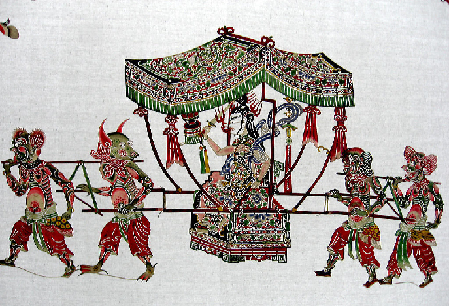
Two thousand years before the advent of cinematography, Chinese people had already started to use tricks of light to create moving images telling stories. Shadow puppetry first appeared in the Han Dynasty (206 BC - AD 220) and has remained an influential part of the Chinese culture ever since.
Many believe that shadow puppetry was even the forerunner of Chinese opera, which itself has developed many forms, including the relative newcomer, Pingju Opera. Though for a while such forms of entertainment fell from grace, in recent years performers in Hebei Province have been finding new audiences with encouragement from the provincial government and the new vision they are bringing to their art.
Casting a Ray of Hope
There are many legends about the origin of shadow puppetry. In one version, one of the concubines of Emperor Wudi of the Han Dynasty fell ill and died. The emperor, devastated, ordered his court officials to bring his beloved back to life. The officials made a model of the concubine using separate pieces of donkey leather, giving her joints that allowed her body to be animated. They adorned her with clothes by painting them onto the leather and, using an oil lamp, made her shadow move as if she still breathed. In time, the simple moving shadows became shadow plays with plots and dialogue.
For several centuries, the shadow plays entertained rural China after sunset. But with economic development and the accompanying spread of television and cinema, shadow plays have become scarcer and scarcer. Its future seemed gloomy, but thanks to support from the central and Hebei provincial governments, shadow puppetry is seeing a resurgence.
One sunny Wednesday morning, China Today went to the rehearsal space of the Tangshan City Shadow Play Troupe, where we were treated to an excerpt from the traditional Chinese fable The Turtle and the Crane. On a white backdrop a frog appeared as if from nowhere, only to be suddenly attacked by a turtle. This is a tale that has made countless children burst into laughter for generations.
Years of preparation go into performances like this. In Tangshan, prospective puppeteers study for three to five years in one of several schools offering specialist training and then spend up to two more years as apprentices.
Troupe leader Da Jianguang told us that all together the troupe gives around 1,000 performances every year and often go overseas to perform. In September 2011, some of the 40 performers were touring in Japan, and Da himself had just returned from the Chinese Culture Week in Washington D.C.
For Da, their tour in Brussels in particular was quite unforgettable. The troupe brought the story of the city’s iconic Mannekin Pis to life to much local acclaim, depicting in shadow and light how the little boy saved the whole of Brussels by pissing on the burning fuse that would have ignited explosives destroying the city walls. “The friendly Belgians later gave us a chocolate statue of the pissing boy as a gift,” Da recalled with a huge grin.
Da explained to us how shadow puppetry is an ideal medium for sharing Chinese culture with an international audience curious about China. “Plays like The Turtle and the Crane have no dialogue, so audiences from other countries can understand them without any difficulties,” Da said.
Rescuing Pingju Opera
Compared with shadow puppetry, Pingju Opera is a relatively young art form. Its birthplace is Tangshan City, where it was founded by Cheng Zhaocai in 1910. Unlike Peking Opera, Pingju Opera is deeply rooted in the lives of common people in northern and northeastern China, portraying their everyday trials and tribulations and meandering love stories. A number of them were made into movies in the 1950s and were very popular.
Becoming a professional Pingju performer requires training from a young age, and most begin when they are about 12 or 13 years old. Four or five years are spent studying in professional schools, after which they start their careers playing small roles. Not until the time they are around the age of 30 are they considered to have mastered their craft enough to take on the leading roles.
After making the long journey to Tangshan, we were lucky enough to witness a rehearsal of the Pingju Opera Yuhe Bridge. It tells a story set during the Ming Dynasty. A father, against his daughter’s free choice of a husband, flies into a rage and throws her into the river. She does not drown, however, and is rescued and reunited with her lover.
“It’s a traditional story, and has a happy ending,” the director of Pingju Troupe of Tangshan Jia Xiangguo remarked. He told us that Yuhe Bridge, which premiered 50 years ago, carries a message against the arranged marriages prevalent in China before the founding of the People’s Republic in 1949. It’s strange hearing Jia, who has been performing Pingju Opera for 30 years, explain this after seeing him play the part of the brutal father.
Pingju Opera has had its ups and downs. It reached the height of its popularity in the late 1970s, but was replaced by other forms of entertainment as more and more TV sets entered people’s homes. Many troupes were dismissed, and performers took on other jobs. “Some performers went into business, and some even repaired bicycles,” recalled the troupe’s Chief Artistic Officer Zhang Junling, who had just starred in a TV play centering on Cheng Zhaocai.
Now attempts are being made to revive the public’s interest in Pingju Opera. Plots have been modernized, with more love stories and historical themes from China’s recent history. Plays like that based on the life of revolutionary martyr Lin Juemin (1886-1911) can educate as well as entertain young people today. The play tells of how he chose to devote himself to freeing his motherland and could no longer carry out his promise to look after his wife, which he famously explained in his “Letter to My Wife.”
Further promoting Pingju Opera, since 2000 the Tangshan municipal government has held a biennial festival dedicated to the art form. The Pingju Opera Festival provides a platform for performers from different regions to exchange experiences and discover outstanding talent. It seems that Pingju Opera has been rescued from its road to obscurity and is now a dynamic and growing scene.
Adapting for the Future
With just the click of a mouse, people can effortlessly access a world of free online entertainment. But modern life does not need to be the death of traditions like Pingju, and older art forms can find new life by adapting to present trends. This is one of the goals of the cultural reforms of Hebei’s 12th Five-year Plan (2011-2015), and Hebei’s cultural restructuring in previous years has already helped build Dachang County into one of the 20 most culturally influential counties in China.
“We are adapting ourselves to modern life,” said Zhang Junqi, the Dachang Pingju Troupe’s finger dancer.
Finger dancing is just one of the many other art forms that the Dachang Pingju Troupe has added to its repertoire since it was established in 1974. As well as Pingju Opera and finger dancing, the troupe performs Chinese acrobatics, Mongolian dancing, skits, and Pipa dancing.
Born in Henan Province, Zhang Junqi has had a dramatic life. Years ago he was found, having fainted from starvation, by Zhao Deping, head of the Dachang Pingju Troupe. Zhao adopted him and offered him the chance of education.
Now Zhang Junqi has become rather stout and he hasn’t disappointed Zhao. After years of hard work he has become an excellent actor and has even developed his own style of finger dancing, which was chosen to be performed at the CCTV Spring Festival Gala in front of a nationwide audience.
The Dachang Pingju Troupe has produced 14 performers who enjoy, like Zhang, fame all over the country. Ten years ago, their focus was on saving Pingju Opera and trying to connect with the audience on an emotional level, but in recent years they have sought inspiration to develop the art form from all sorts of sources, including the opinions of foreign artists.
Now, the troupe is like one big family with strong loyalty to each other and their roots. When one of the troupe’s performers was offered RMB 30,000 for one night’s performance, he refused, preferring to stay with this troupe. Despite their success, which has taken them abroad and given them many opportunities to perform, they continue to put rural Hebei first. They have performed in four fifths of Dachang’s towns and villages.
As performers of traditional folk arts, the Dachang Pingju Troupe’s members are not only the inheritors of China’s cultural heritage, but are also burdened with a heavy social responsibility. It is clear that the troupe, with their determined approach to their art, will live up to this responsibility and help pave the road for further progress.
|
|
|
|
|
|
|
|

Copyright 1995 - . All rights reserved. The content (including but not limited to text, photo, multimedia information, etc) published in this site belongs to China Daily Information Co (CDIC). Without written authorization from CDIC, such content shall not be republished or used in any form. Note: Browsers with 1024*768 or higher resolution are suggested for this site.
License for publishing multimedia online 0108263 Registration Number: 130349 












 Raymond Zhou:
 Pauline D Loh:
 Hot Pot
 Eco China
 China Dream
 China Face