|
|
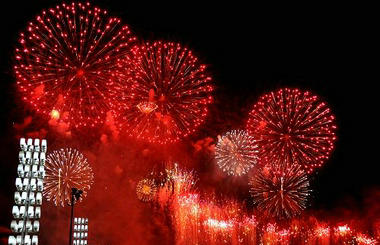
An artist performs the Lion Dance to celebrate the Chinese lunar New Year in Chinatown in Lima, Peru, Feb. 6, 2016. [Xinhua/Luis Camacho] |
Home to Latin America's largest Chinese community, Peru hosts especially colorful New Year celebrations marking the start of the Lunar Year, the Year of the Monkey.
In a country where an estimated 10 to 15 percent of the population of 30 million are of Chinese descent, New Year festivities are both popular and packed in Peru.
In Lima's Chinatown, groups perform the lion dance, accompanied by gongs, drums, cymbals and fireworks. They go from establishment to establishment, symbolically feeding on lettuce (a symbol of prosperity because its Chinese words sheng cai mean making money) that is tied together with a red envelope containing money and hung from doors.
The lion dancers, juggling and jumping about, "scare away the evil spirits" as the crowd follow them around, trying to pet the ferocious feline masks for good luck.
Along Capon, one of the city's pedestrian streets, various astrologers read the oracle and sell blessed objects to give prosperity and good health to homes. This street is the most representative of the Chinese community in the Peruvian capital, with its restaurants and large wall tiles representing the 12 animals of the Chinese zodiac, including this year's monkey.
The Confucius Institutes of the Pontifical Catholic University of Peru and the Ricardo Palma University, both in Lima, also organized celebrations featuring traditional Chinese folk music and dancing, along with games and prizes.
Lima isn't the only Peruvian city to observe the Chinese New Year, with smaller celebrations taking place in other Peruvian cities with sizable Chinese communities.
"The main characteristic of the Spring Festival is the family gatherings," says Victor Tay Loo, a Peruvian of Chinese descent who maintains his ancestral traditions and customs, passed down to him by his Chinese parents.
"Work or study could have kept the family apart during the year, but for this day everyone returns to their parents' home and helps with the cleaning and buying and getting the food ready," Tay Loo said. "They all share dinner together at midnight, including large fish."
"We pay tribute to our ancestors and hand out red envelopes (with money) to the children and grandchildren. We also interact as a family - conversing and sharing past experiences, remembering anecdotes and making plans for the future," said Tay Loo.
Tay Loo's house, in the Gran Lima district, is decked with traditional and contemporary Chinese paintings and other objects of art.
"I lived in China for several years during my youth, and since then, I have been passionate about Chinese art. Even though it may seem strange, many of these pieces were acquired here in Peru," said Tay Loo.
One piece made of ivory depicts a monkey riding a horse, and Tay Loo explains that, "according to Chinese tradition, a monkey sitting atop a horse signifies that good things will come quickly."
Throughout history, China and Peru have had very active social and cultural exchanges.
At the start of the 17th century, Chinese, Japanese and Philippine laborers were brought to Peru aboard Spanish galleons to help in construction, including the building of Lima's Bridge of Stone, which connects the banks of the Rimac River.
Starting in 1849, and until 1874, the Chinese community in Peru became more visible with the arrival of 150,000 Chinese contract workers, who would come for eight-year periods.
Peru's Chinese community has produced high-profile cultural and academic figures, such as Pedro Zulen Aymar, Emilio Choy Ma and Victor Li-Carrillo Chia, known respectively for their work in favor of the country's indigenous minorities, in the field of history and in philosophy.
The Chinese community has also given the country well-known musicians Blanca Wong, Eva Ayllon and Pedro Mina, and writers and poets, such as Manuel Li and Enrique Li.
In addition to Peru, Chinese New Year celebrations also are held in various countries across Latin America.
In Argentina's capital Buenos Aires, Chinese New Year celebrations draw hundreds of thousands of residents, so many, in fact, that the venue had to be changed to accommodate them all.
In 2011, some 15,000 people attended the celebrations. By 2014, that number had ballooned to 450,000 people over two days. This year, even more fans of China and Chinese culture had been expected to attend.
With that in mind, the celebrations, which used to take place at the city's famed China Town, were moved to a larger location: the National Parks plaza, in the city's northern Nunez district.
At the opening ceremony of the series of celebrations on Feb 6, China's ambassador Yang Wanming greeted top officials, including Vice-President Gabriela Michetti and Buenos Aires Mayor Horacio Rodriguez Larreta.
"It's a millennial tradition that we all celebrate," the city's Secretary of Sports Matias Lopez said.Visitors to the plaza got a chance to enjoy Chinese music and dance, traditional opera, puppetry, martial arts demonstrations and cuisine.
This year, Venezuela again joined the 140 countries around the world that celebrate the Spring Festival, with a variety of cultural and artistic events.
In the capital Caracas and other cities, residents were treated to performances of the Chinese production My Dream, a unique show featuring dazzling musical numbers put on by accomplished dancers and singers who are sight or hearing impaired.
Speaking at a ceremony in the capital, China's ambassador to Venezuela, Zhao Bentang, said, "We have built a relationship based on substantial cooperation and exchange and have also deepened cultural and humanistic ties."
Officials also marked the occasion by announcing the coming opening of a Confucius Institute in Venezuela's Peninsula de Paraguana, in north Falcon state, where students will be able to learn Chinese.
"We congratulate the people and government of China on the occasion of the Chinese New Year and reaffirm the bond between our nations," Venezuelan Foreign Affairs Minister Delcy Rodriguez posted on Twitter on Feb 8.
|
|
|
|
|
|
|
|

Copyright 1995 - . All rights reserved. The content (including but not limited to text, photo, multimedia information, etc) published in this site belongs to China Daily Information Co (CDIC). Without written authorization from CDIC, such content shall not be republished or used in any form. Note: Browsers with 1024*768 or higher resolution are suggested for this site.
License for publishing multimedia online 0108263 Registration Number: 130349 
















 Raymond Zhou:
 Pauline D Loh:
 Hot Pot
 Eco China
 China Dream
 China Face