The culture of Chinese small living goods
As everyone in the world knows, China has a great cultural heritage, which attracts people from all over the world to learn about China. With such a long, unbroken history and culture, China's traditional arts have made one of the greatest artistic and cultural contributions to the nation’s rich heritage and to mankind. This can be seen even from small day-to-day supplies, such as the Chinese snuff bottle, Chinese brush pen holders and Chinese perfume pouch, which are very famous throughout the world.
The Chinese Snuff Bottle
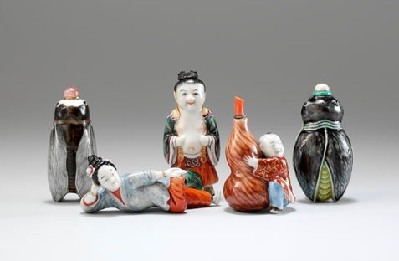
Chinese snuff bottles were at the heart of a fashion that had no equivalent in China's long history. Because of the extraordinary variety of styles, techniques and materials found in these small objects, and the exquisite craftsmanship that was lavished upon them, these miniature masterpieces became one of the most important manifestations of the applied arts during the Qing Dynasty.
At first confined to the elite of the new dynastic house, the popularity of snuff and the snuff bottle was firmly established in and around the court of Beijing by the end of the 17th century. The custom appears to have remained centered there for most of the 18th century, when the use of snuff became a social ritual of the upper class. These containers, upon which so much art, refinement and money had been expended, became the subject of avid acquisition. Snuff bottles also became the new currency for the purchase of favors, positions and advancement in government.
Spreading slowly and gradually to the rest of the country, snuff-taking and the collection of snuff bottles had become a nationwide habit among all social classes by the end of the 18th century. It was common courtesy to offer friends a pinch of snuff upon meeting them in the street or at home, and great status was accrued to the owner of the most unusual or finest bottle.
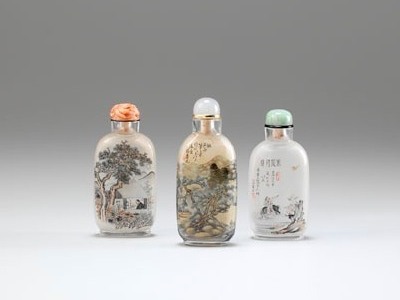
Made in every material known to the Chinese—glass, porcelain, jade and other hard stones, ivory, coral, lacquer, amber, wood, etc—the snuff bottle was then produced in enormous quantities and of varying quality to supply the increased demand. Although the high point in the manufacturing of most types of bottles was the 18th century, a great many fine bottles continued to be made throughout the 19th century.
The popularity of snuff and the snuff bottle rose and fell with the Qing Dynasty. After the revolution and the establishment of the Republic in 1912, the fashion of taking snuff died away. Today, however, there are a rapidly growing number of collectors throughout the world who are fascinated by these small, exquisite objects.
Snuff bottles made of crystal or glass (and, more rarely, other materials such as agate or hair crystal) are painted on the inside using a narrow sliver of bamboo or brush, and ink and color. The earliest recorded inside-painted bottles were produced in the early 19th century, and were recorded as being the work of Gan Xuanwen of the Lingnan School in Guangzhou. The proliferation of inside-painted bottles came with the foundation of the Beijing School in the late 1870s by Zhou Leyuan. Another notable artist of that time was Ding Erzhong, whose work was characterized by his delicate brushstrokes and unprolific output. There are also many other notable artists: Ma Shaoxuan, Chen Zhongsan, Wang Xisan, and Liu Shouben, whose works are famous all over the world.