 |
|
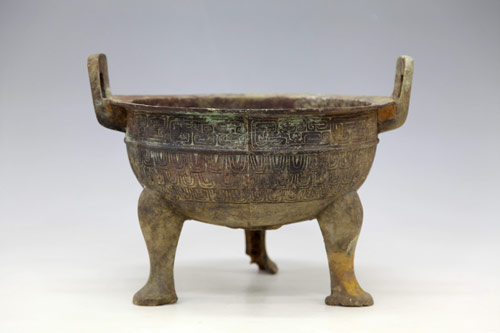
The bronze cauldron, a national grade one artifact, changed hands six times and was finally found in Haining, Zhejiang province, in October. Provided to China Daily |
When a villager of Yidigang in Suizhou, Hubei province, stumbled upon some newly dug holes in the fields one day in August 2011, he did not expect his discovery to lead to a huge number of lost treasures.
He reported his find to the local police station, which led to a lengthy investigation involving not only Hubei province, but other places as well.
Earlier this month, police officers from Suizhou Public Security Bureau announced in the provincial capital Wuhan that they have unearthed "Hubei's biggest tomb-robbery case", since the founding of the People's Republic of China in 1949.
"We established a rigid supervision system around the ancient tombs," says Zhang Jun, a Suizhou police officer involved in the case.
"During our investigations, we hired local villagers to patrol the area, day and night," he adds.
They found 198 stolen cultural relics in the provinces including Hubei, Shandong, Shaanxi and Henan, after a 14-month campaign against the tomb raiders.
Eight items, all bronzes, have been appraised as national grade one artifacts, 36 pieces as grade two and 104 pieces as grade three.
"It is astonishing to see so many historical relics and in such great varieties," says Bao Dongbo, the curator of Hubei Provincial Museum and chief of the province's archaeological institute. He is also a member of a seven-person appraisal panel of these treasures.
Bao says the antiques originated from the Shang Dynasty (c. 16th to 11th century BC) right up to the Jin Dynasty (1115-1234), and included articles ranging from sacrificial vessels to daily utensils.
"The gang has a big network which expands to many cities, making it difficult to nab the suspects," says Zhang, the police officer involved in the case. "The antiques have been passed from hand to hand, sold and resold. The raiders don't know the final buyers. They operate through brokers."
Zhang says more than 30 police officers organized a task force on May 8, 2012 to handle the case.
They focused on the antique markets in two Chinese ancient capitals: Luoyang in Henan province, and Xi'an, capital of Shaanxi province; and found the mastermind behind the looting. His name is well-known in the nation's antique business circle. Police found 148 artifacts in his home.
"The suspects are usually very rich, and have professional archaeological knowledge, though many are not highly educated," Zhang says.
The discovery of the mastermind led to the arrest of 21 other suspects.
Many local media quoted unnamed experts as saying that the value of only the grade-three artifacts surpassed 100 million yuan ($16 million). But, curator Bao denies such a high estimate and is strongly opposed to putting a value on national treasures.
"We should focus on the artifacts' values in terms of history, science and arts, rather than how much they are worth," he says. "Some of the pieces will fill in the gaps in our nation's study on ancient history."
Citing an example, he says the national grade one artifact, a bronze cauldron, was sold six times and finally found in Hai-ning, Zhejiang province, in October. The last buyer paid 1 million yuan for it.
Bao says based on archeological survey, a large number of relics is still buried underground. But archeologists will usually not excavate such hidden treasures unless it is absolutely necessary to make way for large constructions. The tomb raiders have shaken the rich mine of relics.
Zhang says every year, there are about two to three such robbery cases. Police have so far been successful in capturing the raiders but had failed to find the leaders. The latest case is considered an important breakthrough.
In 2009, a large-scale tomb robbery involving 11 pieces of national grade one artifacts was uncovered in Hunan province and three suspects were sentenced to death. But capital punishment has been lifted for tomb raiders according to The Criminal Law Amendment (VIII) issued in 2011.
Zhou Lihua in Wuhan contributed to the story.
wangkaihao@chinadaily.com.cn

|
|
|
|
|
|
|
|

Copyright 1995 - . All rights reserved. The content (including but not limited to text, photo, multimedia information, etc) published in this site belongs to China Daily Information Co (CDIC). Without written authorization from CDIC, such content shall not be republished or used in any form. Note: Browsers with 1024*768 or higher resolution are suggested for this site.
License for publishing multimedia online 0108263 Registration Number: 130349 




















 Raymond Zhou:
 Pauline D Loh:
 Hot Pot
 Eco China
 China Dream
 China Face


