|
|
An excavation of underground cultural relics at the Yuzhen Palace in 2005 verified its architectural layout and provided firsthand materials of preserving the site. Tao Debin / For China Daily |
When plans to divert water from Southern China to the north threatened a World Heritage temple complex, engineers decided to move the buildings vertically, Han Bingbin reports from Shiyan, Hubei province.
When ancient and modern structures compete for space, money and attention, the old usually gives way to the new. But when rising waters caused by the South-to-North Water Diversion Project threatened Hubei province's historic Yuzhen Palace, a team of local and national officials agreed on an unusual rescue approach: The building would rise, too. Cultural historians had feared for the palace even though it's part of a complex of palaces and Taoist temples that were listed as a UNESCO World Heritage site in 1994.
Yuzhen Palace was built by Emperor Chengzu of the Ming Dynasty (1368-1644) in a tribute to the mythical Taoist priest Zhang Sanfeng. But some felt it lacked the charm of better-known structures - including the Five Dragon Ancestral Temple, the Grand Purple Cloud Palace and the South Cliff Palace - higher up on scenic Wudang Mountain.
In 2003, Yuzhen's appeal took another hit after an accidental fire while the structure was rented to a private martial arts school.
A local cultural relic official complained to Beijing News in 2004 that there was little investment to preserve the palace even though tourism revenue had increased after UNESCO's heritage listing. This was just one example of the low interest, even neglect, the palace faced. But soon the country's top cultural relic authorities and experts were drawn into a decade of discussions for a plan to save it from being inundated by the water project.
One idea, floated early on by Wudang's cultural relic bureau chief Zhao Benxin, was to build a dike. But the risk of a breach made the planners shudder.
A safer choice would have been to dismantle the temples and rebuild them with the original materials elsewhere. But to Zhao, the geomantic change would have cost the site its historic value. Zhao said he'd rather see Yuzhen completely demolished.
What finally saved the palace is a plan that challenges Zhao's imagination after he's worked 30 years to protect cultural relics on Wudang Mountain: Elevate the three palace gates, the heaviest weighing 4,500 tons, by a record-setting 15 meters with lifting jacks. The rest of the palace would be dismantled and then rebuilt in the same position after the surrounding ground was shored up to the same height.
Zhao visits the site almost every day, holding occasional meetings to stress the importance of the building, asking for in-depth project diaries and peppering engineers with what-if questions till each is satisfactorily answered.
"Each detail could go wrong," he says. "I have to think of the problems even before the engineers do."
But as the gates go up meter by meter, high anxiety is replaced by a sense of security. He says it comes in part from technology - the imbalance-sensitive control system has kept the range of error within 0.02 millimeters, far above the national standard. Zhao also cites the rich experience that the Hebei Academy of Building Research, the project's construction company, has demonstrated.
Lifting and moving technologies on architecture were first used in the West in early 20th century. Chinese engineers embraced it in the 1980s, but the process wasn't widely known until a decade ago, when the technologies were applied on culturally significant buildings. In the best-known example, the then 73-year-old Shanghai Concert Hall was moved 66.46 meters to the south and lifted more than 3 meters in 2003. Since then, the technologies have become a regular option when massive urban construction clashes with the need for cultural relic protection.
As such projects have evolved, the Hebei Academy of Building Research has grown to become a leader in the industry that includes at least 30 active companies, says the Yuzhen project's deputy director Bian Zhihui. The academy has successfully elevated or moved more than 30 ancient buildings since 2002. That year, its engineers raised the Jingang Tower in Yunnan province by 2.6 meters, their highest record before the Yuzhen project. Their farthest move was achieved in 2006 when they horizontally shifted the Ciyuan Temple in Henan province some 470 meters.
In August, they began the task of moving an ancient temple in Anhui province 120 meters. They've also finished preliminary studies for a church in Wuhan that may be shifted 35 meters away from its original location.
Infrastructure developments such as road widening and subway construction, according to Bian, are most often the reasons for the relocation of ancient buildings. But it's still a rare practice.
"Many ancient buildings are directly demolished in city expansions when short of investments," says Bian, who has seen clients abandon plans to relocate architecture because of the expense.
For years, Bian's team has looked for technologies and strategies to reduce the cost. But the unique characteristics of each ancient building and site make it hard to widely apply a cost-reducing plan.
Using their experiences of the past decade, Bian is now studying for his doctor's degree at Tianjin University with a specific focus on moving ancient buildings. Though he believes the technology is mature enough for wide use, high cost remains a key reason that the business of lifting buildings has its limits.
More importantly, he adds, is a market-based challenge: If citizens don't appreciate the need to protect such cultural relics, the financial issue is irrelevant. That's why cultural relic protection in many places doesn't have as strong a voice as city construction, says Beijing-based cultural relic expert Wang Shiren.
"In many cases, cultural heritage was not given a thought at all during urban planning. Whatever stands in the way of city expansion is demolished," Wang says.
He suggests that other cities follow Beijing's example by establishing a joint office between city planning and cultural relic departments, so that negotiations can be held in time to protect important buildings.
But when in conflict with "constructions concerning national economy and people's livelihood", Wang adds, ancient buildings can be part of a compromise with the help of technology.
Shanghai-based Tongji University's architecture professor Ruan Yisan disagrees. The original environment is the most important living condition of an ancient building, he says, so relocation is the start - rather than the end - of destruction.
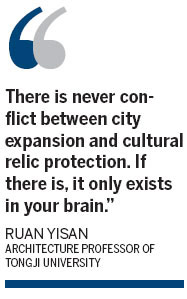
"There is never conflict between city expansion and cultural relic protection. If there is, it only exists in your brain," he says. "There are many different ways of developing a city. Why can't roads be bent? Why can't old architecture stand alongside new buildings?"
Several years back, the municipal government of Shanghai picked out 64 old streets and promised they would never be widened and buildings on both sides would be kept precisely to the original style.
Ruan says this sets a good example in preserving the old: Keep it where and what it is.
"Old buildings should be cared for like a treasure. It's also like an old man in bed. Moving him around would only kill him."
Contact the writer at hanbingbin@chinadaily.com.cn.
Zhou Lihua contributed to this story.
 |
|
Guillermo Munro,Feng Xiuxia / For China Daily |

|
|
|
|
|
|
|
|

Copyright 1995 - . All rights reserved. The content (including but not limited to text, photo, multimedia information, etc) published in this site belongs to China Daily Information Co (CDIC). Without written authorization from CDIC, such content shall not be republished or used in any form. Note: Browsers with 1024*768 or higher resolution are suggested for this site.
License for publishing multimedia online 0108263 Registration Number: 130349 


















 Raymond Zhou:
 Pauline D Loh:
 Hot Pot
 Eco China
 China Dream
 China Face