A Wander through the treasures of Xi'an
|
An important point on the ancient Silk Road, Xi'an, capital of Shaanxi province, is becoming increasingly modern while keeping its original flavor. Hou Zhi / Xinhua |

Ancient city boasts a myriad of cultural and culinary delights for travelers, Lu Hongyan reports.
With a history of around 6,000 years, Xi'an is a history buff's paradise, with treasures and historic relics at every turn and even under every footfall, according to local residents.
In 1970, construction workers found in the south of the city a large hoard of gold and silver ware produced in the Tang Dynasty (618-907). More than 1,000 pieces of relics were excavated.
Just four years later, local farmers made an even more stunning discovery near the city: They found the now world-famous Terracotta Warriors when they were digging a well in a field. The huge underground "army" was actually buried a mere five meters beneath the surface.
Emperor Qinshihuang (259-210 BC), China's first emperor, believed that he would enter the afterlife, so he gave orders that an army of terracotta sculptures should be built to protect him after his passing. Every figure is handmade and varies in height according to its role, with generals being the tallest figures. The army also features chariots and horses, and every human and animal character depicted has delicate, individual facial expressions and detailed clothing and accessories. No one figure is exactly the same as another. The army is a replica of what the imperial guard would have looked like in its glory days.
Archaeologists have so far discovered three vaults containing 8,000 terracotta warriors, 130 chariots and 520 horses. This is, however, just a small part of the entire "army", and more figures remain buried underground.
Xi'an is undoubtedly one of the greatest ancient capitals of the past, standing alongside Rome, Athens and Cairo. It was also the eastern terminus of the Silk Road. In as early as the seventh century, Xi'an was the world's largest city with a population of more than 1 million, and it also had one of the most efficient urban management systems of the period.
The rulers of 13 Chinese dynasties chose Xi'an as their capital, including the Qin (221-206 BC) and Han (206 BC-AD 220) as well as the Tang (618-907), which was a period of great prosperity and development.
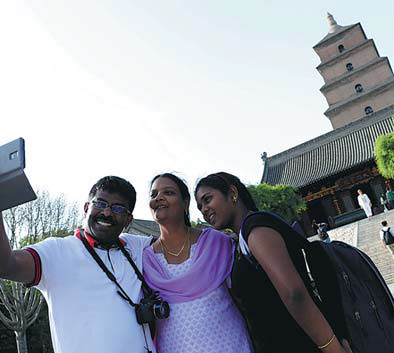
The city continues to preserve its traditional traffic system, which features a network of roads that stretch uniformly from south to north or from east to west, just like on a chessboard. It is a style that can also be seen in the road networks of other former dynastic Chinese capitals, including Beijing. The most famous ancient building in the city is the Dayan (Giant Wild Goose) Pagoda, dating back more than 1,300 years, when Buddhism was flourishing in China. The seven-story pagoda is 64.5 meters in height, and was built with rammed earth.
One of the pagoda's many functions was to store the sutras and figurines of the Buddha that were brought to China from India by the Buddhist translator and traveler Xuanzang (AD 602-664).

Surrounding the city center is a 14-kilometer long and 15-meter wide wall, built in the Ming Dynasty (1368-1644). It is the best preserved ancient city wall in China, and one of the largest ancient military defensive systems in the world.
Today the wall serves a far less martial purpose: It is a magnet for throngs of eager tourists, and in good weather, travelers can rent bicycles and ride along the wall that separates the city center from the outlying areas.
In addition to its myriad cultural attractions, the city also has numerous characteristic, delicious local snacks to tickle tourists' taste buds. Due to its position on the Silk Road, Xi'an's local foods have been influenced by travellers from far and wide. Being a growing base of wheat, Xi'an is home to many kinds of flour-made food, and even the humble noodle appears in different shapes, sizes and tastes.
One such noodle dish is biangbiang mian. It is famous not only for its distinctive taste, but also for its name, which cannot be typed out on a computer.
Another iconic local snack is roujiamo, which looks like a Chinese version of the hamburger. This simple and fast food is believed to date back some 2,400 years.
In an authentic roujiamo, the pork inside is stewed for hours in a soup containing more than 20 kinds of spices and seasonings. It is then minced into fine shreds and mixed with coriander and mild peppers.
The meat is then stuffed in a mo, a type of flatbread made of wheat flour, and baked in a clay or mud oven. Many time-honored roujiamo shops are hidden in the small streets in the city center, keeping as low profile as the city itself.
Several blocks away from the shops is a Muslim community called Beiyuanmen Street, also known as Fangshang by local residents. There tourists can taste another famous food, yangrou paomo (pita bread soaked in lamb soup). The region is also a sightseeing destination featuring many centuries-old mosques built in the traditional Chinese, not Middle-Eastern, style. Replicas of the Terracotta Warriors, paper-cutting handicrafts and painted clay sculptures are some of the most popular souvenirs for tourists.
Contact the writer at luhongyan@chinadaily.com.cn
|
Terracotta Warriors are known throughout the world and attract millions of visitors from both home and abroad. Zhao Hanrong / Xinhua |

|
A growing base for wheat, Xi'an is home to a variety of flour-made food. Li Mingfang / Xinhua |

|
Yangrou paomo is a part of the province's food culture that dates back to Song Dynasty (960-1279). Li Yibo / Xinhua |

|
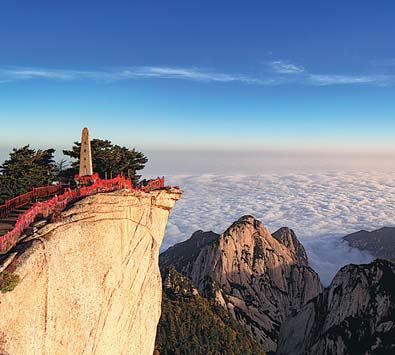
The North Peak is one of five peaks on Huashan Mountain in Xi'an. Hou Huaili / Xinhua |
|
Visitors enjoy a day at the Dayan (Giant Wild Goose) Pagoda, a landmark in Xi'an. Li Xiao / Xinhua |
(China Daily 06/28/2016 page24)