Qualcomm lends its weight to Chinese semiconductor firms
|
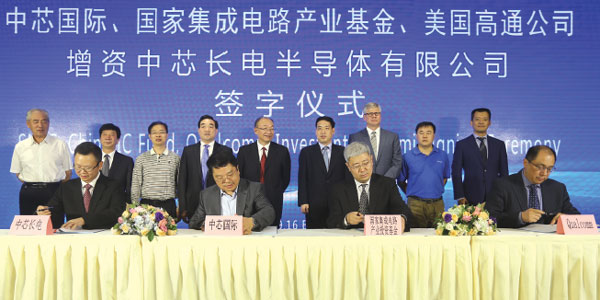
Representatives from SMIC, China IC Industry Investment Fund and Qualcomm at a signing ceremony for a contemplated investment into SJ Semiconductor Corp. Photos provided to China Daily |
Qualcomm Inc, the global chip giant, believes that strategic tie-ups with Chinese companies, especially in the wireless and semiconductor sectors, will play an integral role in the United States-based company's long-term growth plans.
"We consider China a key player in the global wireless and semiconductor industries. Though we entered the Chinese market two decades ago, we are happy to have played an important role in the industry's development in China, especially in terms of research and development, in licensing of advanced technologies and in providing the most advanced chipsets for Chinese companies," said Steve Mollenkopf, chief executive oficer of Qualcomm.
Mollenkopf, who was in Beijing recently for a signing ceremony of a contemplated investment, said that Qualcomm will continue to scale up its investments and involvement in China.
The new Made in China 2025 strategy unveiled by the Chinese government aims to restructure industries in a manner that they can adapt to the new normal of slower but higher-quality economic growth.
The key takeaway of the plan is the added focus on integration of manufacturing and new-generation information technology products. Such a strategy will result in new methods of production, industrial patterns, business models and economic growth engines.
Semiconductor technologies are expected to be the cornerstone of the new economic transformation and this is something that excites Qualcomm, said Mollenkopf.
"Our strategic collaboration with and the technical support to the Chinese wireless industry will help create a vibrant ecosystem centered on semiconductors and generate millions of direct and indirect jobs. In other words, what we are envisaging is sustained economic growth for the entire Chinese wireless industry."

Industry focus
Since 1994, Qualcomm has established several close partnerships with Chinese semiconductor companies.
Semiconductor Manufacturing International Corp, one of the largest and most advanced semiconductor foundries in China, for example, is one of its key partners. SJ Semiconductor, which was set up in 2014 as a joint venture between SMIC and Jiangsu Changjiang Electronics Technology Co Ltd, recently received contemplated investment of $280 million from a group of investors led by Qualcomm, SMIC and China Integrated Circuit Industry Investment Fund for China's first 12-inch wafer bumping production line.
Mollenkopf said that the investment marks Qualcomm's long-term strong support for the continued growth of China's prosperous semiconductor ecosystem. "This investment, if completed, is also expected to increase the production capability of the joint venture so it can meet the mass production needs of SMIC's 12-inch process technology," he said.
"Qualcomm is continuing its capital and technology investment around the SMICcentric ecosystem. We believe, Qualcomm will bring more world-leading experiences and technologies to China to support its industrial upgrade and Internet Plus strategy, now and in the future."
Last year, SMIC and Qualcomm Technologies, a wholly owned subsidiary of Qualcomm, teamed up to develop 28nm chip manufacturing technology and wafer manufacturing services for Qualcomm's Snapdragon 410 processor, aiming at mass market mobile devices.
That collaboration made SMIC the first company on the Chinese mainland to produce high-performance, low-power consumption processors using the most advanced process nodes, the company said.
SMIC's production of the chip was considered by many industry experts as a major breakthrough in the commercialization of 28nm chips and the start of a new era in China's advanced manufacturing. The new processor features integrated 4G LTE technology and comes with high-performance graphics and 1080-pixel highdefinition displays. It is 20 percent to 30 percent faster and consumes 30 percent to 50 percent less power than 40nm chips. Snapdragon 410 processor is now available in more than 550 mobile device designs and it has shipped more than 200 million units globally from more than 60 OEMs.
Deepening collaboration
Mollenkopf, however, said that enhancing research capabilities in China would be a key task for the chip industry. In June, SMIC, Qualcomm, Huawei and Belgium-based Interuniversity Microelectronics Center established a research company called SMIC Advanced Technology Research and Development Corp in Shanghai.
The said company will primarily work on innovation for the next-generation leading process node - 14nm. In addition, it will also focus on developing complementary metal oxide semiconductor logic technology to further enhance China's leading integrated circuit R&D platforms. It is already working on developing 14nm chip technology in China.
Derek Aberle, president of Qualcomm Inc, believes that the initiative will be an important milestone for IC industries both in China and around the world. "It reinforces our commitment for the sustained growth of China's booming semiconductor ecosystem."
Since SMIC is the largest shareholder in the company, it has rights to license the patents for technologies developed by the joint venture and apply them in current and future range of products.
According to the new company, the growth in China's IC technology prowess will facilitate the mass production of 14nm to 16nm chips in China by 2020, a goal set by the National IC Industry Development Promotion Outline issued by the State Council in 2014.
In July 2014, Qualcomm announced an investment commitment of up to $150 million to support Chinese startups in the Internet, e-commerce, semiconductor, education and health sectors. To date, four high-tech companies and a foundation have benefited from the commitment, receiving about $40 million investments. The foundation, China Walden Venture Investment, mainly focuses on investing in semiconductor and related companies with businesses in China.
The US company is also looking to partner with more local governments in the country. It has already teamed up with the Guizhou provincial government for a new company to develop and sell chipsets in China. The chipsets will be developed using Qualcomm's ARM-based server technology.
Chen Min'er, governor of Guizhou, announced full support to Qualcomm to jointly build a new generation of electronic information technology cluster in Guizhou, which was said to be in line with the guidance and requirement from President Xi Jinping regarding following the two bottom lines of development and ecological protection.
Aberle said Qualcomm will not only set up an ofice in the province but also recruit top talent from the province and across the country.
Looking to the future, Aberle said he expects huge opportunities in China, especially for data center equipment. The partnership with the Guizhou government will lay a solid foundation for high technology-led growth and innovation in not only Guizhou, but the whole of China, he said.
haonan@chinadaily.com.cn
(China Daily 09/17/2015 page15)