Japan's new state secrets law called threat to freedoms
The heavy-handed way Japan's ruling coalition forced the state secrets law through parliament has raised fears in the country of fledgling authoritarianism.
The opposition in the parliament and protests on the street have demanded that the ruling bloc - the Liberal Democratic Party and New Komeito - retract the bill.
The upper house approved the bill on Friday. The more-powerful lower house had passed it on Nov 26. The ruling coalition has a comfortable majority in both houses.
Japan's newspaper The Asahi Shimbun criticized the parliament, saying it had abandoned its duty as one of the three branches of government.
Prime Minister Shinzo Abe says the law is essential to its new US-style national security council and can relieve US concerns over the risks of sharing its sensitive information with Japan.
The law, proposed by the Abe administration, will significantly broaden the definition of what constitutes an official secret. It allows heads of ministries and agencies to classify 23 vaguely worded types of information related to defense, diplomacy, counterintelligence and counterterrorism.
Under the law, Japanese national public servants and prefectural police department employees who handle special secrets, as well as civilians contracted by ministries and agencies, will be subject to aptitude assessments every five years to ensure that they will not become whistle-blowers.
Critics are worried about the "forceful methods" of Abe's government. The bill was on the fast track for approval. Abe's Cabinet endorsed it in October.
Legal and media experts said the law is too broad and vague, making it impossible to say exactly what it covers. The lack of an independent review process leaves wide latitude for abuse, they added.
Jake Adelstein, a Tokyo-based reporter, calls it "an ominous new bill" that will "give the government expanded powers to classify nearly anything as a secret and intimidate the press into silence".
The law mandates prison terms of up to 10 years for government officials who leak secrets. Journalists who get information in an "inappropriate" or "wrong" way could be jailed for up to five years. It bans attempted leaks, inappropriate reporting, complicity and solicitation. Critics say the law will prevent journalists from investigating government mistakes.
Abe promised that the government will set up an oversight committee to monitor the classification process, an apparent effort to ease public concerns and opposition criticism.
Meanwhile, the Mainichi Shimbun newspaper questioned the credibility of the Abe administration on this issue, recalling that the Japanese prewar government made similar remarks during parliamentary debates on its secrets-protection legislation at the time.
The prewar military secrets-protection law was originally legislated in 1899 during the Meiji period. The law was eventually revised in 1937 on the grounds that intelligence activities by other countries were becoming active and astute amid growing tensions between Japan and China. The revised law vaguely categorized secrets and newly introduced bans on access to military-related areas and punishments on the formation of "spy groups". The law, whose maximum sentence was the death penalty, was abolished after World War II.
A Japanese movie-industry group who opposes the law said the Abe administration is returning Japan to its dangerous World War II days.
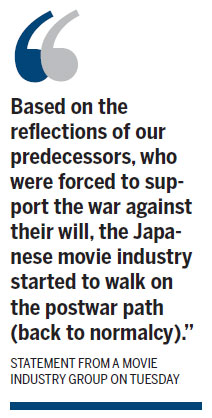
"Based on the reflections of our predecessors, who were forced to support the war against their will, the Japanese movie industry started to walk on the postwar path (back to normalcy)," the group said in a statement on Tuesday.
Such noted film directors as Isao Takahata, Yasuo Furuhata and Yoji Yamada joined the opposition group, saying the law could deprive Japanese people of the right to know and endanger freedom of expression.
caihong@chinadaily.com.cn
(China Daily 12/09/2013 page10)