On the road to a driverless future
|
Software by Mobileye detects information while on the road, such as the location of other vehicles and signs. An Audi drives with some human input. Photographs by Mobileye |
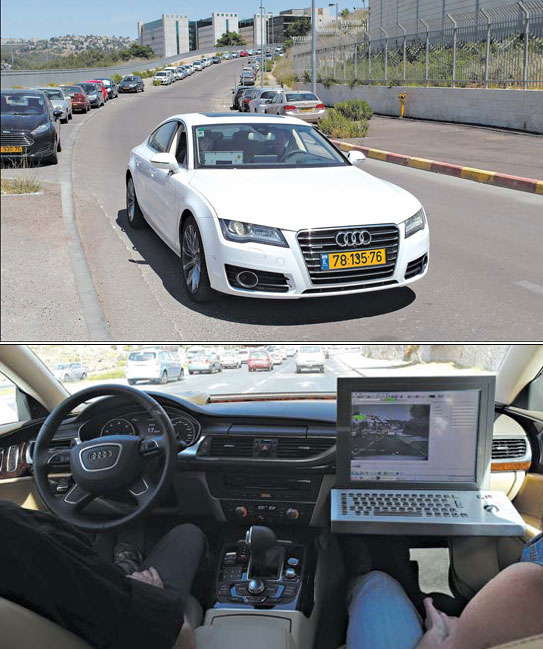
JERUSALEM - On a freeway from Jerusalem to the Dead Sea, I sat in the driver's seat of an Audi A7 in April while software connected to a video camera on the windshield drove the car at speeds up to 100 kilometers per hour: making a singular statement about the rapid progress in the development of self-driving cars.
While the widely publicized Google car is festooned with cameras, radar and the laser range finders called lidars, this one is distinctive because of the simplicity and the relatively low cost of its system - just a few hundred dollars' worth of materials. "The idea is to get the best out of camera-only autonomous driving," said Gaby Hayon of Mobileye Vision Technologies, the Israeli company that created the system in the Audi.
The Mobileye car does not offer the autonomy achieved by Google's engineers. The Google car will merge onto freeways, drive safely through intersections, make left and right turns, and pass slower vehicles.
By contrast, the Mobileye vehicle is capable only of driving in a single lane at freeway speeds, as well as identifying traffic lights and automatically slowing, stopping and then returning to highway speeds.
But by blending advanced computer vision techniques with low-cost video cameras, the company is demonstrating how quickly autonomous driving can be commercialized. "You cannot have a car with $70,000 of equipment," said Amnon Shashua, a founder of Mobileye, referring to Google's lidar system, "and imagine that it will go into mass production."
Mobileye has recently begun offering the third generation of its technology, which companies like Volvo have promoted for its ability to detect pedestrians and cyclists. Nissan also recently gave a hint of things to come with a demonstration of a car that could automatically swerve to avoid a pedestrian. The system was based on Mobileye technology.
As soon as this summer, the first limited systems offering a feature known as "traffic jam assist" will begin arriving from more than five major automobile makers. Those cars will drive safely in stop-and-go traffic, but will require drivers to keep their hands on the steering wheel.
But more advanced systems will be introduced as early as 2016, according to Mobileye, and it was that advanced capability I experienced.
In California in 2010, I was the first reporter to drive in the Google car, a Toyota Prius fitted with sensors that created a remarkably detailed map of the world around the car.
It was a tour de force. The car was taken out of automatic pilot just twice - while passing a cyclist and then again to back into a parking space.
In the Google car, I had felt detached from the machine intelligence that guided it. As the car piloted itself through its first curve, there had been an eerie more-human-than-human sense.
But in the Mobileye car I was acutely aware of the autopilot's limitations. The car had a tendency to weave a bit when it started to pull away from an intersection - behavior that did not inspire confidence. Once, while passing a parked car, the Audi pulled in the direction of the other vehicle. Not wanting to learn the car's intentions, I nudged it back to the center of the lane.
The Mobileye engineers said the single camera would be supplemented with an array of five more: a wide-range camera and additional side-mounted and rear-facing cameras. The goal, they said, was to build a system with the same capability as the Google car's.
After 20 minutes of freeway driving, I put the Audi back on autopilot and headed toward Jerusalem. The demonstration was not as dramatic as my Google ride, but it gave me a clearer understanding of what the automobile industry has in its sights.
The New York Times