Oil spill response base network set to open
'Inefficient' system to be improved as offshore exploration expands
BEIJING - Twelve national-level bases for offshore oil spill response equipment are poised to open by year-end as an ever-rising number of oil tankers sail China's shores and offshore oil exploration facilities multiply.
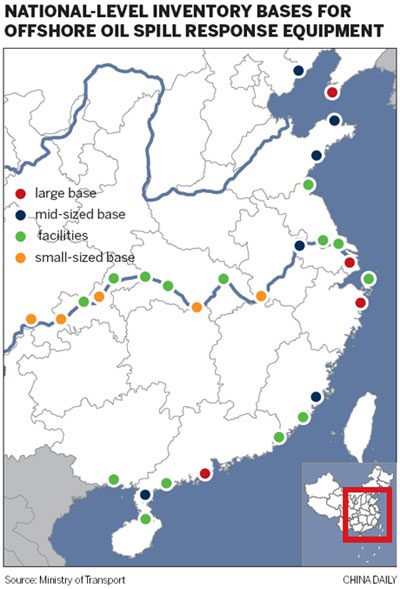
There will eventually be 29 bases near major coastal cities and along the Yangtze and Yellow rivers, a Ministry of Transport (MOT) official said on condition of anonymity.
The MOT, established in 2008 to oversee the regulation and development of road, water and air transport, is directing the base construction program. These facilities will cover all major oil spills within 20 nautical miles of the coast.
There will be four large bases in Dalian of Liaoning province, eastern coastal Shanghai, Ningbo of Zhejiang province and the Hong Kong special administrative region. The facilities will be able to clean up about 1,000 tons of spilled oil. Another six mid-sized bases will be able to deal with spills of up to 500 tons.
The source didn't specify the locations of the 12 bases that are about to open or provide a timeline for the completion of all 29 bases.
China started considering the bases in 2003, but little happened until a massive oil spill last July after a pipeline explosion in Dalian's Xingang port.
The spill, which polluted more than 183 square kilometers (sq km) of the sea, resulted in a disciplinary warning in November by the State Council for Jiang Jiemin, chairman of PetroChina Co Ltd.
Energy companies have experienced several leaks at sea this year, prompting safety concerns.
In September, the government ordered the country's biggest offshore oilfield - Penglai 19-3, in which China National Offshore Oil Corp (CNOOC) Ltd owns a 51 percent stake - to shut down after about 700 barrels of crude oil were discharged off the northern Bohai Bay in two incidents in June.
These incidents drew public criticism, as well as questions from industry experts about the oversight of maritime oil and gas exploration and environmental protection.
A report from the State Oceanic Administration said that China's coastal waters had been further damaged by pollution in the past five years. About 48,000 sq km of coastal waters failed to meet even the country's fourth (and lowest) level for seawater quality.
"China's growing oil demand has led to a rapid increase in crude oil transportation by sea and domestic offshore oil exploration, which has exposed our oceans to a larger oil spill threat," said Ma Jun, director of the Institute of Public and Environmental Affairs, an independent environment non-governmental organization.
Oil demand will rise about 20 percent from 2010 to reach 535 million tons by 2015, accompanied by higher imports, said Dai Jiaquan, deputy head of a research division of China National Petroleum Corp, the parent of PetroChina.
More than half of China's crude oil was imported last year and analysts expect even higher import dependency in the future.
Tankers are a major means of transporting crude oil and fuel oil imports, meaning higher spill risks as the import volume grows, according to a researcher from CNOOC who declined to be identified.
Recent oil leaks proved that China's spill response system is very inefficient, Ma said. "It's urgent to develop the response system to reduce the harm resulting from oil spills."
There are no official figures on the number of established offshore oil spill equipment bases in the country. Several small bases reportedly exist in Qinhuangdao city of Hebei province, Yantai of Shandong province and the southern coastal city of Shenzhen.
That compares with some of the world's biggest energy consumers, including the United States and Japan, which have more than 10 such bases.
Oil spills at sea since last year have exposed problems in the oil-spill risk management system among Chinese energy companies and inadequate government supervision, said Wang Yamin, an associate professor at Shandong University's marine college.
The chain of spill equipment bases is a good move, Wang said, but it's more important to take adequate precautions against further spills.
China Daily
(China Daily 12/21/2011 page13)