The enterprises that reduced a government headache
|
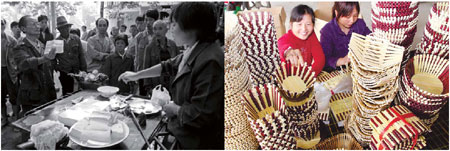
Left: A tax official from the Qingshan district Taxation Bureau in Wuhan, Hubei province, tells a street vendor that she needs to pay her outstanding tax on Sept 15, 1998. Right: Farmers in Dexing city, Jiangxi province, produce bamboo baskets that were exported to Africa in April. Left: Xu Lin / for China Daily; Right: Zhuo Zhongwei / for China Daily |

In 1983, Cao Dewang decided to lease the Gaoshan Glass Factory from his village in Fuqing, Fujian province. His aim was simple: feed his family and the families of fellow village workers, and provide them with education.
With the country just recovering from the "cultural revolution" (1966-1976) and starting to allow the private economy to develop, Cao could not imagine he would one day own the factory, now called the Fuyao Group, which supplies windows to luxury car brands such as Bentley and Audi, and employs more than 15,000 people.
Over the past three decades, entrepreneurs such as Cao, together with foreign investors, have become the main source for jobs as urbanization advanced quickly.
"The private economy creates jobs as well as empowers workers to become rich. If China wants to become an affluent society and make its people rich, the private economy is a crucial force," says Huang Mengfu, chairman of the All-China Federation of Industry and Commerce, which represents more than 2 million private enterprises and owners.
In 1979, there were just 107,800 private enterprises, employing 1.84 million people. About 22.58 million people were self-employed.
In 2010, the number of private enterprises rose to 8.4 million, about three quarters of all enterprises in China, while the number of self-employed businesses increased to 34 million.
In total, more than 180 million people were employed by the private economy last year, growing by 55 percent in five years.
Liang Hongfei, an associate professor at the School of Governance with Peking University, says more than half of those under the age of 30 in cities work in private companies.
"From the perspectives of history and the reality in China, the development of the private economy has provided a key to the Chinese government to solve one of its main headaches - employment," he says.
When Cao started making automobile glass in 1985, many people thought he was crazy. There was almost no private car ownership and even governments and State-owned companies had very few.
However, Cao says what worried him most then was failure, which would cost workers their jobs.
"Private enterprise was the last choice for a university graduate and it demanded enormous courage for a worker chose to work with us, so I had to be responsible to them," Cao says.
After struggling for a few years, Fuyao got its biggest opportunity; the global automobile industry began to look at China after it joined the World Trade Organization in 2001 and the Chinese became more and more affluent.
In 2010, Fuyao's revenue reached 8.51 billion yuan ($1.31 billion), 55 times its 2000 figure. The number of employees grew from 1,673 in 2000 to 15,601 last year.
In 2005, Cao, who was born in 1946, began to reduce his involvement at Fuyao. Four years later, the pious Buddhist started a charity foundation and turned most of his attention to charity and the overseas strategy of the company.
For the older generation of entrepreneurs such as Cao, who started their businesses in the early 1980s when the country was still in poverty, feeding their employees may have been the most basic goal of their entrepreneurship.
However, younger entrepreneurs, who were "free from want", had closer contacts with world's trends and were more confident. Their aims were to enrich and empower people with modern technologies and global vision, in addition to getting rich.
Jack Ma, chairman of the Chinese business-to-business e-commerce company Alibaba Group, started the company with 17 colleagues in 1999 in his apartment in Hangzhou, Zhejiang province.
Initially, the former English teacher at a college of electronics wanted to start an online yellow pages.
However, in a province known for a developed private and export-oriented economy, Ma believed Alibaba could do more and build an online trading platform between Chinese suppliers and worldwide buyers.
"In the 1980s, people became rich because they were bold; in the 1990s, they became rich because they had relations; now, in the 21st century, we can say we become rich because we have knowledge," Ma says.
The company, which now employs about 14,000 people, became the largest Chinese e-commerce company after it took over Yahoo!'s business in China.
Taobao.com, which Ma and his partners founded in 2003, has become the most popular shopping website in China as well as a favorite platform to start businesses for many people.
A report on online business and business people compiled by Alibaba in 2010 shows that more than 12 million businesses and 65 million business people are selling their products and services regularly online.
Wang Jianhua, Party chief of Shaoxing University in East China's Zhejiang province, says the Internet has provided many opportunities and many of his students are active traders on Taobao.com.
"E-commerce websites such as Taobao have provided many low-cost ways for young entrepreneurs to start their businesses," he says.
In spite of the progress, private enterprises still face challenges including regulatory hurdles, pressure from the much bigger and richer State-owned companies and rising costs of labor and raw materials.
"Private enterprises, especially small and medium-sized ones, face bigger challenges now than in the financial crisis," Wang says.
Huang, from the All-China Federation of Industry and Commerce, says the government should provide a favorable growth environment for small and medium-sized enterprises.
"Only when that improves, the 60 percent of workers employed by such businesses can see their incomes raised. Then China's goal to enrich its people can be realized."
Chen Limin and Chen Jia contributed to this story.
(China Daily 06/01/2011 page6)