Chinese divers splash out on courses
|
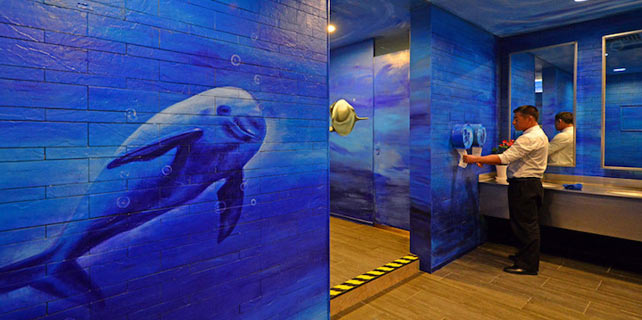
'Did you enjoy a deep dive last night?' has become a popular greeting among young white collar workers in the office this summer. Diving has become one of the fastest growing sporting hobbies in China. Zhou Qianxian / For China Daily |

Nation becomes the world's fastest growing market for learning to dive
BEIJING - When 25-year-old He Fan watched Disney's Finding Nemo she was captivated by the wondrous sights beneath the waves.
The English language teacher from Urumqi, the capital of Xinjiang Uygur autonomous region - the world's most landlocked city - had only ever experienced 30 minutes of snorkeling before, albeit off the tropical paradise Indonesian island of Bali.
However, fuelled by those two experiences and a curiosity about marine life that she has nurtured since childhood, He splashed out on professional diving instruction and gained a globally recognized certificate of competence, despite knowing she was entering deep financial waters.
"Different oceans in different seasons offer completely different 'wow' experiences," she said. "I have tried more than 20 diving destinations worldwide in the past five years. Diving at this level is really costly. I spent about 45,000 yuan on equipment. The total cost of one-hour scuba diving is about $200 on average.
"The Little Mermaid is not only a charming film, it also charms our purses.".
According to Henrik Nimb, a senior official with the Professional Association of Diving Instructors (PADI), the world's largest diving training organization, about 5,000 Chinese people attained PADI certification between 2001 and 2008.
There are about 30 diving centers and resorts across China certified by PADI, two of which are in Beijing: Extreme Experience Diving Club and Beijing Dragon Diving. Shanghai has five centers while tropical Hainan has 10 high-end PADI centers and resorts.
Nimb said that China has become the fastest-growing market for PADI in the world and he believes that it will become the world's largest diving market within 10 years.
Professional divers

Manoel Wang, a manager at Masey International Exhibition Co Ltd, said: "Currently, only 0.1 percent of tourists from the mainland are experienced divers and they always travel to their diving destinations on their own accord and not through travel agencies.
"Professional diving is a money-burning activity: The full set of equipment would cost you 30,000 yuan at least. If you rent at the diving resort, the price ranges from $100 to $150 per session on average."
The cylinder containing enough air for 45-minutes costs $100 and the instructor tends to charge $100 for a two-hour service, Wang added.
It's not only the inexperienced who need an instructor, Wang said. Experienced people diving in an unfamiliar place should also be accompanied. The rule is all divers should at least be accompanied by a "buddy" - someone to help them out if a situation gets tricky.
"Diving in the Chinese mainland is still in its infancy because it has not been part of the culture and the market still needs to be explored," said Wang.
Because of their geography, people in Taiwan, from where Wang comes, and Hong Kong learn about the ocean at a very early age and they regard them like a gym, treating sea-related sports as daily exercise as well as a part of their social lives, the businessman said.
However, he said that in coastal cities on the Chinese mainland, there has been an increase in the number of people taking up the sport.
Some industry experts say the expense has deterred many who might be interested.
Lu Bing, a scuba diving trainer in Dalian, Liaoning province, said that a PADI course would cost more than 3,500 yuan on the mainland but was about $50 to $100 in other countries.
Wang said: "You can learn and take the test abroad if you are confident speaking a foreign language."
PADI had awarded about 18.5 million certificates worldwide by 2009. A total of 87,401 took the test in 2009. About 67 percent of certifications are awarded to male divers. The average age of PADI-certified divers is 29.
"But in China, most of my tourists are in their 30s. Many are wealthy," Wang said. "Chinese young people tend to regard diving as nothing more than watching fish. They prefer to try something more exciting."
The post-80s generation has become a major force driving consumption in China's urban areas, according to a survey by market consulting firm CTR. Women and more wealthy people, who usually have higher education backgrounds, job status and income, are the other two highest spenders, it said. These are the groups Chinese diving centers want to attract.
Industry experts say that Chinese diving organizers and diving center operators need to further improve the quality of their services with better equipment for rent, as well as introduce exciting programs to lure youngsters.
Diving for fun
Terry Bai, a Shanghai-based freelance photographer, has expanded his career into the oceans. From Hainan to Saipan, he has dived in the oceans off more than 10 countries.
"Digital cameras enable us to take underwater photos more easily, thanks to their relatively small body and high light sensitivity," said Bai, who is organizing an ocean-themed personal exhibition in Shanghai. "The plastic waterproof shell designed for diving photographers is my must-have equipment.
"Of course, shooting underwater requires higher diving skills and you have to better control your breathing when you come across a picturesque scene. Also, carefully watching the flow of the water is crucial for a good result.
"You can obtain a very bizarre hallucinatory effect through the magic pen of the light underwater which is quite different from the light on the land."
Bai said that underwater photography is not only a kind of artistic creation but also a tough physical test. He said it was an attractive activity and that people who didn't try it would never understand.
Wang of Masey International said that tourists without certification who want to experience life under the ocean's waves could always go snorkeling. Shallow water behind coral reefs can hold abundant marine life forms including exotic Picasso trigger fish and baby moray eels.
"Most of the trip packages to coastal countries and islands provided by travel agencies in China include diving as an activity and they don't charge the tourists a lot but, of course, they only mean snorkeling," said Wang.
"You only need a mask and an air pipe which cost about 200 to 300 yuan," Wang said. "The rent price is around 70 to 80 yuan at the resort."
At Taobao.com, China's largest e-commerce site, there are about 70,000 diving-related items available.
Zhang Jingfang, a diving product vendor at Taobao, said: "The business is good. I usually earn thousands of yuan a month.
"Such low priced products have a market because the large numbers of divers at the entry level buy these simple bits of equipment before traveling to somewhere where snorkeling is productive. The chances are it is not a regular trip so they might only use them once."
Dive the world
The gold standard Asian diving destinations include Sipadan in Malaysia, Bali in Indonesia and Thailand's Lembeh Straits and Koh Similian.
Ma Nan, marketing manager of Beijing UTS International Travel Service Co Ltd, said his company didn't organize any inbound trips with diving activities because tourists prefer to dive off other countries.
The Annual Report of China Outbound Tourism Development 2009-2010, released by the China Tourism Academy (CTA), estimated that 54 million tourists would go abroad this year, up from 47 million in 2009.
"Most of our tourists are young people and also some parents would like to try the activity with their kids," Ma said. "Diving tourism is still new in the Chinese market but we expect a boom in the near future."
Wang of Masey International said: "Hainan and the Maldives rank at the top of the Chinese divers' destination list."
The quality of services at Chinese diving resorts is comparatively lower than at their overseas counterparts: The sea water is not that clear and the equipment is a bit outdated and past its best, Wang said.
"It depends on what kind of scenery you are expecting to see," he said. "There is also a diving service at Qiandaohu Lake in Zhejiang province."
Ding Ding, the public relations manager at Hua Yuan International Travels Company Ltd, named Phuket, Bali and Maldives as among Chinese divers' favorite destinations.
"The average cost of diving in Australia is about AU$150 per person per session but the scene here is definitely competitive," Ding said.
Wang said: "There are some slight differences in price from place to place, but not that much. The Great Barrier Reef is the most expensive option and Southern Asia is cheap."
As to the soaring number of diving centers and indoor diving resorts across China, diving organizers and travel agencies expressed indifference.
Wang didn't think such diving centers would have much of a market since their major function was training.
"However, good divers only can be trained in the oceans," he said. "When more Chinese people accept and gradually fall in love with the activity, they will know that the core philosophy of diving is appreciating the fabulous marine life and its habitats and making friends with Mother Nature."
China Daily
(China Daily 07/26/2010 page13)