Obama's new doctrine: Easier said than done
Americans elected Barack Obama their president on his promise to "change" things both at home and abroad. Obama inherited a trashy legacy from George W. Bush: wars in Afghanistan and Iraq, the global financial crisis, a lackluster image of the US and a number of rising powers in the world. And one year on, he seems to be more successful in his diplomacy than in changing things at home.
Obama faces two pressing tasks on the diplomatic front: fortifying America's position and repairing the country's image, and seizing the initiative to transform the international order in order to maintain Washington's hegemony in the long run.
| ||||


Obama's diplomatic and political thrust has been on four fronts. First, he has tried to improve America's image by steering away from unilateralism and militarism of the Bush administration. Among his moves are the decisions to close down the Guantanamo Bay prison, set a timetable for US forces' withdrawal from Iraq, return to climate change talks, implement a "reach-out-hand" diplomacy with countries such as Iran, the Democratic People's Republic of Korea (DPRK), Cuba, Venezuela and Myanmar, and efforts to improve relations with the Islamic world.
America's image has improved to a certain extent in the first year of his rule. A Pew Center poll conducted in 25 countries shows the percentage of people friendly toward the US increased in 24 countries; the only exception was Israel.
Second, Obama has changed America's counter-terrorist strategy dramatically by abandoning Bush's hypothesis. He regards terrorism as one of the many problems the world faces today and has shifted America's frontline against terrorism from Iraq to Afghanistan and Pakistan. Plus, he attaches great importance to all-around cooperation with other major powers in the fields of economics, politics and military relations.
Third, the Obama administration has been making great efforts to maintain its core relationships with global and local powers. It has tried to take Bush's proactive China policy forward by forging a relationship of comprehensive cooperation, establishing the Strategic and Economic Dialogue, and cooperating at G20 summits and climate change talks.
On other fronts, US Secretary of State Hilary Clinton and Russian Foreign Minister Sergei Lavrov are trying to reshape US-Russian relations. The first move to improve bilateral ties, however, came from Obama when he declared that the US would not deploy anti-missile systems in Poland and the Czech Republic. And the way things are going, the US and Russia could sign the Strategic Arms Reduction Treaty.
America's ties with the European Union (EU) got a boost when Vice-President Joe Biden told the Munich Peace Conference that the US respects its EU allies. In return, other NATO members have agreed to provide more help to the US in its war against the Taliban in Afghanistan. Obama, too, has helped US-EU ties by coordinating with European leaders on climate change issues.
Fourth, the US administration has been trying to take the lead in meeting global challenges, though its ability to set international agenda is being tested extensively in the process. The US has played a vital role to help reform the world financial and economic order. But despite some developing countries getting a greater say in structural reform of the IMF and other international agencies, the US still dominates them.
In the field of disarmament, Obama delivered a utopian "nuclear-free world" speech in Prague in April, urging all countries to abandon Cold War mentality and reduce nuclear weapons. The US pushed the UN Security Council to organize a nuclear disarmament and nuclear non-proliferation summit, too, which certainly is a meaningful endeavor. Likewise, the US has assumed a responsible role in shaping a new global climate political mechanism.
In other words, the abyss US diplomacy had fallen into during the Bush administration is evident to everyone. But despite being more successful in dealing with world affairs, compared to solving problems at home, Obama still faces a series of knotty questions.
His effort to clear the mess America has created in the Middle East in the name of counter-terrorism by waging a war against the Taliban has worsened the situation in Afghanistan. Obama announced his "new Afghanistan strategy" on Dec 3, ordering an increase of 30,000 US troops over 18 months. But it is open to debate whether his new strategy for Afghanistan will work. In fact, a new wave of terrorist attacks this year has already forced his administration to consider opening a new counter-terrorist front in Yemen.
Though the US has extended its hand to Iran and the DPRK with the hope of the resolving intractable nuclear issues, mutual doubts still remain. That the two countries have not yet responded positively to America's overtures shows they still pose a potential threat to US interests.
Relations among major global powers are yet to take the direction in America's favor, as Obama expected them to, and US-Russian ties have improved only to a limited degree. Moreover, the time-honored ties between the US and Japan are also facing difficulties.
In Sino-US relations, the Taiwan issue and human rights have always been sticking points. But now, trade disputes could complicate matters further.
It is doubtful, too, whether Obama's efforts to mitigate climate change will get the US Senate's approval.
The transformation of the international order reflects the decline of America's comparative advantage and ebbing of its international influence. Though Obama has shown an unswerving resolve to adapt to changing reality, his serious-minded philosophy lacks enough steam to lift the US to its position in the 1990s.
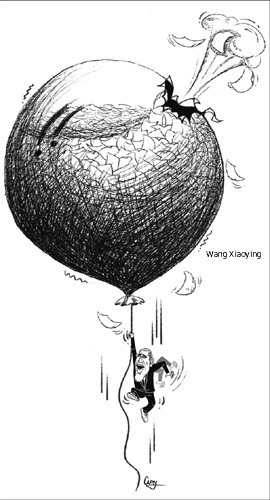
The nagging problems at home are acting as brakes for Obama's aggressive diplomatic ambitions, making America's pursuit of the strategic targets of hegemony a turbulent affair. In this sense, Obama's new political and diplomatic doctrine appears more like strategic adjustment than a prescription to arrest the decline of America hegemony.
The author is director of the Institute of America Studies, Chinese Institute of Contemporary International Relations.
(China Daily 01/20/2010 page9)