Is Obama's 'New Deal' really new?

The international community has started evaluating the achievements and flaws of US President Barack Obama's diplomatic "New Deal" now that he has been in office for almost one year.
Obama has noticeably distanced himself from his predecessor George W. Bush's foreign policy not only in terms of ideas, but also policies and strategies.
At the beginning of his presidency, Obama conceded that major international issues could not be resolved today by the US alone, instead international cooperation was needed to deal with them. The US should not only rely on traditional allies, he said, but also seek new partners such as China, India, Brazil and South Africa.


He said G20, not G7 or G8, was the right platform to tackle the global financial crisis, and developing countries
?should be allowed to join dialogues and coordinate strategies with the industrialized powers to tackle crises.
He criticized the Iraq War and shifted the focus of America's war on terrorism to Afghanistan. He even set a very ambitious goal: a nuclear-free world.
In a famous speech at Cairo University in Egypt, he declared: "America is not, and never will be, at war with Islam", and the US "does not accept the legitimacy of continued Israeli settlements" on Palestinian territory.
During his visit to Europe, he said the US was not going to dictate but listen. On his Asian tour, he dubbed himself the first "Pacific president" of the US, promised that the US had no intention of containing China and described Sino-US relations as the "most important bilateral relation" in the world.
Obama has not been short on amiable rhetoric. He wants the US to "reset" and improve its relations with Russia. He has said the US will change the attitude of the West, which has "often approached Africa as a patron or a source of resources rather than a partner". He seeks a new beginning in relations with Latin American countries. He has been modest, polite and punctilious, shaking hands with old US foes such as Venezuelan President Hugo Chavez, and bowing to the king of Saudi Arabia and the emperor of Japan. His words and actions have exhibited his charisma, won hearts, ameliorated the international image of the US and strengthened cooperation in international relations.
But if we analyze his "New Deal", we will see a "specter" hovering above it, the specter of "Pax Americana" that the US has always sought to establish. All US leaders, from the president and the secretary of the state to other higher officials have reiterated that America has not and will not give up its role as world leader.
In almost every speech on foreign policy, Obama has repeatedly defined his strategic goal as reshaping America's image as world leader, but not giving up that role. Here, his foreign policy is no different from that of other US presidents.
In Europe, he did say that the US would listen. But he stressed that the US would lead, too. In Japan, he said the US would maintain and strengthen its dominance over the region, which is of extreme significance in the 21st century.
In a long speech soon after assuming office, he mentioned American "leadership in the world" more than 10 times. The US foreign policy's emphasis that Washington should lead the world is too strong for Obama to get rid of.
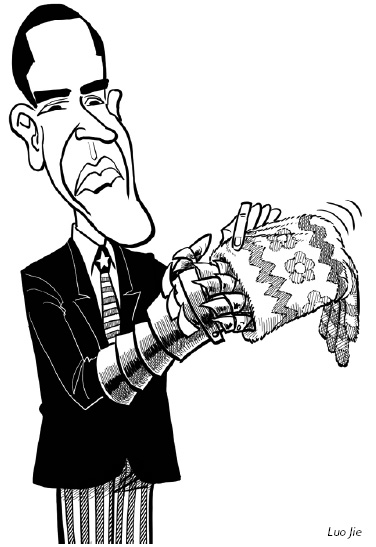
Under the shadow of the "Pax American" specter, Obama's "New Deal" is more like an iron hand in a velvet glove. At times he hides his real aims, and at others he talks one way and acts in another.
Though his "New Deal" seeks international cooperation, it does not advocate real multilateralism. US officials have made it clear that their country is seeking multilateralism under the dominance of America and though they are seeking other powers' help, the US is still in charge of resolving crucial international issues.
Obama has never said the UN or other international organizations should play the central role in resolving international issues. So his "New Deal" is at best aimed at forming an "orchestra conducted by the US".
Obama has moved the focus of America's war on terrorism to Afghanistan and is considering opening a new front in Yemen. Though he does intend to fight terrorism, he seems to have a subtle motive, too, to control the lifeline in Eurasia from the Middle East and South Asia to Central Asia, Mongolia and the Korean Peninsula.
Once the US gets control of this lifeline, it can dominate most of the oil and gas reserves of the world, and deter Russia and China politically and militarily.
Obama has treated China with carrots and sticks. During the initial days of his presidency, Sino-US relations transited smoothly from the Bush era. On his China tour, Beijing and Washington reached consensus in some areas, which definitely was a positive sign. His "New Deal" says China and the US are in the same boat and Sino-US relations are the most important in the world. He has even said that China and US will shape the 21st century jointly, and Beijing could share the leadership with Washington in many international affairs.
But if he is sincere about honoring his words, why does he still stick to the Taiwan Relations Act and sell arms to Taiwan? Why did he appoint a so-called "Special Coordinator for Tibetan Issues"? Why does he resort to protectionism against Chinese products? The US has not changed. It is still arrogant and continues to use a two-pronged strategy against China.
If the US does not stop hurting China's core national interests, how can Beijing and Washington stay in the same boat? Cooperation must be based on equality, reciprocity and mutual respect for each other's core interests. It is not difficult to draw a conclusion from all this about how different or valuable Obama's "New Deal" is.
The author is a Beijing-based researcher on international studies and former Chinese diplomat.
(China Daily 01/15/2010 page9)