Let us graduate from sprint to marathon
Views in the West about China have undergone many changes over the past two decades, from the "China collapse theory" to the "China threat theory" and then from the "China opportunity theory" to the "China savior of the world theory". But none of them reveals the true picture that is China, so speculation over the nature of the country continues.
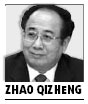
The reasons behind the misconceptions are manifold, Zhao Qizheng, Chairman of the Foreign Affairs Commission of the National Committee of the Chinese People's Political Consultative Conference, says in an interview with China Daily. China has gone from the periphery of the international community to the center of the world stage in a short period. So it's natural for other key players to view it with curiosity, misunderstanding and even suspicion, just like people do when a new neighbor moves into a community.
The Cold War mentality and the Western media's China-bashing strategy for commercial reasons play an important part in creating these misconceptions, says Zhao, who is also former minister of the State Information Office.
But he concedes that China has to present itself in a better way so that the international community understands what the reality is. Since it doesn't tell a good story, it almost always finds itself in an awkward position after the West presents another distorted version of the reality that is China.
That's why public diplomacy has become so important. The government, academic institutions, NGOs, the media and others who communicate with the people abroad can contribute to the country's image building. They should explain to foreigners China's policies and real situation, and answer all their questions. Chinese officials who refuse to meet journalists or attend public functions abroad are not serving the country well.
China's story has to be told from a global perspective, Zhao says. For example, the Butterfly Lovers is the original creation of Yueju Opera, which uses South Chinese dialect, something that even people in the North cannot grasp fully. But after the tragic love story was made into a violin concerto even foreigners have appreciated it.
People-to-people communication across countries can build bridges and foster better understanding. That's why Zhao held several rounds of talks with American futurist and writer John Naisbitt and his wife Doris. "China model" was the subject of their discussion, which will soon be published as a book, Dialogue: China Model (New World Press).
In 2005, Zhao co-authored Riverside Talks: A Friendly Dialogue between an Atheist and a Christian, which was based on his dialogue with religious scholar Luis Palau. These, he says, are attempts to clear any misgivings that the West has about China.
John Naisbitt first visited China in 1967. In recent years, he and his wife have been dividing their time between their home in Austria and Tianjin. After reading the couple's new book, China's Megatrends, Zhao found they have in-depth knowledge of China and present an objective account.
But China is too big to be summarized in a book, so Zhao felt the need to talk with them on wider issues concerning the "China model". His talks with the Naisbitts were very meaningful and covered a wide range of subjects. It's an interesting coincidence, he says, that he and Doris Naisbitt read the same article in Stern, a German magazine. Both agree that although the Dalai Lama leads an undemocratic religious regime, he has a good public relations strategy because he presents a smiling and amiable face.
Talking about the "China model", Zhao says the term is part of foreign lexicon, just like "Beijing Consensus". Unlike Washington Consensus, which is a US-led plan for developing small, developing countries, the "Beijing Consensus" is a mere academic term, which does not enjoy China's consent. In other words, China has no plans to make other countries follow its development pattern. A country should adopt or follow a development model that suits it best.
What the West sees as the "China model" is the combination of the concepts, policies, and the successful implementation of those policies during the past three decades. But it's more like a case study than a model, Zhao says.
The other big misunderstanding some countries have is about China international relations. All the talk about a "G2" - group of China and the US - is baseless, Zhao says. China supports multi-polarization; it doesn't seek to govern the world jointly. It doesn't pose a threat to other countries, either. One should not read its competitive edge in the economy or its necessary defense spending as a threat.
Facts and figures support what Zhao says. Although China has been doing relatively well in these times of global economic downturn, its GDP is just over 6 percent of the world's total, while the US' is nearly 21 percent. So when the international community looks at China to save it from the economic recession, it should realize that its consumption is just about the equivalent of France.
Zhao told the Naisbitts that it was understandable that Westerners find it difficult to read the true picture of China because the country is developing very fast. China is like a speeding train, he says. And in order to see it clearly, one has to run at its speed.
But in response to Doris Naisbitt's question on whether China should continue running so fast, he says it is high time the country decided the speed it should travel at.
He also compares China to a sprinter, running the 100 meters for the past 30 years, who in his eagerness to win every race, forgot to wear his T-shirt. He has had no time to think about how to run, either. But that T-shirt is the cultural, environmental and social development, which China has to put on before the sprints finish.
China should now think about what will be the right speed for its development, Zhao says. It should adopt a different strategy that targets a more sustainable and all-around development. It's akin to running a marathon, in which endurance is supreme.

(China Daily 09/08/2009 page9)